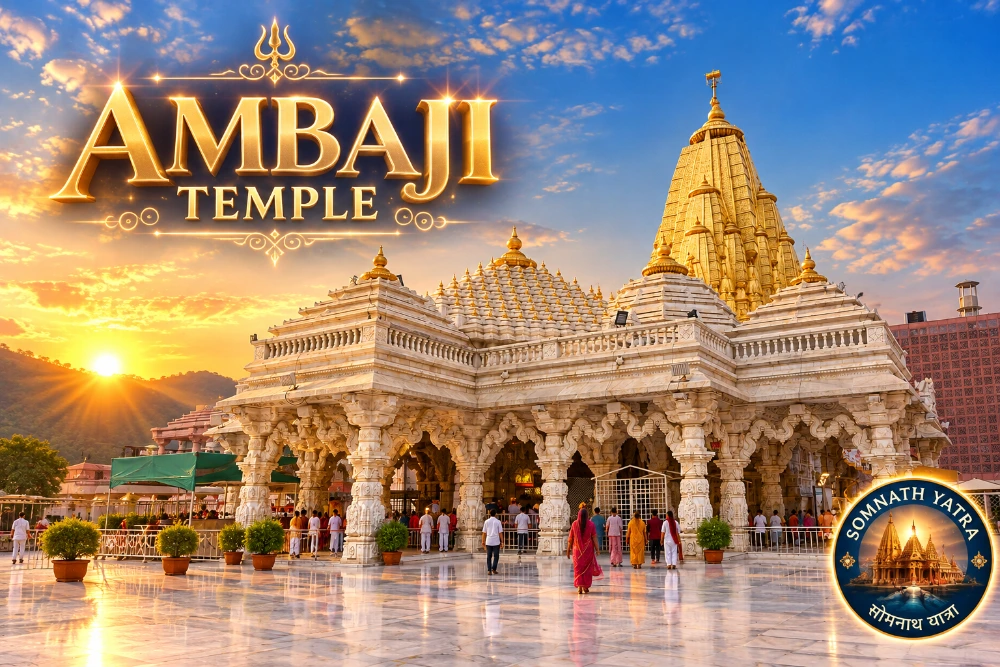
Ambaji Temple Pilgrimage Guide: Darshan Timings, Gabbar Hill, & Travel Logistics
At the foot of the Aravalli hills in Danta taluka, Banaskantha district, Gujarat, stands the Ambaji Temple—one of the most revered Shakti Peethas in India. The temple enshrines the Viso Yantra, a sacred geometric diagram of the Mother Goddess, venerated without an open-view idol. Lakhs of pilgrims arrive during Navratri and Bhadarvi Poonam, making Ambaji one of Gujarat’s most visited religious sites. This guide covers darshan timings, the Gabbar Hill ropeway experience, trust accommodation, Mohanthal prasad, how to reach from Ahmedabad and Abu Road, and everything else you need to plan a complete Ambaji pilgrimage.
Temple Significance: The Heart of Shakti Peetha & The Viso Yantra
Ambaji is one of the 51 Shakti Peethas—sacred sites scattered across the Indian subcontinent where parts of Goddess Sati’s body fell as Lord Shiva carried her charred remains in a cosmic dance of grief and rage. According to classical Shakta traditions and the temple’s own history, Sati’s heart (Hridaya) fell on the Arasur hill, sanctifying the ground where the Ambaji Temple now stands. The temple is also known as Arasuri Ambaji because of its location in the Arasur hill range of the Aravallis.
The ancient text Tantrachudamani identifies Ambaji as a place of supreme spiritual power. The Skanda Purana and Padma Purana also reference the site’s sanctity. The temple’s own scripture, Ambaji Mahatmya, describes the sacred geography of the region in detail.
The Sacred Viso Yantra (Why There Is No Idol)
Unlike most Hindu temples where a physical idol is enshrined, Ambaji’s sanctum sanctorum houses the Viso Yantra (Shree Visa Yantra)—a geometric Shakta diagram drawn according to precise Vedic mathematical principles. The yantra contains configurations and sacred numbers associated with the Mother Goddess, and it is venerated in its concealed form. Devotees offer flowers, sindoor, and prayers directly to the yantra. The temple trust does not permit open viewing of the yantra by the general public—this is a deliberate act of reverence, not secrecy.
The yantra is a silver-plated copper plate. The number 51 is inscribed on it, representing the 51 Shakti Peethas. The entire geometric structure is a map of cosmic energy—triangles, lotus petals, and bindu points arranged in a precise configuration. Pilgrims who understand the yantra’s significance describe the darshan as deeply moving, even without seeing the yantra directly.
Darshan Timings, Aarti Schedule, & Entry Guidelines
Daily Aarti & Temple Closing Hours
| Session | Summer | Winter | Details |
|---|---|---|---|
| Morning Aarti | 6:00 AM | 6:30 AM | First aarti of the day |
| Morning Darshan | 6:00 AM – 12:00 PM | 6:30 AM – 12:00 PM | Regular darshan, free entry |
| Rajbhog Closure | 12:00 PM – 4:00 PM | 12:00 PM – 4:00 PM | Temple closed for midday rest |
| Evening Darshan | 4:00 PM – 8:30 PM | 4:00 PM – 8:00 PM | Regular darshan, free entry |
| Rajbhog Aarti | 12:00 PM | 12:00 PM | Midday offering |
| Evening Aarti | 7:00 PM | 6:30 PM | Most spectacular aarti—arrive 30 minutes early |
Dress Code, Electronic Lockers, & Entry Rules
Dress code: Both men and women must wear conservative clothing covering shoulders and knees. No shorts, sleeveless tops, or revealing attire. The temple trust provides free dhoti and saree covers at the entrance if needed. Dress code enforcement is strict during festivals—do not risk being turned away after a long journey.
Electronic devices: Mobile phones, cameras, smartwatches, and all electronic items must be deposited at the free locker counters near the Chachar Chowk gate before entering the sanctum. The counters are managed by the temple administration and do not charge a fee. Carry only your wallet, keys, and any prasad offerings into the sanctum.
Footwear: Free shoe stands are available at the entrance gates, managed by the temple administration. Remove footwear before entering the temple complex. Wear comfortable slip-on shoes for easy removal. The temple floor can be hot during summer—carry socks if visiting in peak season.
Parking: Designated parking areas operate for cars, buses, and two-wheelers. Parking charges are ₹20–₹50 depending on vehicle type. During Navratri and Bhadarvi Poonam, parking fills up by early morning.
Special darshan: Fast-track passes are available at the temple counter near the main entrance. Prices fluctuate based on season and trust resolutions—check the official ambajitemple.in website or inquire at the counter before your visit. The fast-track pass is especially useful during festivals when regular darshan queues stretch 2–3 hours.
Gabbar Hill: Cable Car, Akhand Jyot, & 51 Shaktipeeth Parikrama
Gabbar Parvat, located approximately 4.5 km from the main Ambaji Temple, is the original seat of the goddess and an indispensable half of the Ambaji pilgrimage. While the town temple enshrines the yantra, Gabbar Hill holds the Akhand Jyot (eternal flame) that has burned continuously since ancient times, the sacred footsteps (Paduka) of the goddess, and a full parikrama path featuring replicas of all 51 Shakti Peethas. Skipping Gabbar is considered an incomplete Ambaji darshan.
Steps vs. Udan Khatola (Ropeway) Timings & Fares
| Mode | Details |
|---|---|
| 999 Stone Steps | Free access. Takes 45–60 minutes depending on fitness. Start early morning to avoid midday heat. Carry water. |
| Udan Khatola (Ropeway) | Cable car ride to the summit. Typical timings: 7:00 AM to 7:00 PM. Ticket prices fluctuate—check at the counter or ambajitemple.in. Faster and easier for elderly pilgrims and families with children. |
At the summit, you will find the cave shrine housing the Akhand Jyot. The eternal flame is visible through a small opening—devotees offer prayers and witness the unbroken fire that has burned for centuries. The Paduka (sacred footsteps) of the goddess are also enshrined here. The 51 Shaktipeeth Parikrama path winds around the base of Gabbar Hill, with exact replicas of each of the 51 Shakti Peeth temples. Some parikrama sections feature light-and-sound shows describing the significance of each peetha.
Sunset at Gabbar: The hill offers stunning views of the Aravalli landscape at sunset. If your schedule allows, time your ropeway ride for late afternoon—the golden light over the desert hills is worth the trip alone.
Evening light show: A 3D projection mapping and light-and-sound show typically operates on Gabbar Hill in the evenings after sunset (usually around 7:00 PM–8:00 PM). The show narrates the mythology of the Shakti Peethas and the history of Ambaji. Check with the temple administration for current show timings, as they vary seasonally.
Temple Architecture
The Ambaji Temple is built in the Nagara style of architecture, common in western India. The current grand marble complex is largely the result of extensive reconstructions initiated by local rulers of Danta State and modernised by the Shree Arasuri Ambaji Mata Devasthan Trust over the past century. The sanctum sanctorum houses the Viso Yantra on a silver-plated copper plate. The temple’s golden dome (kalash) is visible from a distance. The Sabha Mandap (assembly hall) features carved pillars and accommodates several hundred devotees. The fortified wall surrounding the temple complex has multiple gates, with the Kamboja Gate serving as the main entrance adorned with intricate carvings.
Festivals & Best Time to Visit
Navratri (September–October)
Navratri is the grandest festival at Ambaji. The temple remains open throughout the night during all nine days, and lakhs of devotees visit for evening aarti and garba. The entire town of Abu Road comes alive with cultural performances, food stalls, and devotional music. Shared jeeps and GSRTC run additional bus services during the festival period. See the Travel Tips section below for accommodation planning advice.
Bhadarvi Poonam (Full Moon in Bhadarva Month)
Bhadarvi Poonam (usually falling in August–September) is the second-biggest pilgrimage day at Ambaji. A massive fair is organised at the temple, and special bus services run from Ahmedabad, Rajkot, and other cities. The full moon night aarti is particularly spectacular. The temple trust arranges additional security and crowd management for this event.
Best Time to Visit
The best time to visit Ambaji is during the cooler months (October–March). The weather is pleasant, and the temple surroundings are lush green after the monsoon. Avoid visiting during peak summer (April–June) when temperatures in Banaskantha can cross 44°C. The monsoon season (July–September) brings heavy rainfall to the Aravalli region—the temple is accessible, but road conditions may be patchy, especially the hill road to Gabbar.
How to Reach Ambaji
By Train (Abu Road Junction Logistics)
Abu Road Railway Station (ABR) is the nearest major station, located 17 km from Ambaji. It sits on the Ahmedabad–Delhi main line, with several daily trains including the Ashram Express, Gujarat Mail, and Ranakpur Express. From Abu Road station, shared jeeps and trax vehicles run round the clock to Ambaji bus stand for ₹50–₹70 per person. Private autos cost ₹300–₹400. GSRTC also runs frequent bus services on this route.
By Road (Bus & Driving Routes)
| From | Distance | Travel Time | Route |
|---|---|---|---|
| Ahmedabad | 180 km | 3.5–4 hours | Ahmedabad → Palanpur → Abu Road → Ambaji |
| Palanpur | 65 km | 1.5 hours | Palanpur → Danta → Ambaji |
| Abu Road | 17 km | 30 minutes | Direct road to temple |
| Mount Abu | ~50 km | 1.5 hours | Mount Abu → Abu Road → Ambaji (hill drive) |
| Rajkot | 260 km | 5–5.5 hours | Rajkot → Surendranagar → Palanpur → Ambaji |
| Udaipur | 165 km | 3.5–4 hours | Udaipur → Sadri → Abu Road → Ambaji |
GSRTC operates direct buses from Ahmedabad, Rajkot, and Abu Road to Ambaji. The Ahmedabad–Ambaji bus takes approximately 4.5–5 hours. Private bus operators also run services on this route. If driving, the roads are well-maintained national and state highways for most of the stretch. During monsoon, exercise caution on the hilly sections near Danta.
Palanpur transit hub: Palanpur (65 km from Ambaji) is a major junction with train stops and bus depots connecting to Western Gujarat. Pilgrims coming from Rajkot, Jamnagar, or Bhavnagar often change buses at Palanpur. GSRTC runs frequent Palanpur–Ambaji services (approximately 1.5 hours).
Nearest Airports
Maharana Pratap Airport in Udaipur (UDR) is the nearest airport, approximately 165 km from Ambaji. Ahmedabad Airport (AMD) is 180 km away. From either airport, book a taxi to Ambaji—fares range from ₹3,500–₹5,000 depending on the vehicle. There is no direct air connectivity to Ambaji; road transport from the nearest airports is the only option.
Where to Stay: Trust Dharamshalas vs. Private Hotels
The temple trust operates official guesthouses that are cleaner, cheaper, and safer than third-party budget lodges:
Official Trust Accommodations
- Ambika Vishram Gruh: Trust-run accommodation near the temple. Clean rooms, basic amenities, subsidised rates. Book through the trust office or ambajitemple.in.
- Holiday Homes: Slightly more modern trust property. Suitable for families. Reasonable rates.
- Yatrik Bhavan: Budget-friendly option for solo pilgrims and couples. Dormitory and private room options available.
Private Hotels
- Ambaji town: Budget hotels and private dharamshalas near the temple. Rates: ₹500–₹2,000 per night. Limited options—book during festivals in advance.
- Abu Road (17 km): Mid-range hotels and guesthouses. Rates: ₹1,500–₹4,000 per night. Better amenities than Ambaji town.
- Mount Abu (~50 km): Full range from budget to luxury resorts. Rates: ₹2,000–₹10,000+ per night. Best for pilgrims who also want hill station sightseeing, but the 1.5-hour drive means you will not be walking to the temple from here.
Temple Prasad & Annakshetra Dining
Ambaji is famous for its traditional Mohanthal—a dense, golden sweet made from besan (gram flour) and pure ghee, sold at official trust-managed prasad counters near the temple. The Shree Arasuri Ambaji Mata Devasthan Trust oversees the preparation and sale of Mohanthal and Mawa Peda, ensuring consistent quality and purity. Purchasing from trust counters supports the temple’s charitable activities. Select shops in Ambaji town also sell Mohanthal, but the trust counters remain the most reliable source.
The temple trust also runs subsidised bhojanalayas (Annakshetra) serving clean, simple vegetarian meals to pilgrims at nominal fees. These dining halls are especially useful during festivals when private restaurants are overcrowded and overpriced. Check with the trust office for current meal timings and rates.
Essential Nearby Excursions
Kumbhariya Jain Temples (2.5 km)
Just 2.5 km from Ambaji, the Kumbhariya Jain Temples are a cluster of white marble temples built during the Chaulukya (Solanki) era in the 11th–13th centuries. The intricate marble carvings rival the Dilwara Temples at Mount Abu but without the crowds. A short detour worth making if you appreciate medieval Indian temple architecture.
Koteshwar Mahadev (8 km)
Koteshwar Mahadev temple, approximately 8 km from Ambaji, is believed to be the origin point of the Vedic Saraswati river. The temple is dedicated to Lord Shiva and features a Gaumukh (cow-mouth spout) from which the Saraswati stream trickles—a sacred sight for devotees. The temple sits in a peaceful setting away from the main pilgrimage crowds. A worthwhile half-day excursion for those with extra time.
Mount Abu (~50 km)
Mount Abu, located in Sirohi district, Rajasthan (not Gujarat), is the only hill station in Rajasthan. The drive from Ambaji takes approximately 1.5 hours via Abu Road. Key attractions include the Dilwara Temples (five exquisite Jain temples from the 11th–13th centuries, located near Nakki Lake on Mount Abu, approximately 52 km from Ambaji), Nakki Lake (a scenic artificial lake popular for boating), and Guru Shikhar (the highest peak of the Aravallis at 1,722 metres). Mount Abu makes a comfortable 1–2 day add-on to the Ambaji pilgrimage.
Travel Tips & Practical Advice
- Carry cash: ATMs are available in Abu Road and Mount Abu but limited in Ambaji town. The temple area has digital payment options, but smaller shops, auto-rickshaws, and shared jeeps prefer cash.
- Water and snacks: Carry water bottles—the temple area can get crowded and hydration stalls may have long queues. Pack light snacks if visiting during festival season.
- Festival accommodation: During Navratri and Bhadarvi Poonam, hotels in Abu Road and Mount Abu fill up 2–3 months in advance. Trust accommodations (Ambika Vishram Gruh, Holiday Homes, Yatrik Bhavan) are also reserved early—apply through ambajitemple.in well ahead of your trip.
- Photography: Photography is not allowed inside the sanctum sanctorum or Gabbar Hill cave shrine. Exterior shots of the temple are permitted.
- Shared transport: Shared jeeps and trax vehicles run round the clock from Abu Road station to Ambaji bus stand for ₹50–₹70 per person. Private autos cost ₹300–₹400. This is the cheapest and most convenient way to reach the temple from the railway station.
Frequently Asked Questions
Why is Ambaji considered a Shakti Peetha?
Ambaji is one of 51 Shakti Peethas—sacred sites where parts of Goddess Sati’s body fell during Lord Shiva’s tandav. At Ambaji, Sati’s heart (Hridaya) fell on the Arasur hill, sanctifying the ground where the temple stands. Ancient texts like the Tantrachudamani, Skanda Purana, and Padma Purana all reference this site’s power.
What is the Viso Yantra and why is there no idol?
The sanctum houses the Viso Yantra (Shree Visa Yantra)—a geometric Shakta diagram drawn according to Vedic mathematical principles. It contains configurations and sacred numbers associated with the Mother Goddess. Unlike most temples, the yantra is venerated in its concealed form; only priests have direct viewing access. Devotees offer flowers, sindoor, and prayers to the yantra as they would to an idol.
Can we take mobile phones inside Ambaji Temple?
No. All electronic items—mobile phones, cameras, smartwatches, earphones—must be deposited at the free locker counters near the Chachar Chowk gate before entering the sanctum. No charges apply. Carry only your wallet, keys, and prasad offerings inside.
How far is Gabbar Hill from Ambaji Temple?
Gabbar Parvat sits about 4.5 km from the main temple. You can climb 999 stone steps (free, takes 45–60 minutes) or take the Udan Khatola ropeway (typically 7:00 AM to 7:00 PM; current fares available at ambajitemple.in). Gabbar holds the Akhand Jyot (eternal flame), the Paduka (sacred footsteps), and the 51 Shaktipeeth Parikrama path. Most pilgrims consider Gabbar an essential part of the Ambaji darshan.
What is the distance from Ahmedabad to Ambaji?
Ambaji is about 180 km from Ahmedabad—3.5–4 hours by car via Palanpur and Abu Road. The roads are mostly national highway and well-maintained. GSRTC runs direct buses too (around 4.5–5 hours). Palanpur, 65 km before Ambaji, is a useful transit point if you are coming from Rajkot or Jamnagar.
Can I visit Mount Abu and Ambaji on the same trip?
Yes, but the distance is greater than many assume. Mount Abu is in Rajasthan, roughly 50 km from Ambaji (1.5 hours by car via Abu Road). A 2–3 day itinerary works well: Day 1 for Ambaji darshan and Gabbar Hill, Day 2 for Mount Abu sightseeing (Dilwara Temples, Nakki Lake, Guru Shikhar), Day 3 for the return journey.
When is the best time to visit Ambaji?
October through March is ideal—pleasant weather, green hills after the monsoon. April to June brings extreme heat (crossing 44°C), and the July–September monsoon can make the Gabbar hill road patchy. Morning aarti timings also shift by about 30 minutes in winter, so check locally if you are visiting in the cooler months.
Where to get Mohanthal prasad in Ambaji?
The Shree Arasuri Ambaji Mata Devasthan Trust runs prasad counters near the temple selling traditional pure-ghee Mohanthal and Mawa Peda. Buying from the trust counters guarantees authenticity and supports the temple’s charitable work. Some shops in Ambaji town also sell it, but the trust counters are the most dependable source.
What is the ropeway ticket price for Gabbar Hill?
Fares change depending on the season and trust decisions. Check current prices at the Udan Khatola counter or on ambajitemple.in before your visit. The ropeway usually runs from 7:00 AM to 7:00 PM. If you are travelling with elderly family members or young children, the ropeway saves considerable effort compared to the 999 stone steps.


