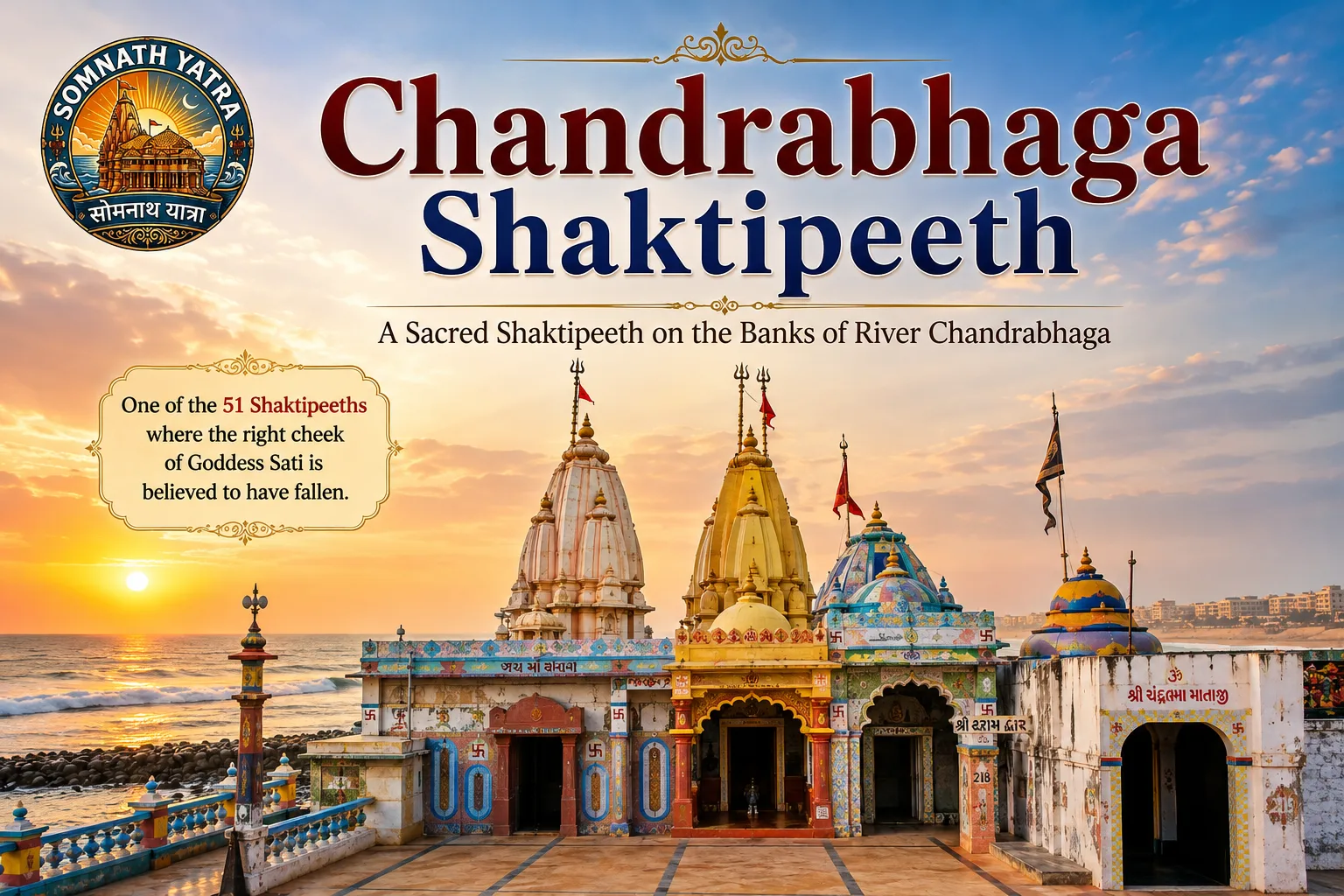
Chandrabhaga Shaktipeeth — History, Timings & Visitor Guide
One of 51 Shaktipeeths. Right next to Somnath. And most pilgrims walk straight past it. Chandrabhaga Shaktipeeth—also called Prabhas Shaktipeeth—sits in the shadow of one of India’s most famous Jyotirlingas. Yet it barely gets a mention in most Gujarat travel guides. No grand entrance gate. No towering shikhara. No queue of devotees stretching down the street. What you get instead? A stone platform. A river confluence. And the kind of silence that makes you stop. This isn’t a temple you visit for the architecture. You visit because the ground is sacred. The story behind it? Older than most religions.
What Is Chandrabhaga Shaktipeeth
Quick primer. Shaktipeeths are sacred sites where parts of Goddess Sati’s body fell after Lord Vishnu’s Sudarshan Chakra cut her corpse into 51 pieces. Lord Shiva was grieving—cosmically, destructively, in a way that threatened to unravel creation itself. Vishnu intervened. The body scattered across the Indian subcontinent. Each landing spot became a temple. Each temple honors a different body part. Chandrabhaga marks where Sati’s stomach—her udara—fell. The Goddess here is worshipped as Chandrabhaga. Literally means “a part of the moon.” Lord Shiva, protector of this site, is called Vakratunda. One with a curved body.
Which Body Part Fell Here
The stomach. Udara in Sanskrit. Puranic accounts place it at the confluence of three rivers—Hiran, Kapila, and Saraswati. The Triveni Sangam. Same river system that makes Prabhas Patan spiritually significant for dozens of other reasons. And the body part matters. Different Shaktipeeths carry different energy based on what fell there. Stomach worship connects to nourishment. Sustenance. The life-sustaining force of the Divine Mother. This one? Nourishment. Protection. The energy that keeps things alive. Not abstract. Not metaphorical. Actual, felt energy. Or so the devotees say.
The Name “Chandrabhaga”
Two stories overlap here. Both matter. First: Chandrabhaga translates to “a portion of the moon.” Second, the local legend runs deeper. Chandra Dev, the Moon God, married all 27 daughters of King Daksha Prajapati. But he loved only Rohini. Neglected the other 26. Completely. Daksha, furious, cursed Chandra to fade from existence. Lose all his light. Desperate, Chandra came to Prabhas and prayed to Lord Shiva. For years. Shiva, moved by his devotion, blessed Chandra. Restored his light—but in cycles. Full moon. Waning. New moon. Waning crescent. Full again. The rhythm we still see tonight.
In gratitude, Chandra built the first Jyotirlinga at this spot. The original Somnath Temple. “Som” means moon. “Nath” means lord. Somnath: the Moon’s Lord. And the Goddess who helped Chandra in his hour of need? She became known as Chandrabhaga. The moon’s savior. The moon’s portion. Take your pick. Both work. Both are true. And both connect Chandrabhaga Shaktipeeth to Somnath in ways most guides completely miss.
Chandrabhaga Shaktipeeth History
The Story of Sati’s Sacrifice
Daksha Prajapati—son of Lord Brahma, father of Sati—hated Lord Shiva. Why? Misunderstanding. Mostly. Shiva lived in cremation grounds. Wore garlands of skulls. Kept company with ghosts. Daksha thought he was unworthy of his daughter. Sati married Shiva anyway. Bold move. Then Daksha organized a massive yagya—a fire ritual—and invited everyone. Everyone. Except his own daughter and son-in-law.
Sati went anyway. When she arrived, Daksha ignored her. Insulted Shiva. Publicly. Deliberately. With the kind of contempt that leaves no room for misinterpretation. Sati couldn’t bear it. She jumped into the yagya fire. And died.
Shiva—enraged and devastated, those two emotions existing simultaneously, which is possible when you’re a god—created Virabhadra from his own fury. Virabhadra beheaded Daksha. But later, Shiva forgave him. Restored Daksha with a goat’s head. Strange choice. But mythology doesn’t always make sense. None of this solved the bigger problem: Shiva wandered the universe carrying Sati’s body. The world tilted on its axis. Creation started to unravel. To restore balance, Lord Vishnu used his Sudarshan Chakra. Sliced Sati’s corpse into 51 pieces. Wherever a piece fell, a Shaktipeeth was born. Each guarded by a Bhairava—a fierce form of Shiva. At Chandrabhaga, the stomach fell. The Bhairava is Vakratunda. And the rivers—Hiran, Kapila, Saraswati—became the sacred ground.
Chandra Dev’s Curse & Redemption
This story connects Chandrabhaga to Somnath in a way most guides miss. Chandra Dev—married to Daksha’s 27 daughters—favored only Rohini. The other 26 complained. Daksha cursed Chandra to lose all his light. Fade to nothing. Chandra, terrified, came to Prabhas Kshetra. Began praying to Lord Shiva. Years of penance. Shiva eventually relented. Blessed Chandra. Restored his light—but in phases. The cycle we still observe tonight. Every 29.5 days. Full to full.
And here’s the part that matters: Chandra built the first Somnath Jyotirlinga. In gratitude. For being saved. The moon god created one of the 12 Jyotirlingas. And Chandrabhaga—the Goddess who embodied the moon’s nurturing energy—received her own sacred spot at the river confluence. The name stuck. The worship continued. And when Sati’s stomach fell at the same location? The site gained double significance. Shaktipeeth plus the place where Chandra was redeemed. Two myths. One ground. The kind of layered sacredness that makes Prabhas Patan unlike anywhere else in Gujarat. Or maybe anywhere else in India.
Chandrabhaga Shaktipeeth — What You’ll Actually See
Manage your expectations. That’s the most useful thing I can tell you. This isn’t Somnath. There’s no massive complex. No crowds. No security checkpoints. What you’ll find is a stone platform at the edge of the Triveni Sangam—the confluence of Hiran, Kapila, and Saraswati rivers. The ancient temple that once stood here? Gone. Destroyed. During the reconstruction of Somnath Temple, the trustees apparently didn’t rebuild the Devi shrine. Left it as is. Whether they forgot or didn’t prioritize it—nobody’s entirely sure. The result is the same.
What remains is the base of an old structure. Some stone carvings on surrounding walls. And the sacred rivers themselves. The spot is identified by the river confluence more than by any building. Devotees consider the water itself as the Goddess’s manifestation. No idol. No garbhagriha in the traditional sense. Just the ground. The water. And the belief that this is where Sati’s stomach fell.
Simple. Almost stark. If you’re expecting ornate carvings and gold-plated sanctums, you’ll be disappointed. But if you understand that some sacred places don’t need buildings to hold their power—you’ll get it immediately. The space feels intimate. Personal. Almost private. Like you’ve stumbled onto something most tourists never find. Because they don’t know it exists. Or they walk right past it on the way to Somnath.
The area sits behind the Shri Ram Temple of the Somnath Trust. Near Harihar Forest. Stone walls with ancient carvings line parts of the perimeter. You’ll see images of various deities etched into the rock—some well-preserved, some worn smooth by centuries of weather. The whole place feels older than the structures around it. Because it is. By centuries. Maybe millennia.
Temple Timings & Entry
| Detail | Information |
|---|---|
| Opening Time | 6:00 AM |
| Closing Time | 8:00 PM |
| Entry Fee | Free |
| Photography | Allowed |
| Best Time of Day | Early morning (6:00-8:00 AM) or evening (5:00-7:00 PM) |
No tickets. No queue. No timed darshan slots. Walk in. Offer your prayers. Walk out. The simplicity is part of the appeal—and, honestly, part of what makes it feel more authentic than some of the bigger, more commercialized temples nearby. Early morning is best. Fewer people. The river confluence catches the morning light. Cooler temperatures help too. And the walk from Somnath in the early morning? Quiet. Meditative. The kind of walk that prepares you for what you’re about to experience.
Evening aarti is worth catching if you’re already in Somnath for the night temple visit. Combine both. Walk from Somnath Temple. It’s 2 km. Takes 25 minutes on foot. Or take an auto for ₹30-50. My suggestion? Walk there in the morning. Auto back. You’ll pass through the same spiritual corridor the ancient pilgrims used. And the walk itself becomes part of the experience. Not separate from it. Connected.
How to Reach Chandrabhaga Shaktipeeth
By Road
Chandrabhaga sits in Prabhas Patan. Same area as Somnath Temple. If you’re already at Somnath, it’s a 2 km walk or a 5-minute auto ride. Dead simple. From Veraval, about 7 km. From Junagadh, roughly 60 km. The roads are well-maintained—NH 51 connects most major towns in Saurashtra to Somnath. Driving yourself? Parking is limited near the temple. Park at Somnath and walk. Easier. Less stressful. And the walk gives you time to mentally prepare. Or not prepare. Just walk. Let the distance do its work.
By Train
Veraval Junction (VRL) is the nearest major railway station. 7 km away. Trains from Ahmedabad, Rajkot, and other Gujarat cities stop here. Somnath Railway Station (SOM) is closer—2 km—but has limited service. From either station, take an auto or taxi. The Veraval-Somnath auto route runs frequently. ₹50-80. And the drivers know the Shaktipeeth. Just say “Chandrabhaga” or “Prabhas Shaktipeeth.” They’ll know. They always know.
By Air
Keshod Airport (IXU) is the nearest. 64 km away. Domestic flights from Mumbai and a few other cities. Diu Airport (DIU) is about 100 km. From either airport, book a cab. Somnath Yatra taxi packages cover airport transfers to Somnath. Most visitors fly into Keshod and take a taxi. 1-1.5 hours. ₹3,500-5,500 depending on vehicle. The drive is flat, straight, and boring. Which is exactly what you want when you’re trying to catch a flight.
Nearby Places to Visit
Chandrabhaga doesn’t need a full day. Two hours. Maximum. But the area around it? Packed. Here’s what’s within walking or short driving distance.
- Somnath Temple (2 km): The main event. One of 12 Jyotirlingas. Evening aarti is spectacular—crowds of thousands, bells ringing, the sea breeze carrying the sound of mantras. Walk from Chandrabhaga. Same spiritual corridor. Same ground. Different energy.
- Triveni Sangam (adjacent): The confluence of Hiran, Kapila, and Saraswati rivers. Sacred in its own right—even without the Shaktipeeth. Stand at the water’s edge. Three rivers merging. It’s the reason this entire area is holy. Not a metaphor. A fact.
- Bhalka Tirth (3 km): Where Lord Krishna was struck by a hunter’s arrow. Small temple. Quick visit. Five minutes. But the story carries weight—Krishna’s departure from earth happened right here. In Prabhas Kshetra. Not somewhere else. Here.
- Veraval Port (7 km): Fishing harbor. Busy, noisy, real. Not a tourist attraction—it’s a working port. But the energy is different from temple-town quiet. The fishermen here have been coming to these waters for generations. Centuries. Maybe longer.
- Gir National Park (45 km): Asiatic lions. If you’re combining a pilgrimage with wildlife, Gir is the obvious add-on. Morning safari. One day. Book a cab from Somnath. Somnath to Sasan Gir taxi runs ₹2,000-7,000 depending on vehicle.
- Diu (83 km): Beach town. Fort. Portuguese architecture. Different vibe entirely. If you need a day away from temples, Diu is the escape. Somnath to Diu car rental starts at ₹3,000.
Best Time to Visit
October to March. That’s the window. Temperatures between 20-30°C. Dry roads. Comfortable walking. The Shaktipeeth is outdoors—no air conditioning, no covered walkways for most of it. Summer (March-June) hits 35-40°C. Walking on stone in that heat? Not pleasant. Monsoon (July-September) brings rain—roads near the river confluence can get muddy. If you’re flexible, aim for November or February. Cool mornings. Warm afternoons. The kind of weather that makes you want to linger. Not rush. Just be there.
Time of day matters too. Early morning (6:00-8:00 AM) is best. Fewer people. The river confluence catches the morning light in a way that photographs beautifully—though you didn’t come here for photos, did you? Evening (5:00-7:00 PM) works if you’re combining it with Somnath’s evening aarti. Midday? Skip it. The stone platform gets hot. No shade worth mentioning. Common sense stuff.
Festivals at Chandrabhaga Shaktipeeth
The Shaktipeeth comes alive during festivals. Regular days are quiet. Almost too quiet for some visitors. But during the major celebrations? The energy shifts completely. Worth timing your visit to catch at least one.
- Navratri (Ashwin & Chaitra Maas): Nine nights of Goddess worship. September-October and March-April. The Shaktipeeth sees its highest footfall during these periods. Garba and Dandiya performances. Special pujas. The entire Prabhas area decorates. If you’re visiting during Navratri, combine Chandrabhaga with Somnath—both temples host extended celebrations. The energy is different from the rest of the year. Denser. More alive. More everything.
- Shivaratri: Lord Shiva’s night. Massive at Somnath. Respectable at Chandrabhaga. Devotees fast, pray through the night. Special abhishek rituals. If you’re already in Somnath for Shivaratri, the walk to Chandrabhaga takes 25 minutes. Do both. The contrast between the massive Somnath celebration and the intimate Chandrabhaga observance? Worth experiencing. Definitely worth it.
- Kartik Purnima (November): Full moon in the month of Kartik. A fair is held at Somnath. Devotees bathe in the Triveni Sangam. The confluence at Chandrabhaga sees heavy crowds. Sacred dip. Ritual offerings. The rivers carry special significance during the full moon—Chandra Dev’s restored light shining down on the place where he was redeemed. Poetic. Almost too perfect. But that’s mythology for you.
- Nag Panchami (Shravan Maas): Snake worship. July-August. Smaller celebration at Chandrabhaga compared to Navratri. But devotees who follow the Shravan calendar consider it important. Special prayers to Nag Devta. The stone carvings around the Shaktipeeth include serpent imagery—ancient, worn, but visible if you look closely. If you know where to look.
Chandrabhaga Shaktipeeth vs Other Shaktipeeths
India has 51 Shaktipeeths. Each one marks where a body part of Sati fell. Each one carries its own significance. Here’s how Chandrabhaga compares to the most visited ones.
| Shaktipeeth | Location | Body Part | Goddess | Bhairava | Entry |
|---|---|---|---|---|---|
| Chandrabhaga (Prabhas) | Gujarat | Stomach | Chandrabhaga | Vakratunda | Free |
| Kamakhya | Assam | Womb | Kamakhya | Umananda | Free |
| Kalighat | Kolkata | Toes | Kali | Nakuleshwar | Free |
| Vimala | Odisha | Feet | Vimala | Varahi | Free |
| Mahalakshmi | Maharashtra | Eyes | Mahalakshmi | Chakrapani | Free |
| Manipur | Manipur | Wrist | Trishna | Sirivanjam | Free |
What makes Chandrabhaga different? Three things. First, there’s no proper temple structure. It’s formless worship at a river confluence. Most Shaktipeeths have grand temples. This one doesn’t. That’s not a criticism. It’s a fact. Second, it sits next to Somnath, one of the 12 Jyotirlingas. You get a Jyotirlinga plus a Shaktipeeth in the same trip. That combination is rare. Very rare. Third, the connection to Chandra Dev’s redemption story adds a layer most Shaktipeeths don’t have. The moon was saved here. That mythology runs deep. Deeper than most visitors realize. Deeper than most guides explain.
Tips for Visitors
- Manage expectations. This isn’t a grand temple. It’s a sacred spot with ancient significance. The power is in the location, not the architecture. If you’re expecting Konark Sun Temple-level structures, you’ll be confused. Go for the spiritual significance. Good instinct.
- Combine with Somnath. Walk from Somnath Temple. 2 km. 25 minutes. Do both in one trip. Morning at Chandrabhaga, evening aarti at Somnath. Different moods. Both valid. Different moods. Both necessary.
- Carry water. No shops immediately at the Shaktipeeth. The area is open, exposed. Summer visits demand hydration. Monsoon visits demand rain gear. Simple advice. Critical advice.
- Wear comfortable shoes. Stone platforms. Uneven ground. Walking from Somnath means mixed surfaces—paved roads, dirt paths, stone steps. Shoes, not sandals. Your feet will thank you.
- Visit during a festival if possible. Regular days are quiet. Almost too quiet. Navratri or Shivaratri transforms the atmosphere. The difference between a regular day and a festival day? Remarkable. Plan accordingly.
- Don’t expect food stalls nearby. The Shaktipeeth area is primarily a pilgrimage site, not a tourist zone. Eat before you come. Or eat at Somnath after. Plan accordingly. Don’t learn this the hard way.
- Respect the rivers. The Triveni Sangam is sacred. Don’t litter. Don’t treat it as a swimming spot. Devotees bathe here for spiritual reasons. Treat the water with the reverence it deserves. It’s not complicated.
Frequently Asked Questions
How far is Chandrabhaga Shaktipeeth from Somnath Temple?
About 2 km. A 25-minute walk or 5-minute auto ride. Most visitors combine both in one trip. Morning at Chandrabhaga. Evening at Somnath. Easy logistics. Zero coordination headaches.
Which body part of Sati fell at Chandrabhaga?
The stomach (udara). The Goddess here is worshipped as Chandrabhaga—meaning “a portion of the moon.” Lord Shiva as Vakratunda. The worship is formless. At the river confluence. No idol. Just water. Ground. Belief. That’s it. That’s enough.
What are the temple timings?
6:00 AM to 8:00 PM. Free entry. No tickets required. Photography allowed. Early morning (6:00-8:00 AM) is best for a peaceful visit. Avoid midday—stone platforms get hot. Literally. Not figuratively. Actually hot.
Why is it called Chandrabhaga?
Two reasons. “Chandrabhaga” means “a portion of the moon.” Also, Chandra Dev (Moon God) was cursed by Daksha to fade. He prayed to Lord Shiva at Prabhas and was redeemed. The Goddess who helped him became known as Chandrabhaga—the moon’s savior. The name connects to both the moon myth and the Shaktipeeth’s identity. Layered. Like everything in Prabhas Kshetra.
Which is the nearest railway station?
Veraval Junction (VRL)—7 km away. Trains from Ahmedabad, Rajkot, and other Gujarat cities stop here. Somnath Railway Station (SOM) is closer at 2 km but has limited service. Auto from either station: ₹50-80. Cheap. Efficient. Done.
Which is the nearest airport?
Keshod Airport (IXU)—64 km. Domestic flights from Mumbai. Diu Airport (DIU) is about 100 km. From Keshod, book a taxi to Somnath. 1-1.5 hours. ₹3,500-5,500. The drive is flat, straight, and boring. Which is exactly what you want before a flight. Boring is good when you’re on a schedule.
When is the best time to visit?
October to March. Comfortable temperatures (20-30°C). Dry roads. Avoid summer (35-40°C) and monsoon (muddy paths near river). November or February are ideal months—cool mornings, warm afternoons. The kind of weather that makes you want to linger. Not rush. Just be there.
Can I take photos?
Yes. Photography is allowed. No restrictions. The river confluence, stone carvings, and surrounding area are all photographable. Be respectful during active worship—don’t shove a camera in someone’s face while they’re praying. Common sense.
Are there hotels nearby?
Plenty in Somnath—budget dharamshalas to mid-range hotels. Somnath Trust runs accommodation. Private hotels line the roads around Somnath Temple. Book in advance during peak season. October-March. Festivals. Most visitors stay in Somnath and walk to Chandrabhaga. That’s the smart play. The obvious play.
Can I visit Chandrabhaga and Somnath in one day?
Absolutely. Recommended approach. Morning: Chandrabhaga Shaktipeeth + Triveni Sangam (2 hours). Late morning: Bhalka Tirth (30 minutes). Afternoon: Somnath Temple + local sightseeing. Evening: Somnath aarti. One day. Both sites. Zero coordination headaches. If you’re adding Gir, make it two days—Somnath + Chandrabhaga on day one, Gir safari on day two. Different moods. Both valid. Different moods. Both necessary.


