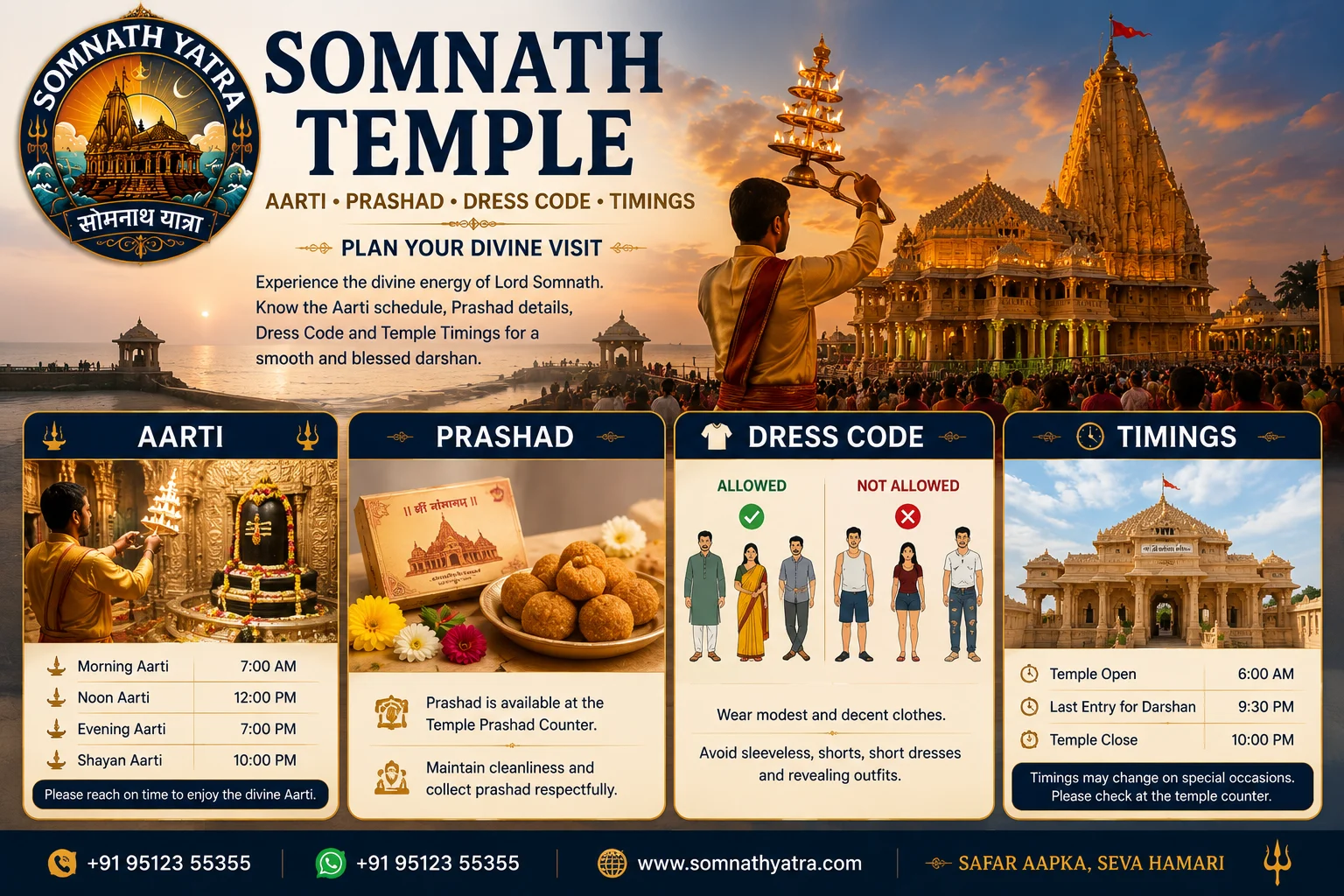
Somnath Temple Timings, Aarti, Dress Code & Light Show
Somnath holds the distinction of being the first among the twelve Aadi Jyotirlingas of Lord Shiva, situated on the western coast of Gujarat at Prabhas Patan. This Somnath Temple visitor guide consolidates verified, up-to-date information on darshan timings, aarti schedules, dress code, prasad, the light and sound show, and essential visitor rules — eliminating the need to cross-reference conflicting sources online.
Somnath Temple: Quick Facts at a Glance
| Detail | Info |
|---|---|
| Location | Prabhas Patan, near Veraval, Gir Somnath district, Gujarat |
| Nearest Airport | Diu Airport (~85 km) |
| Nearest Railway Station | Veraval Junction (~7 km) |
| Best Time to Visit | October–March (pleasant weather, manageable crowds) |
| Entry Fee | Free for all devotees |
| Managed By | Shree Somnath Trust |
| Official Website | somnath.org |
| Mobile Phones | Not allowed inside the temple |
| Photography | Prohibited inside the sanctum; allowed on temple premises and exterior |
The Somnath Temple complex extends beyond the main shrine. It includes a museum, beach access, the Vallabhghat sunset point, and the light and sound show venue. A complete visit — covering darshan, aarti, prasad, and the evening show — requires approximately 3–4 hours. Visitors who wish to explore nearby attractions should allocate a full day.
Somnath Temple Timings: When to Visit
The Somnath Temple darshan timing for 2026 follows a consistent daily schedule. Understanding these hours is essential for planning a smooth visit.
Daily Darshan Timings
| Time Slot | Activity |
|---|---|
| 6:00 AM | Temple opens; darshan begins |
| 6:00 AM – 12:00 PM | Morning darshan window |
| 12:00 PM | Noon aarti (brief pause in darshan flow) |
| 12:00 PM – 7:00 PM | Afternoon darshan |
| 7:00 PM | Evening Sandhya aarti (darshan pauses) |
| 7:00 PM – 9:00 PM | Evening darshan |
| 9:00 PM – 10:00 PM | Temple closes (final darshan) |
According to the Shree Somnath Trust’s official FAQ, the temple closes at 10:00 PM. However, the last entry is typically called well before closing time. Visitors arriving after 9:30 PM may not be permitted entry.
Special Day Variations
Mondays attract significantly larger crowds. Queue times on Mondays can be two to three times longer than on regular days. While the temple occasionally extends operational hours during peak Mondays, visitors should plan to arrive early rather than rely on extended timings.
Festival days — including Mahashivratri, Shravan Mondays (July–August), and Kartik Purnima — bring substantial pilgrim influxes. During these periods, the Shree Somnath Trust may implement regulated entry with timed slots and extended wait times. Checking the official website or local announcements one to two days before a festival visit is recommended.
Full moon and new moon days see a noticeable increase in devotee footfall. While not as intense as Mondays, these days warrant earlier arrival.
Best Time Slots for Darshan
Early morning (6:00 – 7:00 AM) offers the quietest darshan experience. The courtyard remains uncrowded, the sea breeze is cool, and the atmosphere is conducive to a peaceful visit. This slot is ideal for visitors prioritizing a spiritual, unhurried experience.
Mid-morning (8:00 – 11:00 AM) brings moderate crowds. Wait times are manageable, and this window provides a practical balance between convenience and experience.
Evening (5:00 – 7:00 PM) is the most atmospheric slot, particularly when timed with the Sandhya aarti. The temple illuminated against the sunset creates a visually striking setting. This is also the most crowded period, with queue times ranging from 45–60 minutes on regular days and longer on weekends.
Seasonal Timing Changes
Summer (April–June): The temple schedule remains largely unchanged, but the heat makes early morning visits essential. Courtyard temperatures can exceed 40°C by mid-morning.
Monsoon (July–September): The light and sound show is typically suspended during heavy rains. Temple closing times may be adjusted based on weather conditions. On the positive side, tourist footfall decreases during this period.
Winter (October–March): Peak season for Somnath visits. Pleasant weather, manageable weekday crowds, and the full complement of experiences — including the evening light and sound show — make this the recommended visiting window.
Somnath Temple Aarti Time: A Complete Breakdown
The daily aarti ceremonies at Somnath Temple are among the most significant rituals performed at any of the twelve Jyotirlingas. The Somnath Temple aarti time schedule includes four daily ceremonies, each with distinct characteristics.
Morning Aarti (Mangala Aarti) — 7:00 AM
The first ritual of the day, performed at sunrise. The sanctum is opened with Vedic chants, the idol of Lord Somnath is adorned, flowers are offered, and the conch is blown. The morning aarti is the most meditative of the four daily ceremonies and draws the smallest crowd, making it ideal for visitors seeking an intimate spiritual experience.
Recommendation: Arrive by 6:30 AM to secure a clear viewing position in the main hall.
Afternoon Aarti (Madhyahna Aarti / Bhog Aarti) — 12:00 PM
Coincides with the midday bhog (food offering). The priests offer prepared food to the deity before distribution as prasad. The ritual is shorter than the morning or evening aartis. Visitors in the midst of darshan at noon will experience a brief pause in the flow as the aarti is performed.
Crowd levels: Moderate. Local devotees arrive specifically for this ceremony, while some tourists have stepped out for lunch.
Evening Aarti (Sandhya Aarti) — 7:00 PM
The most visually striking and widely attended of the four daily aartis. As the sun sets over the Arabian Sea, the temple lights illuminate the complex and the evening ritual commences. Conch shells sound in unison, bells ring, and the priests perform the aarti with large multi-tiered lamps. The combination of the illuminated temple, the sound of waves, and the scent of camphor and incense creates an atmosphere that is widely regarded as the highlight of a Somnath visit.
Recommendation: Arrive by 6:15–6:30 PM. The inner hall fills rapidly. Positioning near the railing on the left side (facing the sanctum) provides a clear sightline. The outer courtyard offers a wider view but less proximity to the ritual.
Crowd levels: High. Expect close quarters with hundreds of other devotees.
Night Aarti (Shayana Aarti) — 8:00 PM
The final aarti of the day, performed as the temple prepares to close. The Shayana Aarti is a quieter, more subdued ceremony compared to the evening aarti. It serves as a natural conclusion to the day’s rituals and is primarily attended by devotees completing the full daily aarti cycle.
Special Aartis
Mahashivratri: The temple remains open through the night with continuous rituals and multiple aartis. Crowd sizes can reach tens of thousands of devotees. Advance accommodation booking and early arrival are essential.
Shravan Month (July–August): Mondays during Shravan are the busiest days of the year at Somnath. Special aartis and extended rituals are conducted. The energy is notable, but so are the queues.
Kartik Purnima: Features special evening ceremonies and lighting arrangements.
Tips for Aarti Attendance
- Arrive 30–45 minutes before the scheduled aarti time, particularly for the evening ceremony
- Footwear must be removed before entering the temple; use the paid shoe storage counters near the entrance (₹10–20)
- Follow the queue system managed by the temple Trust — volunteers are available to assist visitors
- During festivals, crowds are denser; secure personal belongings and maintain patience
Somnath Temple Prasad: What to Expect & Where to Get It
Somnath Temple prasad is a sacred offering blessed at the sanctum. Consuming prasad after darshan holds spiritual significance for devotees.
Types of Prasad
- Panchamrit — A sacred mixture of milk, curd, honey, sugar, and ghee. The most common prasad distributed after aarti.
- Laddus — Besan or motichoor laddus, available at temple counters. The most popular option for visitors purchasing prasad to take home.
- Coconut — Whole coconuts offered during pooja, sometimes broken and distributed to devotees.
- Dry fruits — Offered during special poojas and distributed as prasad on specific days.
Where to Get Prasad
Official temple counters managed by the Shree Somnath Trust are located on the premises. These are the recommended source for authentic prasad at fair prices.
Availability: Prasad is typically available during darshan hours (6:00 AM – 9:00 PM), with the best selection during morning and evening slots.
| Item | Price |
|---|---|
| Panchamrit | Often free after aarti |
| Laddus | ₹20–50 per piece |
| Dry fruit packets | ₹100–300 |
| Special pooja prasad | Varies by offering type |
Special Prasad Days
Mondays often feature special prasad variations tied to Lord Shiva worship. Festival days bring unique offerings — Mahashivratri prasad, for instance, may include items not available on regular days.
Can You Take Prasad Home?
Yes. Laddus and dry fruit packets are available in sealed packaging with a shelf life of 3–5 days at room temperature. Counter staff can provide secure packaging for long-distance travel. Panchamrit, being liquid-based, is intended for on-site consumption.
Nearby Food Options
The area surrounding the temple includes several pure vegetarian eateries serving Gujarati thalis and snacks. Restaurants on Somnath Temple Road, one to two blocks from the entrance, offer better quality and pricing than the immediate vicinity of the temple.
Advisory: Purchase prasad only from authorized counters. Vendors outside the temple complex may charge inflated prices for inferior quality products.
Somnath Temple Dress Code: What to Wear & What to Avoid
The Somnath Temple dress code requires modest and respectful clothing. Traditional Indian attire is preferred, but well-covered Western clothing is generally accepted. The security staff at the entrance enforce these guidelines, and visitors not meeting the dress code may be denied entry.
For Men
Allowed: Kurta-pajama, dhoti, formal pants with shirt, full-length trousers with a collared or crew-neck t-shirt.
Not permitted: Shorts, sleeveless vests, torn or ripped jeans, beachwear.
Footwear: Must be removed before entering the temple. Paid shoe storage counters (₹10–20) near the entrance provide secure storage.
For Women
Allowed: Saree, salwar kameez, long kurti with leggings, modest long dresses.
Not permitted: Short dresses, skirts above the knee, sleeveless tops without a dupatta. While jeans are not explicitly banned, full-length, non-distressed jeans paired with a modest top are recommended.
Dupatta: Not mandatory but recommended. A dupatta enhances modesty and provides greater comfort during crowded aarti sections.
For Children
Children under 10 generally receive more flexibility. Comfortable, covered clothing is recommended — kurta sets for boys and long dresses or kurta-leggings for girls.
Footwear & Accessories
- Shoe storage: Paid counters near the entrance at ₹10–20 per pair
- Leather items: Not officially prohibited, but visitors may choose to leave leather belts and wallets in lockers as a courtesy
- Jewelry: Keep minimal for security purposes, particularly during crowded aarti ceremonies
What Happens If You’re Not Dressed Appropriately?
Entry security will flag non-compliant attire. In some cases, a dupatta or covering cloth may be provided at the entrance. However, availability is not guaranteed — visitors should come prepared with appropriate clothing.
Seasonal Dress Tips
- Summer: Light cotton fabrics, breathable materials, comfortable sandals for easy removal
- Winter: Light jacket or shawl for early morning and evening visits, particularly during aarti when sea breeze intensifies
- Monsoon: Compact rain jacket or umbrella; the temple complex is partially open to the elements
Somnath Temple Light and Sound Show: A Complete Visitor’s Guide
The “Jay Somnath” light and sound show is a major attraction for visitors to the Somnath Temple complex. This audio-visual presentation narrates the temple’s history from its mythological origins through its repeated destruction and eventual reconstruction.
What Is the Show?
An open-air projection mapped onto the Somnath Temple facade, using laser graphics, 3D projection mapping, and ambient sound effects. The narration covers the temple’s mythological origins, construction across different eras, destruction by Mahmud of Ghazni and subsequent invaders, and the modern reconstruction led by Sardar Vallabhbhai Patel with the Pran-Pratistha ceremony performed by President Dr. Rajendra Prasad on 11 May 1951.
The show appeals to pilgrims, history enthusiasts, and architecture appreciators alike.
Show Timings
| Detail | Info |
|---|---|
| Daily Schedule | 8:00 PM – 9:00 PM |
| Duration | Approximately 45–60 minutes |
| Languages | Hindi and Gujarati (varies by day) |
| Monsoon Season | Typically suspended during heavy rains (July–September) |
During peak winter season and major festivals, the Shree Somnath Trust may add additional show times or adjust the schedule. Checking the notice board at the venue or the official website on the day of visit is recommended.
Ticket Information
| Category | Price (approx.) |
|---|---|
| Adults | ₹50 |
| Children (5–12 years) | ₹25 |
| Children (below 5 years) | Free |
Purchase location: Ticket counter near the show venue on the temple premises. Same-day tickets are usually available. Advance booking is advisable during peak season (October–March) and festival periods.
Online booking: The Shree Somnath Trust website may offer online ticketing options. Checking in advance can help avoid counter queues.
Seating
The show is held in an open-air seating area on a first-come, first-served basis.
- Front-center rows provide the clearest projection on the temple facade
- Back rows remain viable due to the large projection size
- Seating typically consists of plastic chairs; high-attendance events may require standing
Recommendation: Arrive 20–30 minutes before showtime for optimal seating.
What to Expect
The show covers:
- Mythological origins of Somnath (Moon God’s worship of Lord Shiva)
- Temple construction across different historical eras
- Repeated destruction by Mahmud of Ghazni and subsequent invaders
- Modern reconstruction led by Sardar Vallabhbhai Patel
- The 1951 Pran-Pratistha ceremony
Photography rules vary by show — some allow phones without flash, while others prohibit all recording. Checking the rules at the venue is advisable.
Tips for the Best Experience
- Arrive 20–30 minutes early for seating and ticket purchase
- Carry a light jacket; evening sea breeze can be cool even in winter
- Combine with the 7:00 PM Sandhya aarti for a complete evening experience
- Use restroom facilities before the show to avoid leaving mid-performance
Nearby Evening Activities
After the show concludes around 9:00 PM:
- Somnath Beach: A 5-minute walk; well-lit for evening strolls
- Dinner: Restaurants on Somnath Temple Road remain open until 10:00–10:30 PM; Gujarati thalis are a recommended option
- Temple illumination: The temple complex is illuminated at night, offering a distinct visual experience from daytime visits
Practical Travel Tips for Somnath Temple Visitors
Understanding the Somnath Temple entry rules before arrival ensures a smoother experience.
Mobile Phone Policy
Mobile phones are strictly prohibited inside the temple. This policy extends beyond switching off devices — phones cannot be carried past the security checkpoint. Free and paid locker facilities near the entrance accommodate phones, cameras, wallets, and bags. The system operates on a token basis: deposit items, receive a token, and retrieve upon exit.
Security Check
A standard security screening is conducted at all entry points. Bags are inspected, and visitors pass through metal detectors. The process is orderly but may take 10–15 minutes during peak hours. Carrying valid ID proof is recommended, as some entry points require verification.
Locker & Storage
Lockers near the main entrance are available for:
- Mobile phones
- Cameras
- Wallets and purses
- Bags and backpacks
Cost: Free for phones (basic lockers); ₹10–50 for larger items depending on size.
Accessibility
The Shree Somnath Trust provides:
- Wheelchairs for senior citizens and differently-abled visitors
- Ramps at key entry points
- Priority darshan for senior citizens and specially-abled persons (free of charge)
Nearby Facilities
- Drinking water: Free water points throughout the complex
- Restrooms: Clean facilities located near the entrance
- Medical aid: Basic first-aid available at the temple office
Time Allocation
| Visit Type | Duration |
|---|---|
| Quick visit (darshan only) | 1–1.5 hours |
| Full experience (darshan + aarti + prasad + light show) | 3–4 hours |
| With nearby attractions | Half day to full day |
Photography Rules
Permitted:
- Temple exterior and architecture
- Courtyard and surrounding areas
- Triveni Sangam and beach
Prohibited:
- Inner sanctum (Garbhagriha)
- Aarti rituals inside the temple
- Any area where security has restricted photography
Nearby Attractions to Combine with Your Somnath Visit
Triveni Sangam
The confluence of three rivers — Hiran, Kapila, and Saraswati — before they merge with the Arabian Sea. A holy dip here is considered sacred, particularly during festival days. The location is visually striking and accessible from the main temple complex.
Bhalka Tirth
The site where Lord Krishna was accidentally struck by an arrow while resting under a tree — marking his final moments on Earth before departing for his heavenly abode. A small temple commemorates the event. Located approximately 5 minutes by road from Somnath.
Gita Mandir
A carved temple dedicated to Lord Krishna, featuring inscriptions from the Bhagavad Gita on its walls. The architecture is notable, and the atmosphere is calm relative to the main Somnath complex.
Laxmi-Narayan Temple
Situated near the Triveni Sangam, this temple is less crowded than Somnath and offers a quieter spiritual experience.
Somnath Beach
A short walk from the temple complex. The beach is not suitable for swimming due to strong currents, but it is ideal for evening walks, observing local fishermen, and watching the sunset from Vallabhghat.
The 3-Day Somnath-Gir-Diu Triangle
For visitors with extended time, the Gujarat coast offers an efficient itinerary:
| Day | Destination | Highlights |
|---|---|---|
| Day 1 | Somnath | Temple darshan, aarti, light show, beach |
| Day 2 | Gir National Park | Asiatic lions (~45 km from Somnath) |
| Day 3 | Diu | Beaches, fort, Portuguese heritage (~85 km from Somnath) |
FAQs (Frequently Asked Questions)
Can I enter Somnath Temple without prior booking?
Yes. Entry is free and open to all devotees. No prior booking is required for general darshan. The Somnath Temple darshan timing for 2026 is 6:00 AM to 10:00 PM — walk in during operating hours.
Is there a VIP darshan ticket? How much does it cost?
The Shree Somnath Trust offers a special darshan option for quicker entry, typically priced around ₹200–500 per person. Senior citizens and specially-abled visitors receive priority access free of charge. Current pricing should be verified on the official website or at the temple counter.
Are foreigners allowed inside Somnath Temple?
Yes. Foreigners are welcome to visit the temple complex, museum, and viewing galleries. However, entry to the inner sanctum (Garbhagriha) may be restricted to Hindus only, in accordance with traditional temple norms.
Can I wear jeans to Somnath Temple?
There is no explicit ban on jeans. The dress code recommends modest, traditional attire. Well-fitted, full-length jeans paired with a modest top are generally acceptable. Ripped or distressed jeans should be avoided.
What is the best time to attend aarti?
For a peaceful, intimate experience, the 7:00 AM morning aarti is recommended. For visual spectacle and atmosphere, the 7:00 PM evening aarti is the preferred choice. Both ceremonies offer distinct experiences.
Is the light and sound show worth it?
Yes. The production quality, combined with the setting of the actual temple facade and the Arabian Sea backdrop, makes it one of the more memorable light shows at Indian heritage sites. It is recommended for both pilgrims and general tourists.
How far is Somnath from Dwarka? Can I visit both in one day?
Somnath to Dwarka is approximately 230 km by road, requiring 4–5 hours of travel one way. Visiting both in a single day is possible but impractical due to transit time. Dedicating a full day to each destination is the recommended approach.
Is there parking available near the temple?
Yes. Ample parking is available near the temple complex for private vehicles and buses. Rates are approximately ₹20–50 for cars, with higher rates for larger vehicles.
Can I carry my wallet/purse inside?
No. All personal items — including wallets, phones, cameras, and bags — must be deposited in lockers before entering the temple.
Is Somnath Temple open during solar/lunar eclipses?
The temple typically closes during eclipses in accordance with Hindu traditions and reopens after post-eclipse rituals are completed. Visitors whose travel dates coincide with an eclipse should check local advisories.
Conclusion
Somnath Temple combines historical significance, spiritual importance, and coastal beauty in a manner that distinguishes it from other pilgrimage destinations in Gujarat. Planning the visit around the aarti timings and the evening light and sound show maximizes the experience. Early morning arrivals ensure a peaceful darshan, while the evening ceremonies offer the full atmospheric impact of this ancient Jyotirlinga.
Whether visiting for the first time or returning, Somnath provides a well-organized, accessible, and spiritually rewarding experience — provided visitors come prepared with the right information.
“Plan around the aarti timings and the light show. Arrive early. Come prepared. Somnath rewards the informed visitor.”
Quick Reference
| Detail | Info |
|---|---|
| Best Time to Visit | October–March (pleasant weather, full experience available) |
| Budget Estimate | ₹500–2,000 per day (temple visit is free; includes prasad, show ticket, local food) |
| One Thing Not to Miss | Evening Sandhya Aarti at 7:00 PM followed by the Jay Somnath Light and Sound Show at 8:00 PM |


