Tulsishyam – Complete Guide to Gir Forest’s Hidden Temple & Hot Springs
03/09/2026
adminsy
10 min read
Complete Guide to Gir Forest’s Hidden Temple & Hot Springs
You drive through the Gir forest. Peacocks cross the road without hurry. Sambhar deer watch from the treeline. The road narrows. The canopy thickens. And then, at the end of this forest drive, you park. You climb 100 steep steps through the trees. And you reach a 700-year-old temple that houses an idol three thousand years old. That’s Tulsishyam. Not a reconstructed tourist site. Not a theme park. The real thing. Where the wild animals are real, the springs are boiling, and the temple sits in a forest clearing that feels like it belongs to another century entirely.
Tulsishyam sits on the border of Amreli district, Junagadh district, and Gir Somnath district, deep inside the Gir National Park—the last home of the Asiatic lion. It’s 45 km from Dhari in Amreli district and 35 km from Una in Gir Somnath district. Historically, this region was ruled by the Kotila’s of Dedan. The last ruler was Kumarshree Jilubapu Kotila, succeeded by Kumarshree Pratapbapu Kotila. The son of Kumarshree Pratapbapu Kotila is Prince Nandkishor Kotila. The approach road runs through the forest itself. Not around it. Through it. The kind of road where, if you’re fortunate, the shape of a lion in the grass at the treeline makes you stop breathing for a moment. Different energy entirely.
The Legend of Tulsishyam
The name tells the story. Tulsi for the demon Tul. Shyam for Lord Krishna. The temple is dedicated to Lord Vishnu—Lord Shyam. Legend says Lord Krishna eliminated the demon called Tul at this very spot. Hence Tulsishyam—Lord Krishna, the conqueror of Tul. Simple. Direct. The kind of legend that sticks because the place itself feels like it remembers. The Puranas refer to this region as Taptodak—hot water. The springs were here before the temple. The forest was here before the springs. And the story of Krishna and Tul is woven into every stone.
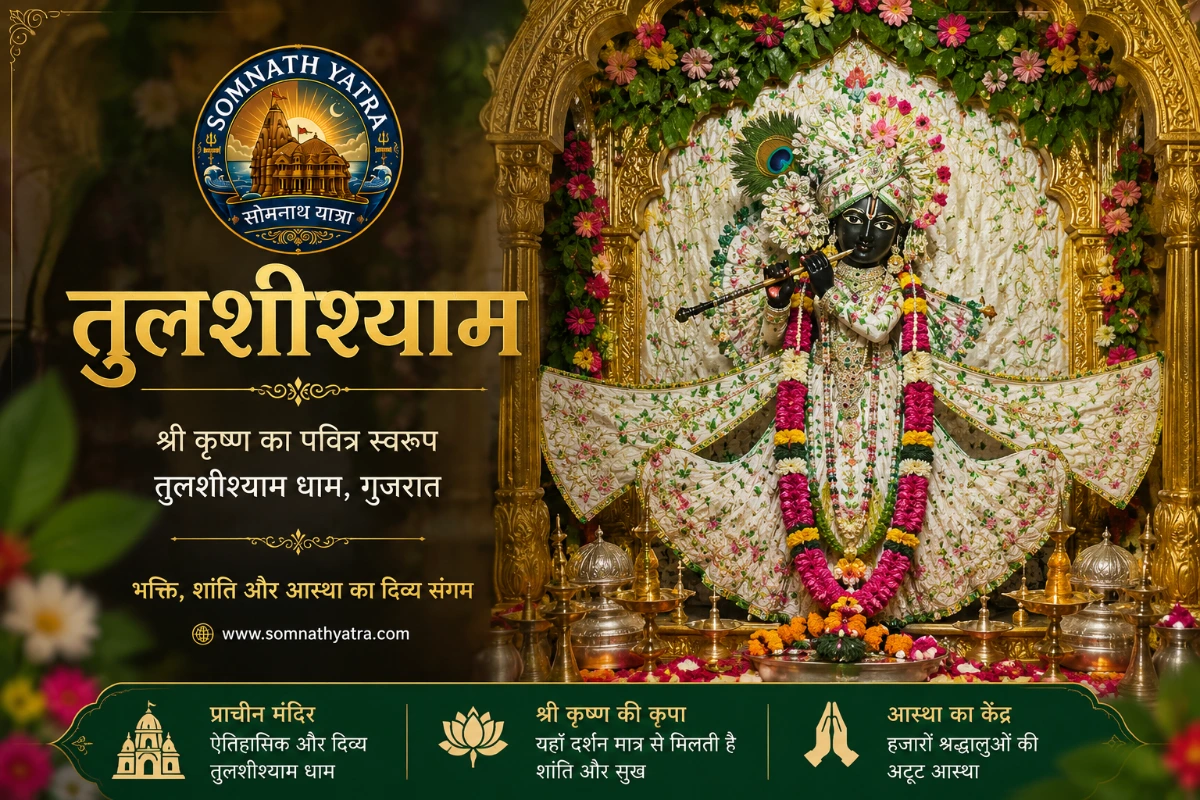
The idol inside the sanctum is made of black stone. It’s believed to be 3,000 years old—predating the temple structure by over two millennia. The temple itself is approximately 700 years old. When you stand before that idol, you’re looking at something that has been worshipped for longer than most civilizations have existed. Different perspective entirely.
Tulsishyam Temple — The 100-Step Climb
The temple sits atop a small hill. To reach it, you climb 100 steep steps through the trees. Not a casual stroll. A proper climb. The kind that makes you earn your darshan. But the climb is part of the experience—each step takes you higher into the canopy, the forest opens below, and by the time you reach the top, you’ve left the noise behind entirely.
The sanctum houses the black stone idol of Lord Tulsishyam. The atmosphere is devotional, unhurried. Bells ring. Incense burns. The priests perform the aarti with the kind of reverence that comes from centuries of tradition. The temple is open from 6:00 AM to 8:00 PM. Entry after 8:00 PM is not allowed, and you must exit by 9:00 PM—wildlife safety regulations. The forest comes alive at night, and not in the tourist-brochure way.
Detail
Information
Temple Age
~700 years old
Idol Age
~3,000 years old (black stone)
Steps to Temple
100 steep steps
Opening Time
6:00 AM
Closing Time
8:00 PM
Exit Deadline
9:00 PM
Entry Fee
Free
The Three Hot Springs (Taptodak)
At the base of those 100 steps, where the path meets the forest floor, three natural hot springs emerge from the earth. The Puranas call them Taptodak—hot water. Each spring has a different temperature. The first is warm. The second is hotter. The third is boiling. You can see steam rising from the water in the cool forest air. The water is rich with sulphur. Pilgrims believe bathing in these springs heals skin diseases, gout, and rheumatism. Whether or not you believe in the medicinal properties, the experience of sitting beside a boiling spring in the middle of a forest is unlike anything else in Gujarat.
The springs are free to access. No entry fee. No restrictions on timing—though the forest road becomes unsafe after dark. The best time to visit the springs is early morning, when the steam rises dramatically in the cool air and the forest is at its most atmospheric. Different mood entirely.
Rukmini Devi Temple
Opposite the Tulsishyam Temple, on a nearby hillock, stands the Rukmini Devi Temple. Also approximately 700 years old. Also requiring 100 steps to reach. The idol here is made of black marble—Rukmini, Krishna’s wife. The temple offers panoramic views of the surrounding forest. If you’ve climbed the 100 steps to Tulsishyam, another 100 to Rukmini Devi is a small price for the perspective. The kind of view that makes you understand why this forest has been sacred for millennia.
Gaushala & Free Meals
The temple maintains a Gaushala with more than 200 cows. And here’s what most guides don’t mention clearly enough: the temple provides free meals—lunch and dinner—to all visitors. Not discounted. Not “pay what you wish.” Free. The kind of community service that makes you rethink what a temple should be. The food is simple, vegetarian, served in the traditional style. No frills. Just nourishment.
Gravity Hill Phenomenon
400 meters north of the temple, on State Highway SH104 (also called SH33), there’s a stretch where vehicles appear to roll uphill in neutral gear. A gravity hill—an optical illusion created by the surrounding terrain. The road actually slopes downhill, but the horizon line is hidden, tricking drivers into thinking they’re rolling uphill. The confusion is the point. It’s a brief, strange interlude between the forest drive and the temple climb. Worth stopping for. Worth experimenting with. The kind of thing that makes you question your senses for a moment.
From City
Distance to Gravity Hill
Amreli
75 km southwest
Junagadh
110 km southeast
Rajkot
166 km south
Bhavnagar
170 km southwest
Dwarka
300 km southeast
Ahmedabad
310 km southeast
Wildlife on the Forest Road
This is Gir forest. The last home of the Asiatic lion. The approach road to Tulsishyam runs through the protected landscape. Peacocks cross without urgency. Sambhar deer watch from the treeline. And if you’re very fortunate, a lion—real, breathing, magnificent—appears at the treeline. The kind of encounter that makes your heart stop. Not a safari. Not a controlled environment. The real thing. Different entirely.
Safety rules: Do not stop in the middle of the forest road. Do not exit your vehicle in the forest section. Drive at moderate speed. Be indoors between 6:00 PM and 9:00 AM. The forest belongs to the animals. You’re a visitor. Act accordingly.
How to Reach Tulsishyam
From
Distance
Mode
Approx. Time
Una
35 km
Car / Bus
45 minutes
Dhari
45 km
Car / Bus
1 hour
Diu
45 km
Car / Taxi
1 hour
Sasan Gir
66 km
Car
1.5 hours
Amreli
76 km
Car
1.5 hours
Veraval / Somnath
100 km
Car
2 hours
Junagadh
170 km
Car
3 hours
Rajkot Airport
150 km
Flight + Taxi
3 hours
Ahmedabad
380-400 km
Car / Train to Una
7+ hours
By air: Nearest airport is Diu (45 km) with limited connectivity. Rajkot Airport (150 km) is more accessible. Ahmedabad airport (300 km) is the major hub.
By train: Nearest railway station is Veraval (85 km) or Una (30 km). Regular trains connect Veraval to major cities.
By road: Well-connected via Una (35 km) or Dhari (45 km). Regular buses from Junagadh, Veraval, and Rajkot to Una. From Una, 35 km through the forest to Tulsishyam. The forest road is the main route—drive slowly, enjoy the wildlife.
Best Time to Visit
Season
Months
Experience
Winter
November – February
Best time. Pleasant 18-28°C. Ideal for temple, springs, and wildlife.
Summer
March – May
Hot (35-42°C). Early morning visit essential. Carry water.
Monsoon
June – September
Green landscapes, occasional rain. Roads may be slippery. Carry umbrella.
Ideal timing: Arrive at 6:00 AM. Climb the 100 steps before the heat builds. Visit the hot springs at dawn—steam rising dramatically in the cool forest air. Have darshan. Eat the free meal. Climb to Rukmini Devi. Leave by afternoon. The forest road is best driven in early morning or late afternoon—maximum wildlife sighting probability. And be indoors by 6:00 PM. The forest belongs to the lions at night.
Where to Stay
The temple maintains a government guest house for overnight stays. Basic facilities. Functional. Not luxury. But the location—inside the forest, near the temple—is the appeal. If you prefer more options, Una (29 km) and Diu (45 km) have hotels ranging from budget to mid-range. Sasan Gir (66 km) offers resort-style accommodation if you’re combining Tulsishyam with a lion safari trip.
Top Things to Do
Activity
Time Needed
Temple Darshan
30-45 minutes
Hot Springs Bath
30-45 minutes
Rukmini Devi Temple
30 minutes
Free Meal at Temple
30 minutes
Forest Drive (Wildlife)
1-2 hours
Gravity Hill Experiment
10-15 minutes
Gaushala Visit
15-20 minutes
Photography
1-2 hours
Nearby Attractions
Tulsishyam sits in the heart of Gujarat’s most biodiverse region. Gir National Park for lion safaris. Diu for beaches and Portuguese heritage. Junagadh for Uparkot Fort and Girnar Hill. Somnath for the Jyotirlinga temple. Veraval for fishing port culture. Different destinations. All within 2-3 hours. Tulsishyam works as a base for exploring the wider Saurashtra region—or as a day trip from Somnath, Diu, or Sasan Gir.
Frequently Asked Questions
What is Tulsishyam known for?
Tulsishyam is known for three things: an ancient Vishnu temple with a 3,000-year-old black stone idol, three natural sulphur hot springs believed to have curative powers, and its location deep inside the Gir forest—the last home of the Asiatic lion. The region was historically ruled by the Kotila’s of Dedan.
How old is Tulsishyam temple?
The Vishnu temple structure is approximately 700 years old. The idol inside is believed to be 3,000 years old, made of black stone. The region was historically ruled by the Kotila’s of Dedan.
What are the hot springs at Tulsishyam?
Three natural sulphur hot springs called Taptodak in the Puranas. The first is warm, the second is hotter, the third is boiling. Pilgrims believe bathing in them heals skin diseases, gout, and rheumatism. Rich in natural sulphur.
What are the temple timings?
6:00 AM to 8:00 PM. Entry after 8:00 PM is not allowed. You must exit by 9:00 PM due to wildlife safety regulations.
Is there an entry fee?
No. Entry to the temple and hot springs is completely free. Free meals are also provided to all visitors—lunch and dinner.
Can I see lions near Tulsishyam?
Yes. The temple is inside Gir forest—Asiatic lions, peacocks, and sambhar deer can be spotted on the forest approach road. Drive slowly. Do not exit your vehicle in the forest section. Be indoors by 6:00 PM.
How do I reach Tulsishyam from Somnath?
Somnath to Tulsishyam is approximately 100 km by road—about 2 hours. The route goes through Una and the Gir forest. Private car or taxi is the best option. No direct bus from Somnath. You can also reach via Dhari (45 km from Dhari).
What is the gravity hill phenomenon?
400 meters north of the temple, on State Highway SH104 (also called SH33). The road actually slopes downhill, but the hidden horizon line creates an optical illusion—vehicles appear to roll uphill in neutral gear. Worth stopping for—brief, strange, and entertaining.
Can I stay overnight at Tulsishyam?
Yes. The temple maintains a government guest house for overnight stays. Basic facilities. Una (29 km) and Diu (45 km) have more accommodation options.
What should I carry to Tulsishyam?
Water, sunscreen, comfortable shoes for the 100 steps, a camera with zoom lens for wildlife, and modest clothing for the temple. If visiting the hot springs, carry a change of clothes. Avoid wearing valuable jewelry in the forest.
Share:
Written by
adminsy
Content writer at Somnath Yatra — sharing travel guides, heritage stories and local insights from Gujarat.
We're dedicated to providing reliable taxi services across Gujarat. Your review helps us improve and assists fellow travelers in choosing the right service.