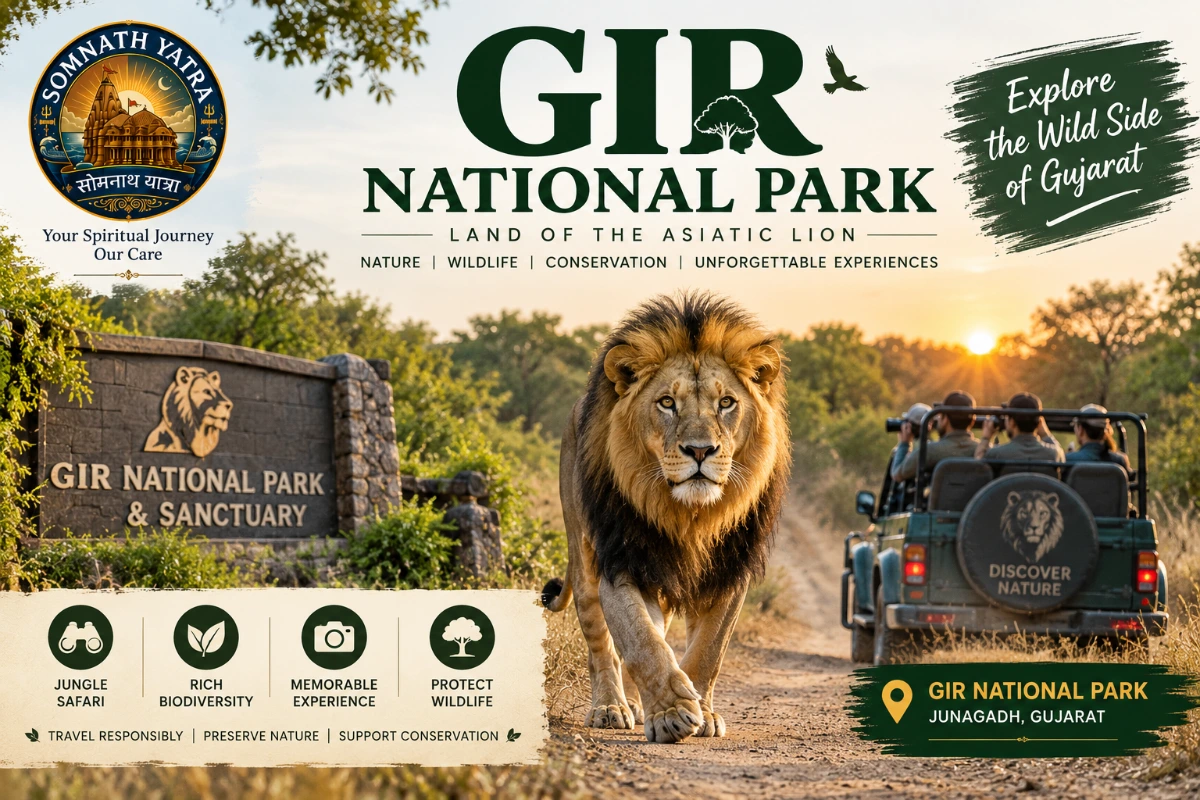
Sasan Gir National Park Complete Guide 2026 – Safari, Lions, Booking & Tips
About Gir National Park
The sanctuary was established in 1965. A 259-square-kilometer core area was declared a national park in 1975. Today, the Greater Gir landscape supports 674 Asiatic lions—the only population in the world. But lions aren’t the only residents. The park harbors 37 other mammal species: leopards, striped hyenas, jackals, sloth bears, sambar deer, chital (spotted deer), nilgai (blue bull), four-horned antelopes, chinkaras (gazelles), and mugger crocodiles at Kamleshwar Dam. Over 300 bird species, most of them residents, make Gir a birder’s paradise. Crested serpent eagles, Malabar whistling thrushes, paradise flycatchers—the list goes on.| Detail | Information |
|---|---|
| Total Area | 1,412 sq km (sanctuary) |
| Core Area | 259 sq km (national park) |
| Established | 1965 (sanctuary), 1975 (national park) |
| Asiatic Lions | 674 (Census 2020) |
| Mammal Species | 37+ |
| Bird Species | 300+ |
| Safari Routes | 13 designated routes |
| Best Time | October 16 – June 15 |
What Wildlife You Can See
The obvious answer: Asiatic lions. But Gir’s biodiversity goes far beyond the big cats. Leopards are present but rarely seen—elusive, nocturnal, the kind of animal that knows how to disappear. Spotted deer graze in open clearings. Sambar deer stand sentinel at forest edges. Nilgai—the largest Asian antelope—move through the grasslands. Four-horned antelopes, found nowhere else in such numbers, browse quietly in the undergrowth. Mugger crocodiles bask on the banks of Kamleshwar Dam. And overhead, 300+ bird species fill the canopy—raptors, waterbirds, songbirds, the full spectrum. Different layers. All worth watching.Did You Know? Asiatic vs. African Lions
Asiatic lions are smaller than their African cousins. But the real difference is visual. Look for the prominent longitudinal fold of skin running along their belly—rarely seen in African lions. Male Asiatic lions have a sparser, shorter mane, making their ears clearly visible even from a distance. They also tend to live in smaller prides. If you spot a lion in Gir and wonder why its ears are so visible, now you know.How the Forest Affects Your Sightings
Gir is a dry deciduous forest. In winter (November-February), the foliage is thick—making wildlife spotting harder but the jungle beautiful. Dense green canopies, filtered light, the kind of atmosphere that makes you feel small. By May, the trees shed their leaves. The landscape looks barren, almost skeletal. But that’s when visibility improves dramatically. Camouflaged lions, leopards, and deer become easier to spot against the bare branches. Summer is harsh on the body but kind to the eyes. Different trade-offs.Gir Jungle Safari — The Main Experience
This is what you come for. The Gir Jungle Trail. A 3-hour drive through the core forest in an open gypsy. Thirteen designated routes, each assigned randomly at the Sinh Sadan forest reception. Teak forests, rocky ravines, perennial streams—the Hiran, Machhundri, and Raval rivers cut through the landscape. Each route offers different terrain and different wildlife. No two safaris are the same. That’s the point. The gypsy accommodates up to 6 adults plus 1 child (3-12 years). A trained eco-guide accompanies every safari. The guide reads the forest—tracks, calls, movements—interpreting what your eyes might miss. The morning slot (6:00-9:00 AM) offers the highest lion sighting probability. Big cats are active, patrolling territories, feeding on overnight kills in the cool dawn air. Evening slot (3:00-6:00 PM) provides golden-hour light filtering through teak canopies. Different moods. Both valid.The Solo Traveler Dilemma
There is no official seat-sharing system for the core Gir Jungle Safari. If you’re a solo traveler or a couple, you must book and pay for the entire gypsy—permit, vehicle, and guide. That’s approximately ₹4,800-5,000 for one person. The only way to split costs is to find a group before booking online. Some resorts and travel forums help connect solo travelers, but there’s no guarantee. Devalia Safari Park offers per-seat bus tours (₹200-250), which is the budget-friendly alternative if sharing isn’t possible.Camera Fees & Restrictions
Basic cameras and smartphones are usually free—no additional charges. However, high-end DSLR or mirrorless cameras with large telephoto lenses (300mm+) may incur extra fees or require special permissions at Sinh Sadan. The forest department hasn’t published a fixed camera fee schedule, so costs can vary. It’s best to declare your equipment at check-in and ask directly. Tripods are generally not allowed inside the gypsy. Monopods may be permitted—ask your guide.The “Reporting Time” Reality
Arriving 30-45 minutes early at Sinh Sadan isn’t a suggestion—it’s mandatory. Gypsies and guides are assigned on the spot at the forest reception. Latecomers can lose their booking without a refund. The forest department operates on strict schedules. If your slot starts at 6:00 AM and you arrive at 6:05 AM, your permit may be cancelled and given to someone on the waitlist. No exceptions. Plan to be at Sinh Sadan at least 45 minutes before your slot. Sleep early the night before.Cancellation & Refund Policy
Cancellations must be made through the official Gujarat Forest Department website. Refund rules:- Before 10 days of safari date: 75% refund
- Before 5 days: 50% refund
- Before 2 days: 25% refund
- Less than 2 days: No refund
Devalia Safari Park (Gir Interpretation Zone)
12 km west of Sasan Gir village at Devalia. A 4.12-square-kilometer fenced compound. This is the interpretation zone—created to reduce tourist pressure on the core sanctuary. Lions, leopards, blackbucks, spotted deer—all free-roaming within natural enclosures. Bus tours depart hourly, lasting 45 minutes. Gypsy tours are also available. Guaranteed lion sightings. Not the wilderness experience. But the guaranteed one. Good for families with young children, travelers on tight schedules, or anyone who wants a confirmed sighting without the uncertainty of the core forest. Note: Devalia Safari Park remains open year-round except Wednesdays. The Gir Jungle Safari is closed from June 16 to October 15.Safari Timings & Season Guide
Three shifts daily during the open season. Timings shift slightly between winter and summer.| Season | Months | Morning Slot 1 | Morning Slot 2 | Evening Slot |
|---|---|---|---|---|
| Winter | Oct 16 – Feb 28/29 | 6:30 AM – 9:30 AM | 9:00 AM – 12:00 PM | 3:00 PM – 6:00 PM |
| Summer | Mar 1 – Jun 15 | 6:00 AM – 9:00 AM | 9:00 AM – 12:00 PM | 4:00 PM – 7:00 PM |
| Monsoon | Jun 16 – Oct 15 | CLOSED (Gir Jungle Safari only. Devalia remains open except Wednesdays.) | ||
Weather & Packing — What Nobody Tells You
The Winter Freeze (December-February)
The 6:00 AM open-gypsy safari is brutally cold. Wind chill at 40-50 km/h driving speed drops the temperature to near freezing. Tourists arrive in light sweaters and freeze for 3 hours. Pack a heavy windbreaker jacket, beanie, and gloves. Layers are essential—a thermal base layer, fleece mid-layer, and windproof outer shell. By 10 AM, it’s pleasant. But those first 4 hours at dawn? The cold is real.The Summer Dust (April-June)
Best time for lion sightings—animals gather at shrinking waterholes. But the dry deciduous forest turns into a dust bowl. Gypsies kick up clouds of fine red dust on unpaved tracks. Bring N95 masks or thick scarves to cover your face. Polarized sunglasses are essential. Carry extra water—dehydration hits fast in 38-42°C heat. The upside? Barren trees mean better visibility. Lions against bare branches are easier to spot than lions hidden behind dense foliage. Different trade-off.How to Book Safari Online
All permits must be booked through the official Gujarat Forest Department website: girlion.gujarat.gov.in. No offline permits are issued for the core jungle safari. Booking opens 90 days in advance at 8:00 AM IST. First-come, first-served. Peak season (November to February) sells out within hours. Plan ahead. Booking steps:- Visit girlion.gujarat.gov.in
- Select date from the calendar
- Choose Gir Jungle Trail or Devalia Safari Park
- Enter group details (max 6 adults + 1 child)
- Select time slot
- Enter traveler name and contact details
- Provide ID proof details (Aadhaar, Passport, Driving License, Voter ID)
- Complete payment
Safari Cost Breakdown
The total cost includes three components: permit fee, vehicle charge, and guide charge. All paid separately.Permit Charges
| Day | Indian (Up to 6 persons) | Foreigner (Up to 6 persons) | Extra Child (3-12 years) |
|---|---|---|---|
| Monday – Friday | ₹800 | ₹7,440 | ₹100 / ₹1,860 |
| Sat/Sun/Festival | ₹1,000 | ₹9,300 | ₹125 / ₹2,325 |
Vehicle (Gypsy) Charges
| Vehicle Type | Seats | Charge |
|---|---|---|
| Category A | 4 Seater | ₹2,500 |
| Category A | 6 Seater | ₹3,500 |
| Category A | 8 Seater | ₹4,500 |
Guide Charges
| Guide Type | Charge |
|---|---|
| Naturalist | ₹700 |
| Guide G1 | ₹500 |
| Guide G2 | ₹400 |
Where to Stay in Sasan Gir
Three tiers. The luxury resorts inside or near the park offer private cottages, swimming pools with forest views, spa facilities, and in-house naturalist guidance. Mid-range hotels cluster around Sasan village—clean rooms, AC, decent restaurants. Budget options include guesthouses and homestays starting around ₹1,500 per night. Book 45-60 days ahead during peak season. Properties near safari gates minimize early morning travel. Some resorts assist with safari booking—worth asking when you reserve.| Category | Price Range (per night) | Features |
|---|---|---|
| Luxury Resort | ₹8,000 – ₹20,000 | Private cottages, pool, spa, naturalist, meals included |
| Mid-Range Hotel | ₹3,000 – ₹7,000 | AC rooms, restaurant, safari booking support |
| Budget Guesthouse | ₹1,500 – ₹3,000 | Basic clean rooms, local experience |
Practical Information — Sasan Gir Village
ATMs & Cash
Sasan Gir is a small village. Resorts and larger hotels accept cards and UPI, but network connectivity is spotty. Local ATMs frequently run out of cash during peak season. Carry enough physical cash to pay gypsy drivers, guides, and local vendors. ₹5,000-8,000 in cash per day is a safe buffer. The nearest reliable ATMs are in Una (30 km) or Junagadh (60 km).Mobile Connectivity
Jio and Airtel work reasonably well in Sasan Gir village and at most resorts. But cell service drops to zero once you enter the core park. No signals. No data. No calls. For 3 hours, you’re offline. Embrace it. Download maps and offline content before your safari. BSNL has the widest coverage in rural Gujarat but is slower. Vi (Vodafone Idea) coverage is inconsistent in this region.Medical Facilities
Sasan Gir has basic health posts and small pharmacies for minor ailments. For anything serious, the nearest reliable hospitals are in Junagadh (60 km) and Veraval (45 km). Carry specific medications you need—don’t rely on local availability. A basic first-aid kit with painkillers, antihistamines, ORS packets, bandages, and insect repellent is essential. The forest department keeps emergency contacts at Sinh Sadan, but response times in the forest can be slow.How to Reach Sasan Gir
| From | Distance | Mode | Approx. Time |
|---|---|---|---|
| Rajkot Airport | 160 km | Taxi | 3.5 hours |
| Diu Airport | 90 km | Taxi | 2 hours |
| Keshod Airport | 54 km | Taxi | 1 hour |
| Junagadh Junction | 60 km | Taxi / Bus | 1.5 hours |
| Veraval | 45 km | Taxi / Bus | 1 hour |
| Sasan Gir Station | 7 km | Auto / Taxi | 15 minutes |
| Somnath | 65 km | Car | 1.5 hours |
| Ahmedabad | 355 km | Car / Bus | 6-7 hours |


