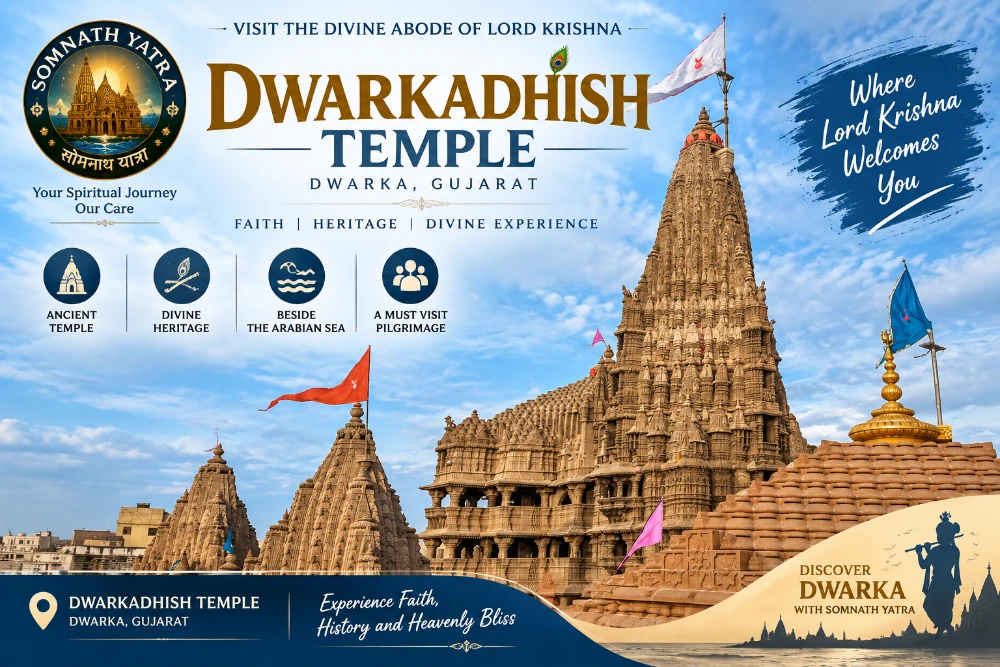
Dwarkadhish Temple in Dwarka, Gujarat with traditional architecture and temple flags
Gujarat Travels

Dwarkadhish Temple, Dwarka – Complete Pilgrimage Guide

05/09/2026 adminsy 13 min read

Dwarkadhish Temple – Darshan Timings, Aarti, History & Guide

One of the four Char Dham pilgrimage sites. A seven-storey temple rising 78.3 meters above the Arabian Sea. A 50-metre flag visible from miles away. And a tradition of worship that stretches back 2,500 years. The Dwarkadhish Temple—also known as Jagat Mandir, the “World Temple”—is the spiritual heart of Dwarka, Gujarat. Dedicated to Lord Krishna in his majestic form as the “King of Dwarka,” this temple isn’t just a place of worship. It’s where mythology, archaeology, and coastal scenery genuinely converge. Different energy entirely. For pilgrims, a visit to Dwarka completes the Char Dham circuit alongside Somnath Temple, Badrinath, and Rameshwar. For historians, it’s a window into Krishna’s legendary kingdom. For first-time visitors, it’s the kind of place that makes you stand at the entrance and stare. The carved pillars. The towering shikhara. The sound of bells mixing with sea wind. Here’s everything—timings, aarti schedule, history, and a few logistics most guides overlook.

History & Scriptural Legend

According to the Skanda Purana, Vishnu Purana, and Srimad Bhagavatam, Lord Krishna established Dwarka after leaving Mathura. To escape the frequent attacks of Jarasandha, Krishna chose the western coast of India and built a magnificent city—described in texts as a prosperous capital of golden palaces and advanced infrastructure, designed by the divine architect Vishwakarma. After Krishna left his earthly form, folklore says the Arabian Sea swallowed the original city, leaving behind only its sacred memories. The temple was first constructed by King Vajranabha, Krishna’s great-grandson, over the Lord’s residential palace (Hari-griha). Archaeological findings trace the foundations back 2,000-2,200 years. The current structure? Mostly 15th-16th century, expanded under the Chaulukya dynasty. Over centuries, the temple survived wars, natural calamities, and coastal erosion. Each restoration preserved the sanctity while adding layers of architectural detail. The result is what you see today—a living temple where ancient rituals continue in a structure that blends multiple historical periods. Unlike many other Krishna temples, Dwarkadhish follows the Pushtimarg tradition, established by Vallabhacharya and Vitheleshnath. This tradition emphasizes the soulful service of Lord Krishna—dressing the deity in royal attire, offering elaborate bhog, and celebrating every moment of the Lord’s divine routine. The atmosphere is one of joyful devotion, not solemn reverence. Different mood entirely.

Architecture – The World Temple

The Dwarkadhish Temple follows the Maru-Gurjara (Chalukya) architectural style. Five storeys rise on 72 intricately carved limestone pillars. The towering shikhara dominates the Dwarka skyline. A 50-metre flag—carrying the sun and moon symbols—flutters atop the spire, changed multiple times daily by priests. The flag symbolizes that Krishna stays with his devotees as long as the sun and moon endure. The flag changing ceremony, known as Dhwajarohan, happens five times a day. Gugali Brahmins climb the 78-meter shikhara barefoot to replace the flag—a breathtaking, gravity-defying spectacle that most visitors never think to watch. If you’re in the temple courtyard during the change, look up. It’s worth every second. Families can even sponsor the Dhwajarohan ritual through the temple trust, though bookings often stretch years in advance. Even if you can’t sponsor it, watching the climb is free and unforgettable. Two ceremonial gates frame the visit. Swarga Dwara (Heaven Gate) is where pilgrims enter. Moksha Dwara (Liberation Gate) leads out toward the Gomti Ghat, where devotees take a ritual bath in the sacred river before or after darshan. The temple complex also houses a memorial to Adi Shankaracharya, the 8th-century philosopher who established the Char Dham pilgrimage circuit. He visited Dwarka and marked it as one of the four sacred sites. His memorial inside the complex honors that historic journey. The sanctum sanctorum houses the black marble idol of Lord Krishna as Dwarkadhish—dressed in royal attire, adorned with jewelry, and attended by priests throughout the day. Unlike the childhood form of Krishna (Bal Krishna), this is the royal, ruling King of Dwarka. Eternal. Majestic. The kind of presence that makes you forget about your phone.

Darshan Timings (2026)

The temple operates in two sessions. The afternoon closure catches first-time visitors off guard. If you arrive at 2 PM expecting to walk straight in, you’ll wait outside a closed gate. Plan around this.
Session Timing Notes
Morning Darshan 6:30 AM – 1:00 PM Starts after Mangala Aarti. Calmest before 8:30 AM.
Afternoon Closed (1:00 PM – 5:00 PM) Temple shut for rest and cleaning.
Evening Darshan 5:00 PM – 9:30 PM Ends after Shayan Aarti. Most atmospheric.
Entry fee: Free for all devotees. No VIP darshan lane exists—despite what third-party portals claim. Do not pay any private agent for “guaranteed fast-track entry.” General darshan is open to everyone. Best time for peaceful darshan: Weekday morning, right after 6:30 AM Mangala Aarti. Arrive 20-30 minutes early. The crowd is thin. The light is soft. The experience is intimate. Weekends and festival days are significantly busier.

Aarti Schedule – 6 Daily Rituals

The temple performs six aartis every day. Each marks a specific moment in the Lord’s divine routine—from waking in the morning to being put to rest at night. Attending at least one aarti, especially the Sandhya (evening) Aarti, is considered the most important spiritual experience of any Dwarka visit.
Aarti Time Significance
Mangala Aarti 6:30 AM First aarti. Auspicious morning awakening of the Lord. Calmest crowd.
Shringar Aarti 7:30 AM Decoration and adornment. The Lord is dressed for the day.
Gwal Aarti 10:30 AM Mid-morning offering. The Lord prepares to go to the cowshed.
Rajbhog Aarti 12:00 PM Grand midday offering. The royal meal is presented.
Sandhya Aarti 7:00 PM Evening aarti at dusk. Most attended. Most spectacular. Bells, oil lamps, bhajans.
Shayan Aarti 8:30 PM Final aarti. The Lord is put to rest for the night. Temple closes after this.
Insider tip: Arrive 30 minutes before aarti time for a good position. The Sandhya Aarti at 7:00 PM draws the biggest crowds. If you want a calmer experience, the Mangala Aarti at 6:30 AM is the slot. Different energy. Both valid.

Daily Rituals – The Lord’s Routine

The Pushtimarg traditions dictate the temple’s daily rhythm. The idol of Dwarkadhish is dressed in royal attire, and the atmosphere is one of joyful devotion. Here’s what happens throughout the day:
Time Ritual What Happens
6:30 AM Mangla Aarti First prayers. Lord is woken. Temple opens.
7:00-8:00 AM Mangla Darshan General darshan begins.
8:00-9:00 AM Abhishek Pooja Ritual bathing with milk, honey, water. Darshan paused.
9:00-9:30 AM Shringar Darshan Lord is adorned with ornaments and clothes.
9:30-9:45 AM Snanbhog Food offering. Darshan paused.
9:45-10:15 AM Shringar Darshan General darshan resumes.
10:15-10:30 AM Shringarbhog Food offering. Darshan paused.
10:30-10:45 AM Shringar Aarti Decoration aarti.
11:05-11:20 AM Gwal Bhog Cowherd offering. Darshan paused.
11:20 AM-12:00 PM Darshan Open General darshan.
12:00-12:20 PM Rajbhog Royal meal offered. Darshan paused.
12:20-1:00 PM Darshan Open Final morning darshan.
1:00 PM Anosar Temple closes for afternoon.
5:00 PM Uthappan Lord wakes. Evening darshan begins.
7:00 PM Sandhya Aarti Evening aarti. Most attended.
8:30 PM Shayan Aarti Final aarti. Lord rests.
9:30 PM Temple Closes All darshan ends.
Note: Darshan pauses briefly during each aarti and bhog offering. If you’re in the queue when a darshan-closed period begins, you’ll need to wait. Plan your arrival to avoid these pauses—or embrace them as part of the experience.

Major Festivals

Janmashtami – Krishna’s Birthday

The biggest event. The temple remains open throughout the night. The midnight Abhishek ceremony is the main event—ritual bathing of the deity at the stroke of midnight. Over 5 lakh devotees flood into Dwarka. The entire city buzzes with energy. Different atmosphere entirely. If you’re planning a Janmashtami visit, book accommodation weeks in advance. The crowds are enormous. The experience is unforgettable. Worth every minute of the chaos.

Holi – Festival of Colors

Celebrated with Tulsi leaves. The temple courtyard fills with colors, music, and the kind of energy that makes you want to join in. The Pushtimarg tradition adds a unique flavor—devotees offer Tulsi (holy basil) along with colors. Different from the water-holi of North India.

Diwali & Annakut

During the five days of Diwali, the temple stays decked out with lamps that are never put off. The Annakut festival—the day after Diwali—sees the temple decorated with mountains of food offerings (56 dishes) to the Lord. The visual spectacle is extraordinary. Thousands of lamps. Mountains of prasad. The kind of celebration that makes you forget about sleep.

Best Time to Visit

Season Months Experience
Winter October – March Best time. Pleasant 18-28°C. Ideal for darshan and sightseeing.
Summer April – June Hot (35-42°C). Coastal humidity. Start early morning.
Monsoon July – September Scenic coastal views, occasional rain. Sudarshan Setu remains accessible.

How to Reach Dwarkadhish Temple

From Distance Time
Dwarka city centre Walking distance 5-10 minutes from Gomti Ghat
Somnath 230 km 4-4.5 hours by car
Rajkot 220 km 4 hours by car
Ahmedabad 470 km 8-9 hours by car
Veraval 235 km 4.5 hours by car
Okha (Sudarshan Setu to Bet Dwarka) 30 km 45 minutes by car
By air: Nearest airport is Rajkot (220 km). Ahmedabad airport (470 km) is the international hub. Okha has a small airstrip with limited flights. By train: Dwarka Junction is well-connected to Ahmedabad, Rajkot, and Somnath. Direct trains available. From the station, hire an auto to the temple (2-3 km). By road: Well-connected from Somnath (230 km), Rajkot (220 km), and Ahmedabad (470 km). Veraval to Dwarka car rental covers the 235 km route in 4.5 hours. Veraval to Ahmedabad car rental passes through Rajkot and can include a Dwarka stop.

Nearby Temples & Attractions

Attraction Distance Time Needed
Nageshwar Jyotirlinga 17 km 1-2 hours
Bet Dwarka (Krishna’s residence) 30 km via Sudarshan Setu 3-4 hours
Rukmini Devi Temple 2 km 30 minutes
Sudama Setu (Bridge) 1 km 30 minutes
Gomti Ghat Walking distance 1 hour
Bhadkeshwar Mahadev Temple 1 km 30 minutes (low tide only)
ISKCON Temple Dwarka 2 km 1 hour
Gopi Talav 20 km 30 minutes
Shivrajpur Beach 13 km 1-2 hours

Rukmini Devi Temple – Why You Must Visit

According to local tradition, a pilgrimage to Dwarkadhish is considered incomplete unless the devotee also visits the Rukmini Devi Temple, just 2 km away. This isn’t optional cultural context—it’s a pilgrimage rule taken seriously by the faithful. The temple houses an 8th-century idol of Rukmini, Krishna’s chief queen, in a simple but beautiful Maru-Gurjara style structure. The legend explains why she lives apart from Krishna. Sage Durvasa, known for his volatile temper, once visited Krishna and Rukmini. When Rukmini offered water to wash the sage’s feet instead of offering it directly to drink, Durvasa flew into a rage and cursed her: she would live separated from Krishna. The curse also turned the Gomti river water salty. That’s why the Gomti Ghat water near the temple tastes different from other river water in Gujarat. It’s mythology explaining real geography. Different energy entirely. Practical tip: Visit Rukmini Temple before Bet Dwarka. It’s on the way. The temple is small but the architecture is detailed. Allow 30 minutes. The curse story adds a layer of meaning to the entire Dwarka experience. One-day itinerary tip: Mangla Aarti at 6:30 AM → Gomti Ghat snan → Sudama Setu walk → Nageshwar Jyotirlinga (17 km) → Bet Dwarka via Sudarshan Setu bridge → Return for Sandhya Aarti at 7:00 PM. Pack the day. Different experience entirely.

Tips & Rules

Do’s: Arrive 20-30 minutes before Mangla or Sandhya Aarti. Carry water during summer. Wear appropriate clothing (see dress code below). Remove shoes at the entrance. Use the separate queue for senior citizens if needed. Take a ritual bath at Gomti Ghat before darshan. Don’ts: Don’t photograph inside the main sanctum. Don’t assume the temple is open in the afternoon—it’s not. Don’t pay third-party agents for “VIP darshan”—it doesn’t exist. Don’t rush. This is a temple, not a train station. Security bans — read this before you go: The Swarga Dwara security check is strict. Mobile phones, smartwatches, and ALL leather items (including men’s leather belts, wallets, and leather watch straps) are banned inside the temple. If you wear a leather belt, you’ll be forced to remove it at the gate and walk back to the cloakroom. The cloakroom queue outside can be chaotic. Best strategy: Leave your phone and leather wallet at your hotel. Carry only cash and temple offerings in a cloth bag. If you must bring a phone, be prepared for a 15-20 minute cloakroom wait. Dress code: The temple strictly enforces dress standards. No shorts for anyone (including men and children). No sleeveless tops. No ripped jeans. Men in shorts will be denied entry at the gate. Women are encouraged to carry a dupatta to cover their shoulders (not strictly mandated for head covering, but appreciated). Cotton kurtas, full-length pants, and salwar kameez are the safest choices. Accessibility: Separate queue arrangements for senior citizens during peak hours. Wheelchair assistance available on request. Drop-off points near the temple entrance. Early morning darshan is recommended for elderly visitors.

Frequently Asked Questions

What are the Dwarkadhish Temple timings?

Morning darshan: 6:30 AM to 1:00 PM. Evening darshan: 5:00 PM to 9:30 PM. The temple is closed in the afternoon between 1:00 PM and 5:00 PM. Timings can shift on festival days—confirm on the official website before visiting.

Is there an entry fee for Dwarkadhish Temple?

No. General darshan is completely free for all devotees. The temple does not run an official VIP darshan lane. Only optional seva and bhog offerings involve a contribution, booked through the official website. Do not pay third-party portals for “fast-track entry.”

What time is the Sandhya Aarti at Dwarkadhish Temple?

The Sandhya (evening) Aarti is at 7:00 PM. This is the most attended and most atmospheric aarti. Arrive 30 minutes early for a good position. The Shayan Aarti at 8:30 PM is the final aarti of the day.

Is the temple open during Janmashtami?

Yes. During Janmashtami, the temple remains open throughout the night. The midnight Abhishek ceremony is the main event. Over 5 lakh devotees visit. Book accommodation weeks in advance. The crowds are enormous. The experience is unforgettable.

How old is the Dwarkadhish Temple?

The original temple was constructed by King Vajranabha, Krishna’s great-grandson, approximately 2,500 years ago. Archaeological findings trace the foundations back 2,000-2,200 years. The current structure dates largely to the 15th-16th century.

Is photography allowed inside the temple?

No. Photography is not allowed inside the main sanctum. You can photograph the exterior architecture and the temple complex. Respect the restriction—it’s a place of worship, not a photo studio.

What is the difference between Dwarkadhish and Jagat Mandir?

They refer to the same structure. “Dwarkadhish” is the deity—the King of Dwarka. “Jagat Mandir” is the name of the temple complex—meaning “World Temple.” Both names are used interchangeably.

Should I visit Bet Dwarka along with the main temple?

Yes. Bet Dwarka (30 km) is believed to be Krishna’s actual residence, while the main temple was his court. Since February 2024, the Sudarshan Setu—India’s longest cable-stayed bridge (2.32 km)—connects Okha mainland directly to Bet Dwarka island. You can now drive your taxi onto Bet Dwarka 24/7. No ferry needed. The old ferry service still operates as an optional, nostalgic experience, but the bridge has made the island fully accessible year-round, including during monsoon when seas were previously rough.

Are there special arrangements for senior citizens?

Yes. Separate queue arrangements for senior citizens during peak hours. Wheelchair assistance available on request. Drop-off points near the temple entrance. Early morning darshan (6:30 AM Mangla Aarti) is recommended for elderly visitors—fewer crowds, calmer atmosphere.

Can I book darshan online?

General darshan is free and cannot be pre-booked—it’s open to everyone. However, you can book seva and bhog offerings online through the official Shree Dwarkadhish Temple Trust website. Avoid third-party portals that charge extra fees for free darshan.
Share:
Written by

adminsy

Content writer at Somnath Yatra — sharing travel guides, heritage stories and local insights from Gujarat.

← Previous Veraval to Ahmedabad Car Rental Next → Sudama Temple Porbandar

Share Your Taxi Experience

We're dedicated to providing reliable taxi services across Gujarat. Your review helps us improve and assists fellow travelers in choosing the right service.

Cab service in Somnath reviews on Google

whatsapp call