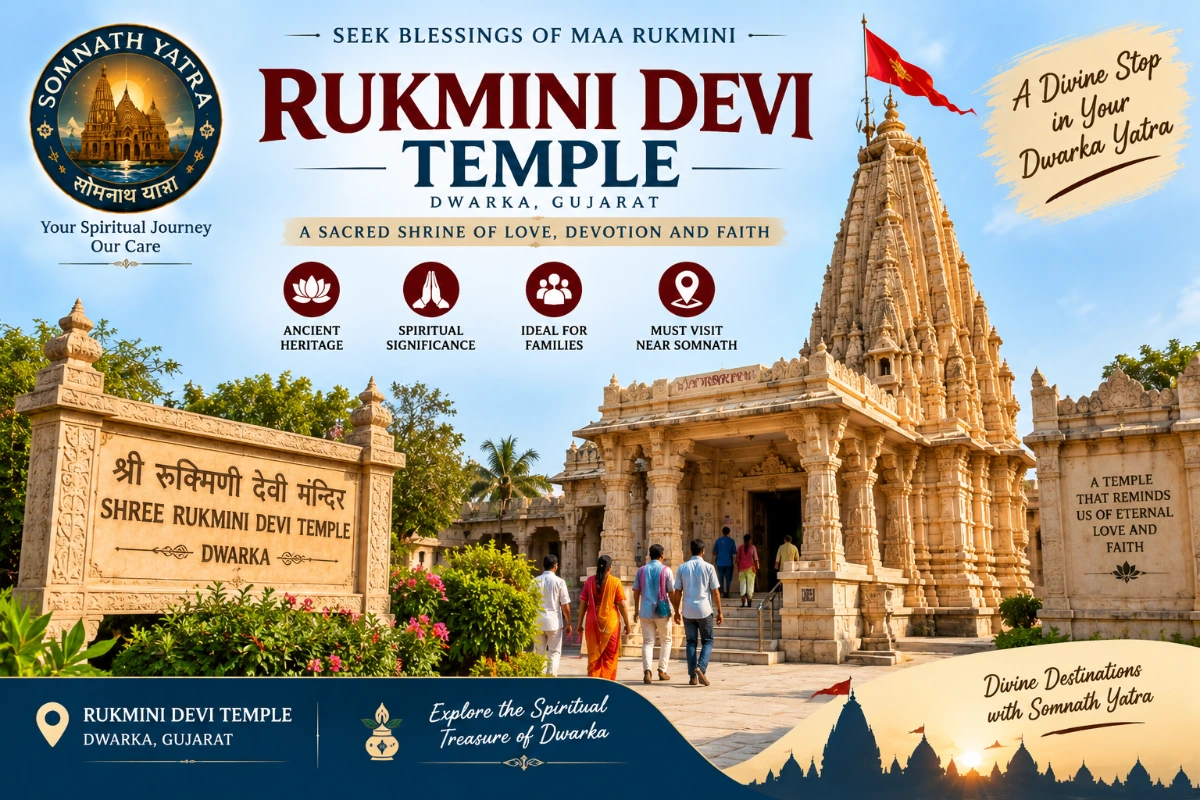
Rukmini Devi Temple, Dwarka – Where Krishna’s Wife Was Cursed by a Sage
Who Was Rukmini – The Princess Who Chose Her Husband
Rukmini was the daughter of King Bhishmaka of Vidarbha. She possessed extraordinary beauty, intelligence, and spiritual wisdom. Despite her father’s approval of a match with Krishna, her brother Rukmi vehemently opposed the marriage. Rukmi arranged her betrothal to Shishupala, a powerful but wicked king who was Krishna’s enemy. Rukmini had fallen in love with Krishna after hearing about his heroic deeds. She sent a secret letter to Krishna—composed of seven shlokas, mentioned in the Bhagavata Purana—pleading with him to rescue her on the wedding day. This letter is popularly referred to as the world’s first love letter. A printed copy of the Rukmini Patra is available at the Dwarkadhish Temple. Every night, before Krishna is put to sleep, the letter is read aloud to the deity. The ritual continues to this day. Krishna, moved by her devotion, arrived in Vidarbha on the wedding day. Rukmini visited the temple of Goddess Parvati before the marriage ceremony. As she emerged, Krishna swept her onto his chariot and eloped with her. A fierce battle followed—Rukmi and allied kings pursued them. Krishna defeated them all. The divine couple was married at Madhavpur Ghed in Gujarat, a location celebrated annually during the Madhavpur Mela festival. Rukmini had first worshipped at an Amba Mata temple to pray for this union. The small Amba Devi shrine still exists within the Rukmini Temple complex today.The Curse of Sage Durvasa – Twelve Years of Separation
Immediately after their wedding, Krishna and Rukmini went to Pindara, a few kilometres from Dwarka, where Sage Durvasa lived in his ashram. Durvasa was the Kul Guru of the Yadus—the family guru. They invited him for a feast at their palace in Dwarka. Durvasa agreed, but on one condition: instead of horses or bulls, Krishna and Rukmini would have to pull his chariot themselves. They agreed. They started pulling the chariot under the scorching sun. After some distance, Rukmini grew desperately thirsty. Krishna pressed his right toe into the earth, and the sacred Ganga water gushed forth from the ground. Rukmini, parched, took a sip without offering water to Durvasa first. Durvasa noticed. His face changed. The entire journey froze. The sage stood up, his eyes burning. In Hindu mythology, you do not eat or drink before a guest—especially not a sage of Durvasa’s temperament. He declared that Rukmini’s inability to honor hospitality would cost her. She would be separated from Krishna. Not temporarily. Not as a test. Separated, as a direct consequence of her devotion being misplaced in priority. Krishna tried to intervene. He begged the sage to revoke the curse. Durvasa refused. The sage was unshakable. But Krishna, being Krishna, found a way around it—not to break the curse, but to make it bearable. He told Rukmini that while they would be separated, he would never truly leave her. The curse had two consequences. First: Rukmini and Krishna would live apart for twelve years. Second: the entire area around Rukmini’s exile would be devoid of sweet drinking water. The land would be barren. The wind would be harsh. And that’s exactly what you see when you arrive—a flat, arid patch of coastal plain, isolated and wind-blasted. The curse isn’t just a story. It’s the landscape.Twelve Years of Meditation at This Exact Spot
According to the Skanda Purana—specifically the Dwaraka Mahatmya—Rukmini spent twelve years at this very location, performing penance and meditation to overcome the curse. She wept. She prayed. She fasted. The sea itself, according to the scripture, came to comfort her with waters full of nectar particles and air perfumed with lotus pollen. The river Ganga, which had sprung from Krishna’s toe, continued to flow here as a gift from the sea to Rukmini. After twelve years of persistent penance, Rukmini attained the first Purusha—Vishnu himself—as her own. The curse lifted. She was reunited with Krishna. The temple marks the exact spot where she performed that penance. The barren, rocky land around the temple is a physical reminder of those twelve years—no vegetation, no sweet water, just stone and wind and endurance.Architecture – Nagara Style with Wind-Eroded Carvings
The Rukmini Devi Temple is a classic example of Nagara style architecture, adapted to the Western Indian Gujarat vernacular. The current stone structure dates to the 12th century CE—contemporaneous with the main Dwarkadhish Temple—though tradition places the shrine’s origins far earlier, possibly to the Mahabharata era. Archaeological evidence and temple records suggest the structure was erected during the transition from the Maitraka dynasty to the Solanki period. But prepare yourself for what the temple actually looks like. Because it sits alone on the flat coastal plains, it has been blasted by salty sea winds for centuries. The exterior carvings are heavily eroded and weather-beaten. The stone is worn smooth in places, almost melted-looking. The structure has a haunting, time-worn appearance that looks drastically different from the highly maintained Dwarkadhish Temple. This isn’t a polished monument. It’s a survivor. The erosion is the story—centuries of wind and salt air wearing down something that was never meant to be pretty. It was meant to endure.Exterior Carvings & Sculptures
The exterior walls carry elaborate sculptures depicting various Hindu deities, celestial beings, mythological scenes, and intricate geometric patterns. At the base of the tower, beautifully carved naratharas (human figures) and gajatharas (elephants) are depicted in detailed relief panels. The carvings showcase the exceptional skill of medieval artisans—despite centuries of wind erosion, the detail remains visible. Visitors should observe the exterior walls for depictions of the Astha Lakshmi—the eight forms of Goddess Lakshmi—reinforcing the theological connection that Rukmini is the earthly avatar of Lakshmi. The lintel above the main entrance features a carving of Garuda (Vishnu’s mount) paying obeisance to the divine couple.The Sanctum – Rukmini’s Marble Idol
The inner sanctum houses a stunning marble idol of Goddess Rukmini, depicted with four arms holding the Shankha (conch), Chakra (discus), Gada (mace), and Padma (lotus)—symbols representing divine power, protection, strength, and purity. She is adorned with gold jewellery and intricate clothing that changes with festivals and seasons. The goddess is honored with the title Raj Rajeshwari—Queen of Queens. Painted walls inside narrate scenes from the story of Krishna and Rukmini—the elopement, the marriage at Madhavpur, the Durvasa incident. Many visitors linger to take in the visual storytelling. The mandapa (pillared hall) features a unique domed roof and square latticed windows—an unusual characteristic for Nagara-style architecture that allows natural light to filter through.The Amba Devi Shrine
Within the temple complex, a small shrine dedicated to Amba Mata (Goddess Parvati) exists. This is the same temple where Rukmini worshipped before her elopement with Krishna. She prayed to Amba Mata to grant her wish of becoming Krishna’s wife. The shrine connects the temple to Rukmini’s origin story—her devotion wasn’t just to Krishna, but to the divine feminine that blessed their union.Jal Daan – The Water Donation Ritual
Here’s what catches most tourists off guard. When you enter the temple, priests will approach you and ask you to perform Jal Daan—a water donation. This isn’t a standard temple scam. It’s a direct response to Durvasa’s curse. The curse decreed that the area around Rukmini’s exile would have no sweet drinking water. For centuries, this region has relied on donated water. When you give money for Jal Daan, you’re funding the distribution of sweet drinking water to pilgrims and locals. The priest will explain this. The donation is voluntary. But understanding the mythology behind it—that you’re literally counteracting a sage’s curse—makes the request feel different. You’re not being fleeced. You’re participating in a 2,500-year-old tradition of remediation. Water is the main prasad here. Unlike most temples where prasad consists of food items like sweets or fruits, the primary prasad at Rukmini Devi Temple is water—pure drinking water that has been offered to the goddess. After your Jal Daan, you’ll receive blessed water back. It’s a cycle: you bring water, offer it to Rukmini, and receive it back as divine blessing. When planning your visit, remember to bring along fresh drinking water to offer to the deity. Typical Jal Daan contributions range from ₹50 to ₹500. The money goes directly to water distribution. There’s no receipt, no formalities. Just a priest, a brass pot, and a story that makes the donation meaningful.Darshan, Aarti & Timings
The temple follows the standard Panchakala (five daily rituals) method of Vaishnav worship:| Ritual | Timing | Description |
|---|---|---|
| Mangala Aarti | 5:00 AM | First prayer of the day, pre-dawn |
| Morning Darshan | 6:00 AM – 12:00 PM | Open for devotees, Abhishekam performed |
| Rajbhog Aarti | 12:00 PM | Midday offering, temple closes after |
| Midday Break | 12:00 PM – 4:00 PM | Temple closed (rest period) |
| Sandhya Aarti | 7:30 PM | Evening prayer with lamps and conch |
| Evening Darshan | 4:00 PM – 9:00 PM | Open for devotees until closing |
The Dwarka Pilgrimage Sequence
The vast majority of pilgrims follow this exact sequence when visiting Dwarka’s temples:| Order | Temple | Distance | Time Needed |
|---|---|---|---|
| 1 | Dwarkadhish Temple (Main Dwarka) | Start | 1.5-2 hours |
| 2 | Nageshwar Jyotirlinga (en route to Okha) | 17 km north | 1 hour |
| 3 | Bet Dwarka (Island Temple, ferry from Okha) | 30 km north | 2-3 hours |
| 4 | Rukmini Devi Temple (on the return trip) | 2-3 km from Dwarka | 30-45 minutes |
Festivals & Annual Events
| Festival | Date (2026) | Significance |
|---|---|---|
| Vaikuntha Ekadashi | January 10 | Special midnight aarti, temple stays open all night |
| Rukmini Ashtami | May 15 | Birth anniversary of Rukmini—the most significant day |
| Janmashtami | August 14 | Krishna’s birthday, celebrated with great fervor |
| Rukmini Vivah | March (varies) | Reenactment of Krishna-Rukmini wedding, procession from Dwarkadhish |
| Diwali (Annakut) | October 21 | Symbolic reunion of the divine couple |
How to Reach Rukmini Devi Temple
| From | Distance | Time |
|---|---|---|
| Dwarkadhish Temple | 2-3 km | 10 minutes by auto |
| Dwarka Railway Station | 5 km | 15 minutes by auto |
| Okha (Bet Dwarka Ferry) | 30 km | 45 minutes by car |
| Jamnagar Airport | 137 km | 3 hours by car |
| Porbandar | 104 km | 2 hours by car |
Nearby Attractions
| Attraction | Distance | Time Needed |
|---|---|---|
| Dwarkadhish Temple | 2-3 km | 1.5-2 hours |
| Nageshwar Jyotirlinga | 17 km | 1 hour |
| Bet Dwarka (Island Temple) | 30 km (ferry) | 2-3 hours |
| Gomti Ghat | 3 km | 30 minutes |
| Sudama Setu (Bridge) | 3 km | 30 minutes |
| Bhadkeshwar Mahadev Temple | 3 km | 30 minutes |
| Shivrajpur Beach | 10 km | 1-2 hours |


