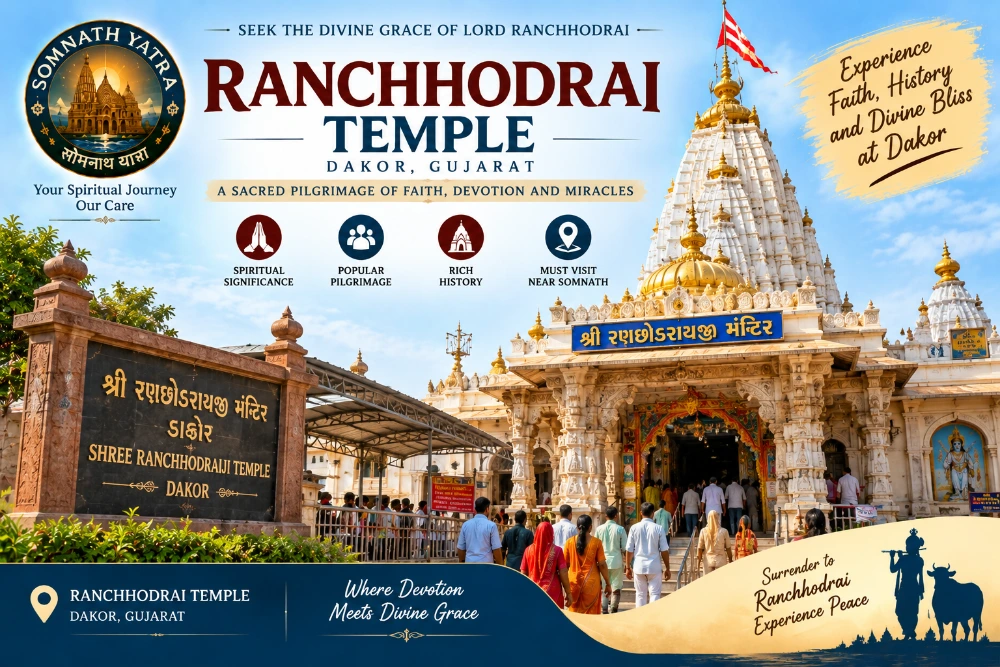
Ranchhodrai Temple, Dakor – Where Krishna Himself Came on a Bullock Cart
One temple where Lord Krishna himself chose to leave Dwarka. Not because of an enemy. Not because of a curse. Because a devotee called him. Ranchhodrai Temple in Dakor, Gujarat, stands as the only major Krishna temple where the deity reportedly arrived on a bullock cart driven by the Lord himself. The black touchstone idol, one metre tall, arrived from Dwarka in the 16th century through the devotion of a simple man named Bodana. Today, this temple draws millions of devotees every year, especially during festivals, and remains the tallest temple in Kheda district with its eight domes and twenty-four turrets rising above the Gomti Lake.
For pilgrims on the Gujarat temple circuit, Dakor sits between Ahmedabad and Vadodara—43 km from Anand, 35 km from Nadiad. The temple complex, built in 1772 by Gopalrao Jagannath Tambwekar at the cost of one lakh rupees, rises on a high plinth of 168 feet by 151 feet. Twelve stone steps lead up from each side. Silver gates carved with Vedic gods face the Gomti Lake. Inside, the Lord sits under a golden-pillared pavilion, accessible to devotees through doors that remain open most of the day.
The Legend – How Krishna Came to Dakor
The story begins in the Mahabharata era. Dakor was then a dense jungle called Hidamba Van, rich with streams and lakes. Sages came here for penance. Among them was Dank Rishi, whose ashram stood in this forest. Pleased with his devotion, Lord Shiva agreed to stay permanently in the form of a Shivling—the Danknath Mahadev. The town took its name from this deity: Dankpur, later becoming Dakor.
But the Vaishnavite transformation came through Bodana Vijayanand, a devotee who was believed to be a childhood friend of Krishna in his previous birth. Bodana grew tulsi plants and regularly walked to Dwarka to offer them to the Lord. He made the journey on foot, carrying nothing but tulsi leaves and unwavering devotion.
One night, Lord Krishna appeared in Bodana’s dream. The Lord said he wished to leave Dwarka and come to Dakor with his beloved devotee. He asked Bodana to bring a bullock cart to the Dwarka temple at midnight.
Bodana obeyed. At midnight, Krishna broke open the doors of the sanctum, woke Bodana, and asked him to load the idol onto the cart. Krishna himself took the reins and drove the cart southward toward Dakor. Along the way, the Lord touched a branch of a neem tree. Since that day, that one branch bears sweet leaves while all others remain bitter—a detail immortalized in Gujarati devotional songs.
When the Gugli brahmins of Dwarka discovered the missing idol, they chased Bodana to Dakor. Krishna instructed Bodana to hide the idol in the Gomti tank and meet the priests. Bodana hid the idol and went to pacify the Guglis with a pot of curd. They attacked him with a spear. Bodana fell dead. The spear also struck the hidden idol, and the tank water turned red with divine blood. Even today, the earth where the idol lay remains red while the rest of the Gomti tank is brown mud.
The Guglis refused to leave. They sat on the tank bank and began a hunger strike, demanding Krishna’s return. Finally, Krishna instructed Bodana’s widow, Gangabai, to offer gold equal to the idol’s weight. The poor widow had nothing—only a golden nose-ring weighing 1.5 grams. When placed on the scale, it proved heavier than the idol. The Guglis accepted and returned to Dwarka, where Krishna promised another idol would appear in six months.
Since then, Ranchhodrai—the Lord who left the battlefield—has remained in Dakor.
Architecture – 8 Domes, 24 Turrets, and a Golden Pavilion
The current temple was built in 1772 AD by Shri Gopalrao Jagannath Tambwekar, a descendant of the original court official who received the deity. Constructed with brick walls and stone pillars, the temple sits on a raised plinth of 168 feet by 151 feet, surrounded by a spacious courtyard.
The Exterior
The main gate overlooks the Gomti Lake. Silver gates are carved with depictions of Lord Ganesha, Surya, Chandra, and other Vedic gods. Above the gate sits the Nagarkhana—a music room where shehnai and drums are played every three hours during darshan and aarti times. Drummers sit in their own balcony atop the entrance, a tradition maintained by descendants of the original builder.
The temple’s eight domes and twenty-four turrets make it the tallest in Kheda district. The central dome reaches 27 metres (90 feet), crowned with a golden kalash and a white silken flag. The exterior shows Maharashtrian architectural influence in its cupolas, while the overall layout follows medieval Gujarati temple traditions.
Two tall multi-storied lamp towers stand on either side of the inner courtyard. During festivals, thousands of oil lights are housed in these structures—a sight unique to this temple.
The Jagmohan – Audience Chamber
Marble stairs lead to the Jagmohan, the main audience hall. The name literally means “the place where the world is charmed by the beauty of the Lord.” Three large entrances open from three cardinal points. The square chamber is surmounted by an imposing dome, recently decorated with intricate mirror work depicting flowers and trellis in a classical Rajput garden style. Previously, the dome was painted with Krishna’s rasa-lila in the Bundi style. Painted murals depicting scenes from Krishna’s life adorn the walls. A small section at the front is railed off and reserved for women.
The Inner Sanctum
The sanctum sits in a straight line from the main gate, following classical temple principles. The Lord stands under a canopied pavilion on a marble platform, his pillars covered in gold. The intricately carved doors and windows are sheathed in silver and gold.
Three doors lead into the sanctum:
- Right door – Connects to the antechamber and a special bathing room where priests must ritualistically bathe before entering. Corridors from here lead to the treasure house, housing the Lord’s countless jewels and clothes.
- Front door – Faces the main audience chamber. This remains open most of the day. Unlike many temples where the sanctum opens briefly, at Dakor the Lord spends maximum time with his devotees. The doors only close when the Lord sleeps—in the afternoon and at night.
- Left door – Leads to the Lord’s bedchamber, a mirrored chamber with silver and gold bedsteads covered in cottons and silks. Perfumes and garlands are kept in readiness. A corridor leads from here to the open hall behind the bedchamber where pilgrims perform religious rituals.
The main idol is carved from black touchstone, standing one metre tall and forty-five centimetres broad. Richly adorned with gold, jewels, and expensive clothing, the four-armed Lord holds the conch, lotus, discus, and mace. The lower right hand is held up in abhaya mudra—the gesture of protection. During festivals, golden gloves studded with gems encase the Lord’s arms.
The throne—a masterpiece of woodcarving plated in silver and gold—was presented by the Gaekwad of Baroda.
The Tulsi Ritual: Because Bodana won the Lord’s heart through tulsi devotion, devotees in the Jagmohan actively throw garlands and loose tulsi leaves toward the sanctum. The priests deftly catch them and offer them to the Lord. This creates a high-energy, slightly chaotic, and joyous atmosphere inside the hall—very different from the solemn quiet of other major temples. If you visit, watch for the moment the tulsi garlands fly through the air. It is a sight unique to Dakor.
The Lakshmi Temple and Friday Procession
Unlike most Krishna temples where the Goddess Lakshmi shrine sits within the complex, at Dakor, Lakshmi’s temple is located in a residential part of town at a distance from the main temple. This follows the tradition at Badrinath in the Himalayas and Tirupati Balaji in South India.
Every Friday, a courtly procession winds through the lanes and bylanes of Dakor. The Lord travels from the main temple to visit his wife. The entire town turns out to witness this divine reunion—a weekly event that connects the mythology to living practice.
Gomti Lake – Turtles and Faith
The ghats of Gomti Lake are teeming with massive turtles and catfish. Local vendors sell small dough balls (aata) along the steps. Buy a ball, break it into pieces, and feed the turtles—they gather in dozens near the steps, and children absolutely love this. It is a highly engaging, traditional activity that connects visitors to the lake far more deeply than generic boating. The lake also holds the legend of turning red when the deity was hidden here centuries ago.
Darshan Timings (2026)
The temple opens twice daily. Morning session runs from 6:45 AM to 12:00 PM. Evening session from 4:00 PM to 7:30 PM. The temple remains closed between 12:00 PM and 4:00 PM.
Morning Darshans
| Darshan | Timing |
|---|---|
| Mangala Darshan | 6:45 AM – 8:30 AM |
| Bal Bhog, Shringar Bhog & Gwal Bhog | 9:00 AM – 10:30 AM |
| Rajbhog Darshan | 11:30 AM – 12:00 PM |
Evening Darshans
| Darshan | Timing |
|---|---|
| Uthapan Darshan | 4:10 PM – 4:55 PM |
| Shayan Bhog Darshan | 5:25 PM – 6:00 PM |
| Shakhdi Bhog Darshan | 7:00 PM – 7:30 PM |
Entry fee: Free for all devotees. No VIP darshan queue. The temple follows the Pushtimarg tradition established by Vallabhacharya and continued by his grandson Harirayjee Maharaj.
Best time for darshan: Early morning during Mangala Darshan (6:45 AM) when crowds are thin. The Rajbhog Aarti at 11:30 AM is the most atmospheric morning experience. Evening Sandhya Aarti draws the largest crowds.
Note: Darshan timings may change during festivals, Purnima (full moon), and special occasions. Check with temple authorities for exact schedule on Purnima days.
Prasad – The Famous Laddu and Rasmalai
The temple is famous for two types of prasad: Laddu and Rasmalai (also called Rasmalayi). The prasad is offered to the deity and then distributed to devotees. In honor of Gangabai’s devotion, women are granted special access and precedence in offering tulsi and participating in daily rituals—a rarity in orthodox temples.
Street Food & Local Flavors – Dakor na Gota
While Laddu is the official temple prasad, eating Dakor na Gota from the heritage vendors just outside the main gate is a mandatory part of the pilgrimage. Across Gujarat, Dakor is synonymous with these spicy, fluffy, deep-fried fenugreek (methi) fritters served with sweet yogurt. People literally drive two hours from Ahmedabad just to eat hot Gota outside the temple.
The vendors have been here for generations. They set up before dawn and sell out by late morning. The Gota is best eaten fresh and hot, straight from the kadhai, with a generous drizzle of sweet curd and green chutney. Pair it with a cutting chai from the neighboring stall and you have the quintessential Dakor experience—no temple visit complete without it.
Tip: The area around the main gate and the bazaar leading to the temple has several heritage Gota stalls. Ask any local for the oldest vendor—they will point you to the one their grandparents visited.
Festivals and Celebrations
The temple celebrates all major Vaishnavite festivals with grandeur:
| Festival | Significance |
|---|---|
| Sharad Purnima | Night-long celebration with moonlit worship |
| Krishna Janmotsav (Janmashtami) | Krishna’s birthday—the biggest annual event |
| Holi | Celebrated with colors and devotional songs |
| Rathyatra | Grand chariot procession through the town |
| Diwali | Five-day celebration with thousands of lamps |
| Bestu Varsh | Hindu New Year celebrations |
| Annakut Mahotsav | Mountain of food offerings to the Lord |
| Amali Ekadashi | Special fasting and worship |
| Tulsi Vivah | Ceremonial marriage of Tulsi plant to Krishna |
| Dussehra | Victory of good over evil |
| Hindoda | Night-long vigil with devotional singing |
All Ekadashis, Purnimas, and Fridays are considered especially auspicious. Special pujas are performed on these days. The temple also celebrates Navkavihar and Gopalnathji festivals.
How to Reach Dakor
By Rail
Dakor has its own railway station situated 1 km from the temple. The station is connected with trains from different cities across Gujarat.
By Road
Dakor is well connected by highways. Private and ST buses are available from Ahmedabad, Vadodara, and Anand. The temple is located in the main bazaar area.
| From | Distance | Time |
|---|---|---|
| Anand | 43 km | 45 minutes |
| Nadiad | 35 km | 30 minutes |
| Ahmedabad | 91 km | 1.5-2 hours |
| Vadodara | 78 km | 1.5 hours |
| Mumbai | 400 km | 7-8 hours |
By Air
Nearest airport: Vadodara Harni Airport (78 km)
International airport: Sardar Vallabhbhai Patel International Airport, Ahmedabad (91 km)
Taxis and road transport are available from both airports to the temple.
Nearby Places to Visit
| Place | Distance | Why Visit |
|---|---|---|
| Gomti Lake | Adjacent | Sacred lake with turtles and catfish—buy dough balls from vendors and feed them |
| Danknath Mahadev Temple | Within town | Ancient Shiva temple, the original shrine of Dakor |
| Gangabai Temple | Near Gomti Tank | Built at the spot where Bodana’s wife hid the idol |
| Nadiad | 35 km | Birthplace of key figures in India’s independence movement |
| Anand | 43 km | Milk capital of India, Amul factory |
| Vadodara | 78 km | Laxmi Vilas Palace, museums |
Visitor Tips
- Arrive early for Mangala Darshan to avoid crowds
- Wear modest clothing—traditional dress preferred
- Remove footwear at the designated area before entering
- Carry cash for donations, prasad, and street food
- Photography restrictions may apply inside the sanctum—check with temple authorities
- The Friday procession to Lakshmi Temple is worth timing your visit around
- Feed the turtles at Gomti Lake—buy dough balls from vendors on the ghats
- Eat Dakor na Gota from the heritage vendors outside the main gate—it is a mandatory part of the pilgrimage
- Temple maintains a Gaushala with approximately 1,200 cattle—milk is used for the deity’s bhog and distributed free to visitors on Purnima days
- The temple trust is managed by a committee of Vaishnav devotees, not the government
- Avoid Full Moon (Poonam) days unless prepared for extreme crowds and walking several kilometers from parking zones
Frequently Asked Questions
What is the history of Ranchhodrai Temple, Dakor?
The temple was built in 1772 AD by Shri Gopalrao Jagannath Tambwekar. However, the deity’s arrival in Dakor dates back to the Mahabharata era, when Lord Krishna reportedly left Dwarka on a bullock cart driven by himself to be with his devotee Bodana. The original shrine has been expanded over centuries into the current grand complex.
What does “Ranchhod” mean?
“Ranchhod” translates to “one who left the battlefield” (Ran = battle, Chhod = leave). The name refers to Lord Krishna’s act of leaving the battlefield of Kurukshetra to fulfill his promise to his devotee.
What are the Darshan timings at Dakor Temple?
Morning: 6:45 AM to 12:00 PM. Evening: 4:00 PM to 7:30 PM. The temple is closed between 12:00 PM and 4:00 PM. Timings may change during festivals and Purnima days.
Is there an entry fee for Ranchhodrai Temple?
No. Entry is free for all devotees. There is no VIP darshan queue. The temple follows Pushtimarg traditions and accepts voluntary donations.
Why does the Gomti Lake have red earth?
According to legend, when Bodana was killed by the Gugli priests, their spear also struck the idol hidden in the lake, causing the water to turn red. The earth where the idol lay remains red to this day, while the rest of the lake has brown mud.
What prasad is famous at Dakor Temple?
The temple is famous for its Laddu and Rasmalai (Rasmalayi) prasad. In honor of Gangabai’s devotion, women are granted special access and precedence in offering tulsi and participating in daily rituals—a rarity in orthodox temples.
When is the best time to visit Dakor?
October to March is the best time when the weather is pleasant. Janmashtami and Sharad Purnima are the biggest festival occasions. Early morning during Mangala Darshan offers the most peaceful experience.
⚠️ Full Moon (Poonam) Warning: On Purnima days, Dakor experiences a massive influx of pad-yatris (foot pilgrims). Hundreds of thousands walk from Ahmedabad, Nadiad, and Vadodara to the temple. Highways slow to a crawl, the town gets barricaded to vehicular traffic, and darshan queues become intense, shoulder-to-shoulder affairs. Casual tourists, families with small children, and elderly travelers should actively avoid Full Moon days unless specifically prepared for extreme crowds and walking several kilometers from makeshift parking zones.
How do I reach Dakor from Ahmedabad?
Dakor is 91 km from Ahmedabad, taking approximately 1.5-2 hours by road. Direct buses are available from Ahmedabad. Dakor also has its own railway station, 1 km from the temple.
Is there accommodation available near the temple?
Yes. Dakor has several dharamshalas, guest houses, and hotels near the temple complex. The temple trust also maintains facilities for pilgrims.
What is the Friday procession at Dakor?
Every Friday, a courtly procession carries Lord Ranchhodrai from the main temple through the lanes of Dakor to the Lakshmi Temple, where the Lord visits his wife. The entire town turns out to witness this weekly divine reunion.


