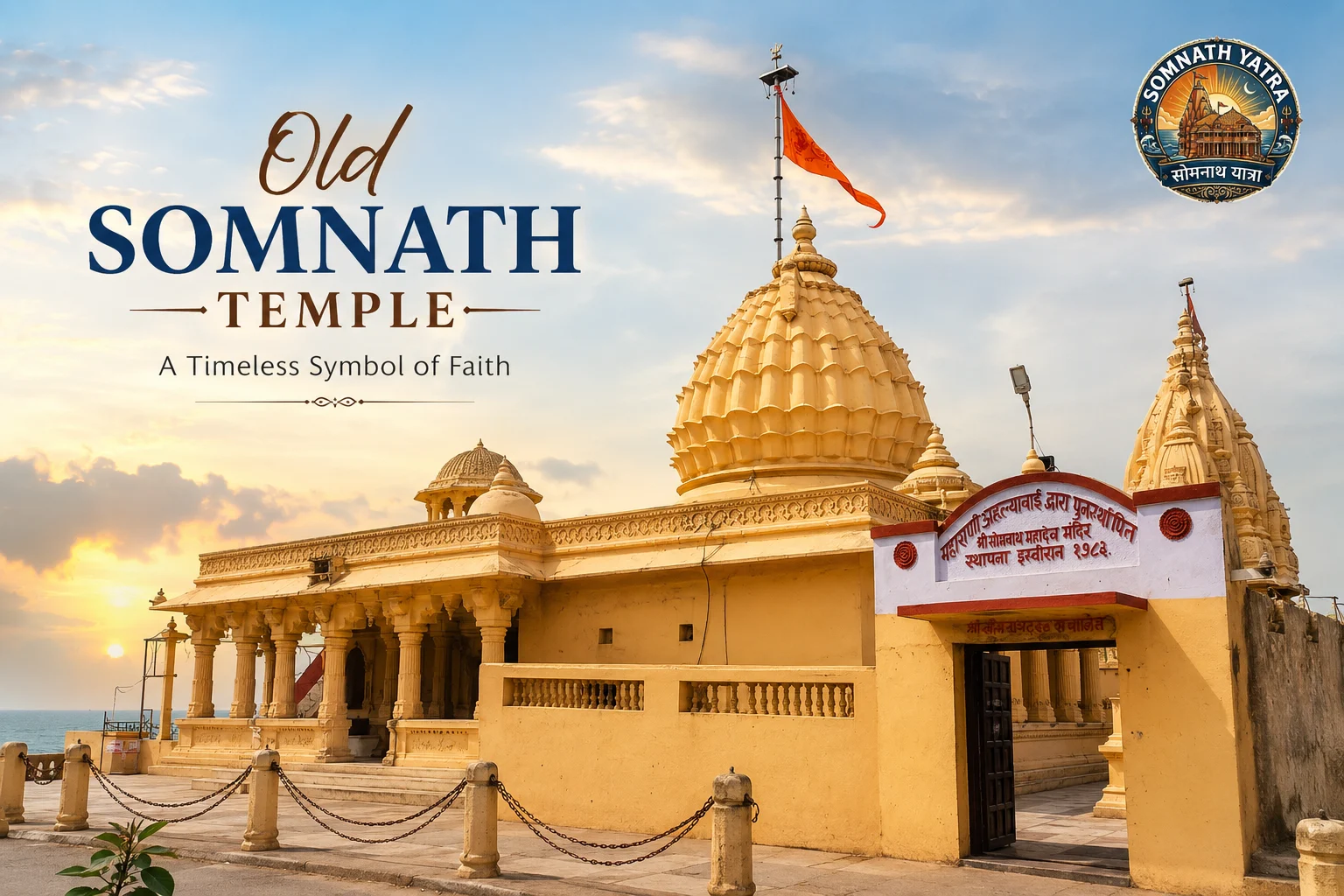
Old Somnath Temple: History, Ruins & Visitor Guide
13/08/2026
adminsy
22 min read
Old Somnath Temple: A Complete Guide to the Original Ruins
Old Somnath Temple has been destroyed seventeen times. Rebuilt seventeen times. That is not a metaphor — it is the documented record of a temple that refuses to stay dead.
Standing on Gujarat’s western coast at Prabhas Patan, where three rivers meet the Arabian Sea, the old Somnath temple predates the Common Era. Its ruins tell a story that no modern structure can replicate. The story of a faith that outlasted empires.
This article is about the old Somnath. Not the reconstructed temple that Sardar Patel inaugurated in 1951 — but the original site. The archaeological remains. The broken sculptures. The foundations that survived Mahmud of Ghazni, Alauddin Khalji, and Aurangzeb. The old temple lies in fragments beside the new one, and those fragments carry more history per square inch than most museums.
Planning a visit? Understanding the old temple changes the experience entirely. You stop seeing a tourist attraction and start reading a battlefield where architecture, faith, and collision collided for over a thousand years. Our complete guide to visiting Somnath from Ahmedabad covers logistics — this article covers the soul.
Mythological Origins — Why Somnath Is Eternal
“Somnath” — the name translates to “Protector of the Moon.” Not poetic license. Hindu mythology traces the temple’s origin to Chandra, the Moon God, who was cursed by his father-in-law Daksha Prajapati. The curse caused the Moon to lose its luster. Slowly. Inexorably. Fading from the sky until nothing remained.
Desperate to survive, Chandra traveled to Prabhas Patan. He performed intense penance before Lord Shiva — the kind of devotion that makes gods listen. And Shiva, moved by what he saw, partially lifted the curse. The Moon would still wax and wane. But it would never disappear completely.
The Shiv Purana records: “I am present everywhere, but in twelve forms and twelve places as the Jyotirlinga. One of these places is Somnath.” The temple at Prabhas Patan claims the distinction of being the first among these twelve. The foremost. The original.
The sacred spot where Chandra worshipped Shiva sits at the Triveni Sangam — the confluence of the Kapila, Hiran, and Sarasvati rivers. Three rivers converging before meeting the sea. A tirtha. A crossing point between mortal and divine realms. Ancient pilgrims understood the geography as spiritual architecture — the land itself arranged for worship.
What makes this mythology significant for visitors is not the supernatural element. It is the cultural continuity. The Somnath story has been told for over two thousand years — passed through generations of priests, pilgrims, and historians. Whether you accept the mythology literally or view it as allegory, the fact remains: people have been coming to this exact spot to worship Shiva since before the Common Era began.
The Moon’s Curse and Redemption
Daksha’s curse carries layers of meaning that ancient visitors understood immediately. Daksha — one of the Prajapati, lords of creation — had many daughters. Chandra married twenty-seven of them. But he favored Rohini. Above all others. The other wives complained. Their father’s rage manifested as a curse: Chandra would lose his brilliance gradually, fading until he vanished.
Chandra’s choice of Prabhas Patan was not random. The region was already sacred — a place where three rivers converged before meeting the sea. Triveni Sangam. The confluence of Kapila, Hiran, and Sarasvati. This was a tirtha: a crossing point between mortal and divine realms. Chandra chose the most powerful spiritual location he could find.
The partial lifting of the curse — allowing the Moon to wax and wane rather than vanish — became the theological foundation for Somnath’s permanence. The temple was not merely a building. It was the physical manifestation of Shiva’s promise. A promise that the Moon, and by extension the devotees who worshipped there, would never be abandoned.
Gold, Silver, Sandalwood, Stone — Four Temples Before History
Temple traditions hold that the current structure is not the first. Not even close. The Shiv Purana and Nandi Upapurana describe four legendary versions of the temple — built before the historical era began:
Yuga
Builder
Material
Significance
Satya Yuga
Chandra (Moon God)
Gold
Original temple — gratitude for curse being lifted
Treta Yuga
Ravana
Silver
Built after being blessed by Shiva on Mount Kailash
Dwapara Yuga
Lord Krishna
Sandalwood
Established before the Mahabharata war
Early Historical
Bhimdev I (Solanki)
Stone
First documented stone structure — around 649 AD
Skeptics dismiss these accounts. Historians take a different view. The progression from gold to silver to sandalwood to stone mirrors the actual archaeological pattern found at sacred sites across India — precious materials in earliest phases, durable stone in later ones. Did Ravana literally build a silver temple? Maybe not. That devotees maintained some form of worship at this site for centuries before the Common Era? Archaeologically supported.
The stone temple attributed to Bhimdev I marks the transition from myth to documented history. Bhimdev ruled Gujarat as part of the Solanki dynasty, and his reign saw the construction of a substantial stone structure at Prabhas Patan. This is the temple that would face Mahmud of Ghazni’s armies in 1026 AD. And the ruins that still lie beside the modern reconstruction today.
Understanding these four legendary temples matters because they explain why Somnath held such emotional power for later generations. When Mahmud destroyed the temple in 1026, he was not demolishing a building. He was attacking a site that devotees believed had been continuously sacred since the beginning of time. The fury of the response — the repeated rebuilding despite devastating losses — makes sense only when you understand what Somnath represented: not architecture, but permanence itself.
Ancient History — From Maitraka to Solanki
Mythology gives way to stone around 649 AD. That is when the Maitraka dynasty of Vallabhi built the first documented structure at Somnath — a substantial stone temple that replaced whatever wooden or perishable shrine had stood before. The Maitrakas were Buddhist sympathizers, yet they maintained and patronized the Somnath temple. A telling detail. The site’s importance transcended sectarian boundaries.
In 725 AD, the temple faced its first recorded destruction. Junayad, the Arab governor of Sind, sent armies into Saurashtra and targeted Somnath. The attack was part of a broader campaign, but the choice of temple suggests it was already famous enough to be a strategic target. The Pratihara king Nagabhata II rebuilt the temple around 815 AD — a large red sandstone structure. The third temple at the site. And the one that would stand for two more centuries.
The Temple Before Mahmud: What the Ruins Revealed
Archaeological excavations led by B.K. Thapar in the mid-twentieth century uncovered the remains of what scholars believe was the temple standing at Mahmud’s invasion. The structure was described as a tri-anga sandhara prasada — a temple with three distinct sections connected by an open hall. The garbhagriha (sanctum) linked to a mukhamandapa (entrance hall) and a gudhamandapa (enclosed hall).
The central dome reached over thirty feet in height. Forty feet in diameter. Walls bore intricate carvings — deities, celestial dancers, floral motifs, geometric patterns characteristic of early Chalukya craftsmanship. According to A. Ghosh, a scholar of Indian temple architecture, this structure represented the earliest known version of the Somnath temple, distinguished by its unique three-domed layout. Unusual. Almost experimental.
What the excavations also revealed was the scale of the temple’s wealth. Fragments of gold foil. Precious stone settings. Broken pieces of what must have been an extraordinarily ornate interior. These fragments corroborate the literary accounts that described Somnath as one of the wealthiest temples in medieval India — a fact that made it an irresistible target.
Solanki Dynasty and the Golden Age
The Solanki (Chalukya) dynasty transformed Somnath from a regional shrine into a pan-Indian pilgrimage destination. Ruling Gujarat from the tenth to the thirteenth centuries, the Solankis patronized Maru-Gurjara architecture — a distinctive style characterized by curvilinear shikharas, elaborate ceiling carvings, high plinths, and free-standing kirti toranas. Arched gateways. Sacred thresholds.
Kumarapala, one of the dynasty’s most powerful rulers, rebuilt the temple around 1169 AD. Inscriptions from that period describe the structure adorned with jewels — a showcase for the Sompuras, Gujarat’s master masons whose skills were renowned across the subcontinent. These were not ordinary builders. They developed techniques for carving sandstone that allowed extraordinary detail without compromising structural integrity. Temples that could withstand the coastal climate — salt air, monsoon rains, intense heat — while maintaining delicate surface ornamentation.
During this golden age, Somnath attracted pilgrims from across India and beyond. The 11th-century Persian scholar Al-Biruni, who occasionally accompanied Mahmud of Ghazni’s troops, recorded details about the temple’s wealth. The 14th-century poet Amir Khusrow noted that Gujarati Muslim pilgrims paid their respects at Somnath before departing for the Hajj — a remarkable detail that underscores the temple’s cross-religious significance. Not just a Hindu shrine. A pilgrimage destination that commanded respect across traditions.
Invasions and Destructions — 1,000 Years of Resilience
The history of Somnath cannot be told without confronting its destructions head-on. This temple was attacked, looted, and demolished more times than any other religious site in India. The pattern is consistent: a powerful army arrives, plunders the legendary wealth, desecrates the sanctum, moves on. Local rulers rebuild. The cycle repeats.
Scholars debate the exact number. Six destructions? Seventeen? The discrepancy arises from differing definitions — a partial raid is not the same as total demolition, and a quick repair is not the same as a full reconstruction. What is beyond dispute is the frequency. The severity. And the extraordinary persistence of the rebuilding efforts.
Mahmud of Ghazni (1026 AD) — The Darkest Night
January 1026. Mahmud of Ghazni crossed the Thar Desert with his army and descended on Gujarat. He had already conducted sixteen raids into northwestern India, but Somnath was different. Farther south. Deeper into hostile territory. The desert crossing cost him many soldiers and animals. He came anyway.
The temple’s ruler, Bhima I of the Solanki dynasty, fled rather than face Mahmud’s battle-hardened forces. The defenders — local chieftains and temple priests — fought but were overwhelmed. Historical accounts describe the massacre of over 50,000 people who tried to protect the temple. Mahmud personally hammered the gilded lingam to pieces. The fragments were carted back to Ghazni and incorporated into the steps of the city’s Jamia Masjid — a deliberate act of humiliation. Devotees would walk over the sacred stone every time they entered the mosque.
The looting was systematic. Total. An estimated 20 million dinars in gold, silver, and precious stones. The temple’s treasury — accumulated over centuries of donations from kings, merchants, and pilgrims — emptied in a single night. Caravans carried the wealth northward through the desert. A train of plundered devotion heading toward a Friday mosque in distant Afghanistan.
What makes Mahmud’s raid historically significant is not just the destruction but the narrative it created. For the Hindu side, Somnath became a symbol of sacrilege demanding eventual retribution. For the Muslim world, as historian Jamal Malik documents, Mahmud became “the exemplary hero and Islamic warrior” — his destruction of Somnath celebrated in Persian literature for centuries. Two completely different readings of the same event. Both deeply felt. Both shaping history.
Alauddin Khalji, Aurangzeb, and Others
Mahmud’s attack was the most famous. But it was far from the last. The pattern continued for nearly seven hundred years:
Year
Attacker
What Happened
Aftermath
1026
Mahmud of Ghazni
Total plunder, jyotirlinga destroyed, 20 million dinars looted
Rebuilt by Bhimdev I (1026-1042)
1299
Alauddin Khalji (Ulugh Khan)
Temple sacked during Gujarat invasion, Vaghela king Karna defeated
Rebuilt by Mahipala I (1308)
1395
Zafar Khan
Last governor of Delhi Sultanate in Gujarat, attacked during founding of Gujarat Sultanate
Partial repairs
1451
Mahmud Begada
Sultan of Gujarat sacked the temple
Rebuilt again
1665
Aurangzeb
Orders to destroy temple completely, idol removed
Ahilyabai Holkar built secret underground shrine
1706
Aurangzeb
Final major demolition, temple fell into disuse
Lay in ruins for 200+ years
17 Attacks, 17 Resurrections
The number seventeen appears frequently in accounts of Somnath’s history. Some sources describe seventeen distinct attacks. Others list seventeen rebuildings. The exact count matters less than the pattern. Each destruction followed by reconstruction. Each demolition answered with renewal. The temple became a living metaphor for the Hindu concept of srishti-sthiti-pralaya — creation, preservation, and dissolution. The cosmic cycle that Lord Shiva himself embodies.
When Aurangzeb ordered the final demolition in 1706, he reportedly commanded the foundations be torn up so thoroughly that no one could rebuild. His orders were carried out with brutal efficiency. The grand structure — nearly seven hundred years old — reduced to rubble. For the first time, Somnath lay silent.
But the silence did not last. Devotees continued visiting the ruins, performing puja among the broken stones. The sacred spot where Chandra had worshipped Shiva could not be erased — even if the temple above it had been. This persistence — the refusal to abandon a sacred site regardless of its physical condition — is perhaps the most remarkable aspect of Somnath’s history. Buildings can be destroyed. Faith cannot.
Architecture of the Old Temple
The old Somnath temple — as revealed through archaeological excavations and the surviving fragments beside the modern structure — was a masterpiece of early Chalukya architecture. Its design followed the Maru-Gurjara style. A regional variation of Nagara temple architecture that reached its peak under the Solanki dynasty between the eleventh and thirteenth centuries.
The Maru-Gurjara style is distinguished by several defining features: curvilinear shikharas that rise in layered, tapering formations; heavy ceiling carvings in the mandapa halls; high plinths elevating the temple above its surroundings; free-standing kirti toranas — arched gateways marking sacred thresholds; balconies projecting from multiple sides. These elements combined to create temples that were simultaneously massive and intricate. Buildings that commanded attention from a distance and rewarded close inspection.
Maru-Gurjara Style and Chalukya Craftsmanship
The Sompuras — Gujarat’s hereditary master masons — were the architects behind Somnath’s grandeur. This guild of builders specialized in stone temple construction, and their work defined the visual identity of Gujarat’s sacred landscape. They developed techniques for carving sandstone that allowed extraordinary detail without compromising structural integrity. Temples that could withstand the coastal climate of Saurashtra — salt air, monsoon rains, intense heat — while maintaining delicate surface ornamentation that made them objects of wonder.
The old Somnath temple’s layout followed the standard Maru-Gurjara progression: entrance through a gudhamandapa (enclosed hall), movement through a mukhamandapa (open porch), arrival at the garbhagriha (sanctum sanctorum) where the jyotirlinga was installed. The entire structure opened eastward — aligning the sanctum with the rising sun. A daily connection between solar cycle and Shiva worship. Destruction and renewal, mirrored in the sky each morning.
Archaeological fragments recovered from the site show pillars carved with celestial dancers, panels depicting scenes from the Ramayana, ornate doorways flanked by dvarapalas — guardian figures. The south and southwest sides retain the most surviving artwork. The original stone — distinguishable by its darker color from the lighter stone of the modern reconstruction — still bears the marks of Chalukya chisels. An original Nataraja, though defaced with chopped arms, survives on the south side. Beside it stands a mutilated Nandi, Shiva’s bull, still facing the sanctum across the centuries.
The Baan Stambh and Other Sacred Features
Among the most intriguing features of the Somnath complex is the Baan Stambh — the Arrow Pillar. This stone pillar stands on the sea-protection wall and bears a Sanskrit inscription declaring that there is no land between this point and Antarctica. The claim is geographically accurate. The temple sits at a longitude where the southern ocean stretches unbroken to the Antarctic continent.
Whether the ancient builders understood this through astronomical observation or simply asserted it as a spiritual metaphor — the inscription connects Somnath to planetary scale. Some scholars interpret the pillar as an astronomical marker: a fixed reference point for tracking celestial movements. Others view it as a symbolic statement about the temple’s universal significance. An unbroken line from sacred stone to the earth’s southern extreme. The pillar has become one of Somnath’s most photographed features. A physical link between ancient architecture and vast geography.
The original Somnath temple also featured a gilded lingam — the central sacred object of the sanctum. Historical accounts describe it as a pillar-stone covered in brilliant jewels, illuminated by gem-studded candelabra. When Mahmud destroyed the lingam in 1026, he had it hammered to pieces and transported to Ghazni. The fragments incorporated into the steps of the Jamia Masjid. A deliberate desecration — devotees walking over the sacred stone every time they entered the mosque. The original lingam has never been recovered. The current lingam in the modern temple is a replacement, installed during the 1951 reconstruction.
Ahilyabai Holkar — The Queen Who Protected the Lingam
After Aurangzeb’s final demolition in 1706, the temple lay in ruins for over seventy years. The grand structure — nearly seven hundred years old — gone. Foundations torn up. Sanctum empty. Prabhas Patan, once one of the busiest pilgrimage sites in India, became a place of broken stones and faded memories.
Then, in 1782, Queen Ahilyabai Holkar of Indore arrived at Prabhas Patan. One of the most remarkable rulers in Indian history — a widow who assumed control of the Holkar dynasty after her husband’s death, governing Indore with wisdom and military skill for over thirty years. A devout patron of temples across India, funding reconstruction projects at Varanasi, Nashik, and numerous other sacred sites. Our detailed article on Ahilyabai Holkar covers her full biography — here we focus on what she did at Somnath.
What she found horrified her. The temple in complete disrepair. Ruins scattered across the site. But the sacred spot — the exact location where the jyotirlinga had stood — remained identifiable through oral tradition. Local priests had continued to worship at the site despite the destruction. Faith persisted without architecture.
Ahilyabai’s response was both practical and strategic. Rather than attempting a full reconstruction — which would have attracted hostile forces — she built a small, simple temple adjacent to the ruins. More importantly, she had a new lingam installed in an underground shrine. Protecting it from future attacks. This hidden sanctum allowed worship to continue even as the main temple site lay exposed and vulnerable.
Ahilyabai’s decision to build an underground shrine rather than a visible temple was political intelligence as well as devotion. She understood that a grand reconstruction would invite destruction. By placing the lingam underground, she ensured continuity of worship while minimizing risk. The shrine she built — now known as “Old Somnath” — still exists today.
The Ahilyabai-built shrine occupies a unique position in Somnath’s history. It represents the bridge between the ancient temple and the modern reconstruction — the period when faith persisted without architecture, when worship continued among ruins rather than within walls. For visitors interested in the old Somnath, the Ahilyabai shrine is the most direct physical connection to the pre-modern era. A small stone structure that carried the tradition forward for 165 years until Sardar Patel’s vision became reality.
Her contribution is sometimes overlooked in the larger narrative. The modern temple — the grand Chalukya-style structure drawing millions — is rightly associated with Sardar Patel and K.M. Munshi. But without Ahilyabai’s quiet intervention in 1782, the continuity of worship at Somnath might have been broken entirely. She did not rebuild the temple. She kept the faith alive until rebuilding became possible. Different contributions. Both essential.
Sardar Patel’s Oath and the Modern Reconstruction
November 1947. Just months after India’s independence, Sardar Vallabhbhai Patel — the man who unified 562 princely states into the Indian Union — visited Junagadh in Saurashtra. On the auspicious day of Kartika Pournami, Patel stood among the ruins of the old Somnath temple. Cupped seawater in his hands. Made a public vow.
“I will ensure that Somnath Temple is restored to its former glory.”
Patel’s commitment was not merely religious. For him, Somnath represented something larger — the reassertion of Indian cultural identity after centuries of foreign domination. The temple had been destroyed by invaders and left in ruins during the colonial period. Its reconstruction would signal that independent India was capable of reclaiming its heritage. He enlisted K.M. Munshi — a prominent Gujarati politician and scholar — to lead the project. Munshi became the driving force. Architectural decisions. Fundraising. Political coordination. All of it fell to him.
The reconstruction drew controversy. Some political figures, including Jawaharlal Nehru, objected to what they saw as a communal project. The debate became part of India’s early post-independence politics — the temple’s reconstruction serving as a proxy for larger arguments about secularism and national identity. Despite the opposition, the project moved forward. The Somnath Trust was established. Construction began on the new structure — a Chalukya-style temple designed to echo the architectural tradition of the original.
The new temple — Kailash Mahameru Prasada — was completed in 1951. President Rajendra Prasad performed the linga-pratishthapana in the sanctum. His speech captured the moment: “The power of reconstruction is always greater than the power of destruction.” Words that resonated beyond the temple walls, becoming one of the most quoted statements from India’s early independence era.
The modern temple rises 155 feet from the ground, topped with a 10-ton kalash and a 37-foot flag mast changed three times daily. Its architecture is faithful to the Maru-Gurjara tradition — curvilinear shikhara, elaborate carvings, multiple mandapas — though the construction uses modern techniques alongside traditional stonework. The temple faces west toward the Arabian Sea, and from its highest point, there is no land between Somnath and Antarctica.
How to Visit the Old Somnath Site
The old Somnath temple remains are located within the same complex as the modern temple. No separate ticket. No special permission. The archaeological site is accessible from the main temple courtyard, and informational signage explains the historical layers visible in the surviving stonework.
The Ahilyabai Holkar shrine — the small underground temple built in 1782 — is also accessible within the complex. This structure provides the most direct physical connection to the pre-modern era. Worth careful attention. The contrast between Ahilyabai’s modest stone shrine and the towering modern temple beside it illustrates the full arc of Somnath’s history: destruction, quiet preservation, and eventual grand reconstruction.
Nearby Places to Explore
Somnath sits in the heart of Saurashtra, a region dense with pilgrimage sites, historical towns, and natural attractions. Our complete guide to 10 places to visit near Somnath covers everything in detail — here are the highlights:
What is the difference between old and new Somnath temple?
The new Somnath temple (Kailash Mahameru Prasada) is the active place of worship, built in 1951 in Chalukya style. The old temple refers to the archaeological ruins and the Ahilyabai Holkar shrine (1782) within the same complex. Both are accessible to visitors.
How old is the Somnath temple?
The mythological origins trace back to the Satya Yuga. The earliest documented stone structure dates to approximately 649 AD (Maitraka dynasty). Archaeological evidence suggests continuous worship at the site for over 2,000 years.
Who destroyed Somnath temple the most?
Mahmud of Ghazni’s 1026 AD raid was the most devastating — the jyotirlinga destroyed, 20 million dinars looted, over 50,000 people killed. Aurangzeb’s demolitions in 1665 and 1706 were the most thorough, reducing the temple to ruins that lay abandoned for two centuries.
Can I see the ruins of the old temple?
Yes. The archaeological remains are located within the temple complex and are freely accessible. Fragments of the original structure — pillars, carvings, wall sections — are visible alongside informational signage explaining their historical context.
Is there an entry fee for Somnath temple?
No. Entry is free for all visitors. No tickets required for the main temple, the old ruins, or the Ahilyabai shrine.
What is special about the Baan Stambh?
The Baan Stambh (Arrow Pillar) bears a Sanskrit inscription declaring that there is no land between Somnath and Antarctica. This is geographically accurate — the temple sits at a longitude where the southern ocean extends unbroken to the Antarctic continent.
Who built the current Somnath temple?
Sardar Vallabhbhai Patel initiated the reconstruction in 1947. K.M. Munshi managed the project. The temple was completed in 1951 and inaugurated by President Rajendra Prasad. The Shree Somnath Trust manages the temple today.
Share:
Written by
adminsy
Content writer at Somnath Yatra — sharing travel guides, heritage stories and local insights from Gujarat.
We're dedicated to providing reliable taxi services across Gujarat. Your review helps us improve and assists fellow travelers in choosing the right service.