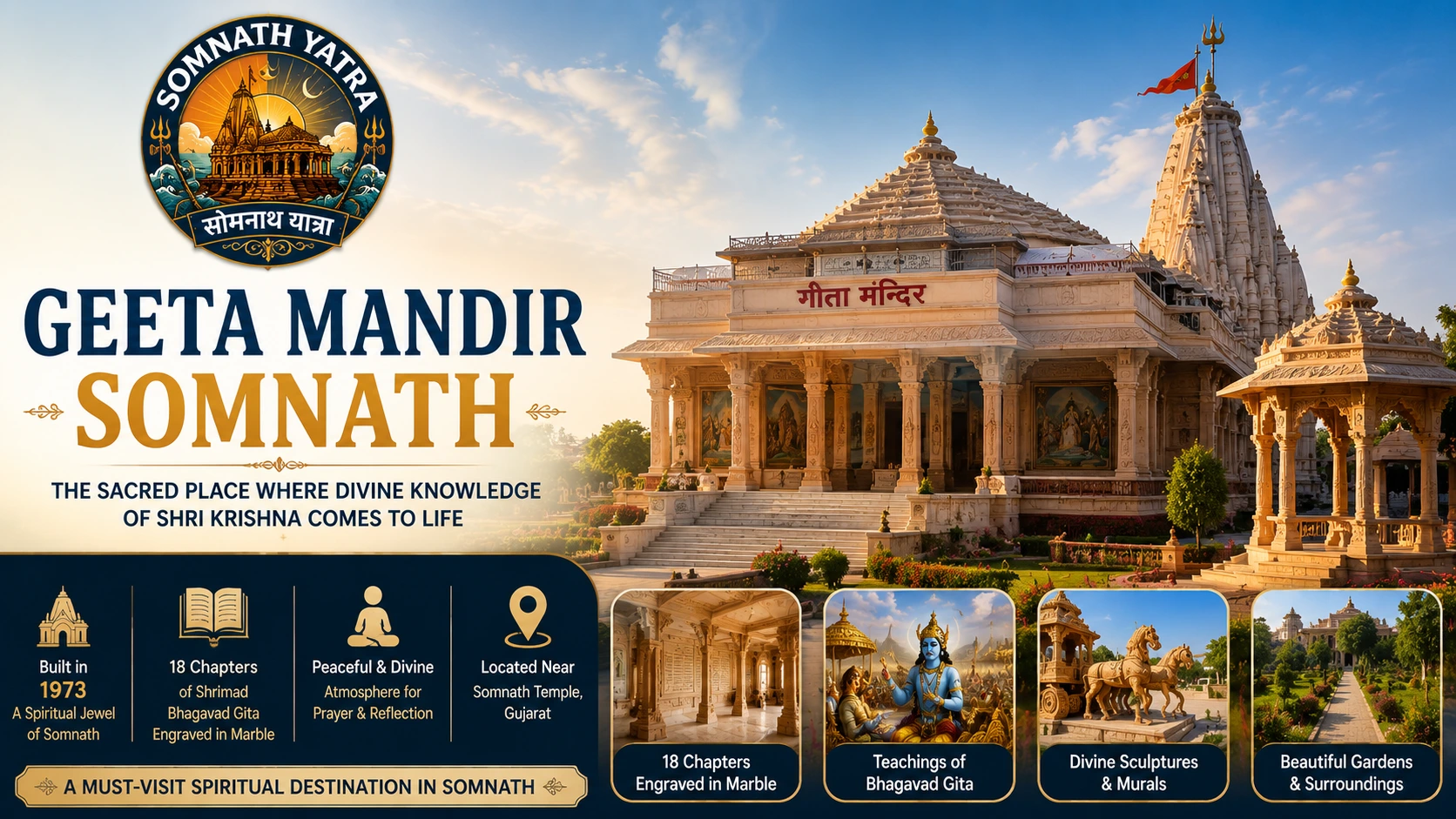
Look, if you’re going to Somnath, you’ll stand in that long queue for Jyotirlinga darshan. Everyone does. But here’s what most people miss — there’s a temple about a kilometer away that nobody talks about, and honestly it might be the better experience. Geeta Mandir. White marble, 18 pillars, zero crowds. I stumbled into it by accident and ended up staying way longer than I planned.
Wasn’t even on our itinerary. We had a train to catch from Veraval and figured we’d kill some time. Auto driver said “paanch minute” — five minutes. Forty-five minutes later I was still there, reading shlokas carved into marble, watching an old woman trace the Sanskrit letters with her fingers. Nobody rushed me. No volunteers telling me to keep moving. Just silence and stone.
That’s the thing about this place. It gives you what Somnath can’t — actual quiet.
Why It Hits Different
Somnath gives you goosebumps. This place gives you calm. Different things, and you kind of need both.
Built in 1970 by the Birla family. Same people who did Laxminarayan Temple in Delhi. They picked a spot near Triveni Ghat where three rivers meet the sea — Hiran, Kapila, Saraswati. According to the Mahabharata, this is where Krishna started his final journey to Neejdham. So they built a temple to his words, not his image. Smart choice, honestly.
The building hasn’t changed since it opened. No renovations, no gold plating, no “renovation” that turns into a completely different structure. What you see is what they built. White marble, clean lines, 18 pillars. That’s it. No unnecessary extras.
The Pillars Are the Whole Point
Walk in and your eyes go straight to them. 18 white marble columns. Each one carries the complete text of one chapter from the Bhagavad Gita. Chapter 1 on the first pillar, Chapter 18 on the last. The whole Gita, chapter by chapter, standing in a circle around you.
The carving is good. Not rushed, not sloppy. Sanskrit shlokas etched deep enough to survive centuries but fine enough that you can actually read them if you stand close. Morning light makes the letters glow a little. Saw an old lady crying while she read one. Not dramatic crying — just quiet tears while her finger followed the text. That’s the kind of place this is.
Floor stays cool even when it’s hot outside. Good thing too, because you’re barefoot. Prayer hall isn’t huge — maybe fits 30, 40 people. No loudspeakers, no fixed prayer schedule blaring announcements. People just come in, sit down, close their eyes. Self-regulating. Everyone respects the quiet.
Walls have paintings from Krishna’s life. Childhood in Vrindavan, the Gita delivery at Kurukshetra, that sort of thing. Traditional style but with newer colours. Kids actually look at them, which is more than you can say for most temple art. Sanctum has idols of Lakshmi Narayana, Sita, Rama under a plain canopy. Nothing flashy.
What It Feels Like to Be There
No tall shikhara visible from the road. You won’t spot it from a distance. Turn off the main road, pass a simple gate, and suddenly there it is — white against green. First thing you notice is how quiet it is. Even with other visitors around, people whisper here.
Shoe situation is basic. No lockers, no organized system like Somnath. Just a stand near the entrance. Fine for a short visit. Don’t leave expensive footwear unattended though.
Most people do the same thing: enter, pray at the main idol, then walk around the pillars slowly. Some read the inscriptions. Some just look. You don’t need Sanskrit to feel it — the sheer physical fact of the entire Gita standing around you in stone creates something hard to put into words. Feels like standing inside a book.
Gardens around the temple are part of the Dehotsarg Campus. Trees, clean paths, open space. After the main temple, people just sit here for a while. Nobody tells you to leave.
Timings and Fees
| What | When |
|---|---|
| Opens | 6:00 AM |
| Closes | 6:00 PM |
| Morning quiet | 6:00 – 7:00 AM |
| Good light for photos | 9:00 – 11:00 AM |
| Quietest time | 12:00 – 3:00 PM |
| Evening prayer vibe | 4:00 – 6:00 PM |
No fixed aarti times like Somnath. No grand bells-and-music ceremonies. Priest does basic rituals morning and evening. Otherwise you just walk in and do your own thing. That simplicity is refreshing after the security checkpoints and crowd management at the main temple.
Entry: Free. No ticket, no counter, no bag scanner. Donation box near the entrance if you want to contribute. That’s it.
Camera: Fine outside. Don’t photograph people praying inside without asking. No flash in the prayer hall.
Parking: Limited, free, fills up during peak season. Better to park at Somnath Temple complex and walk or auto over.
Best Time to Go
October to March. Weather’s good, marble floors are comfortable, sky’s clear. That’s your window.
Summer — April through June — gets brutal. 40°C plus. The marble compound has barely any shade. If you must go, do it at 6 AM or after 5 PM. Otherwise you’ll be sweating through your shirt in 15 minutes.
Monsoon brings humidity and occasional heavy rain. Greenery looks nice but roads can get waterlogged. Check conditions before you go.
Time of day matters more than season here:
- 6-8 AM: Best light, coolest air, almost nobody there. Pillars look incredible in morning sun.
- 9-11 AM: Still good light, some visitors, prayer atmosphere building.
- 3-4 PM: Dead quiet. Best for reading inscriptions without anyone bothering you.
- 5-6 PM: Warm evening light, local devotees showing up, nice energy.
Janmashtami is the big one here. Flowers, lights, bhajans for hours. Not chaotic like a city temple — focused, joyful. If you can time your Somnath trip around it, do it.
What to Wear
Standard Hindu temple stuff. Men — full trousers or kurta-pajama. Women — saree, salwar suit, long skirt. Nothing crazy strict. Nobody’s checking your outfit at the door. But you know, respect the place.
Remove shoes before entering. Wash hands if there’s a facility. That’s about it.
How to Get There
From Somnath Temple — it’s part of the same circuit. Three options:
- Walk: 20-25 minutes. Flat road, safe, fine in cool weather.
- Auto: ₹30-50. Right outside Somnath main gate.
- Tirth Darshan Bus: Somnath Trust runs one at 8:30 AM and 3:30 PM from the main gate. Covers all nearby temples. ₹30-50. Takes 2-2.5 hours for the whole circuit. Honestly the best option if you’re short on time.
From Veraval station: 7-8 km. Auto ₹80-120. Taxi ₹200-300.
From Diu airport: 85-90 km. Prepaid taxi ₹2,000-3,000. About 2 hours.
Local Fares
| Route | Auto | Taxi |
|---|---|---|
| Somnath to Geeta Mandir | ₹30-50 | ₹150-200 |
| Somnath to Bhalka Tirth | ₹80-120 | ₹300-400 |
| Somnath to Veraval Station | ₹80-120 | ₹250-350 |
| Somnath to Diu Airport | — | ₹2,000-3,000 |
Always confirm the rate before getting in. Fares change with season and fuel prices.
What’s Nearby
You’re in the Dehotsarg Campus, so everything’s close:
- Somnath Temple: 1-3 km. 5-10 min auto. The main attraction, obviously.
- Dehotsarg Tirth: Walking distance. Same campus. Where Krishna left for Neejdham. Sit by the Hiran river for a bit.
- Triveni Sangam: Walking distance. Three rivers meeting the sea. Dip your feet, do a quick ritual, or just watch.
- Bhalka Tirth: About 5 km. 10-15 min auto. Where Krishna was struck by Jara’s arrow. Worth combining.
- Mahaprabhuji Ni Bethak: Adjacent. Walking distance.
- Baldevji’s Cave: Adjacent. Walking distance.
- Somnath Beach: 2 km. Evening walks, sunset.
The Route I’d Recommend
If you’re fit and weather’s good, do this walking circuit:
- Start at Somnath Temple. Early darshan, 6 AM.
- Walk or auto to Geeta Mandir. Spend 30-40 minutes with the pillars.
- Dehotsarg Tirth. 5 minutes. Sit by the river.
- Triveni Sangam Ghat. 5 minutes.
- Mahaprabhuji Ni Bethak and Baldevji’s Cave. 10 minutes.
- Back to Somnath for breakfast.
Under 2 km total walking. Covers the whole spiritual geography of Prabhas Patan.
Full Day Plan
- 6:00-7:30 AM: Somnath Temple Mangala Aarti and darshan
- 7:30-8:00 AM: Breakfast. Trust Bhojanalaya or nearby hotel.
- 8:00-8:45 AM: Geeta Mandir. Slow darshan, read pillars, sit in the hall.
- 8:45-9:15 AM: Dehotsarg Tirth and Triveni Sangam.
- 9:15-9:45 AM: Mahaprabhuji Ni Bethak and Baldevji’s Cave.
- 10:00-11:30 AM: Bhalka Tirth. Auto, 5 km.
- 12:00-1:00 PM: Lunch. Veraval or Somnath. Try Kathiyawadi thali.
- 3:00-4:00 PM: Ahilyabai Temple and Rudreshwar Temple.
- 4:00-5:30 PM: Somnath Beach. Rest. Sea breeze.
- 6:30-7:30 PM: Back to Somnath for Sandhya Aarti.
- 8:00-9:00 PM: Light and Sound Show.
Facilities
| Thing | Available? | Note |
|---|---|---|
| Washrooms | Yes | Basic but clean enough |
| Drinking water | Yes | Near the compound |
| Wheelchair | Partial | A few steps at entry, flat inside |
| Senior citizens | Okay | No staff, but low crowd helps |
| Kids | Yes | Safe, open space |
| Food | No | Eat before or after at Somnath |
| Cloakroom | No | Unlike Somnath, no lockers here |
Money Stuff
| Expense | Cost |
|---|---|
| Auto (Somnath to Geeta Mandir) | ₹30-50 |
| Half day taxi sightseeing | ₹800-1,500 |
| Parking | Free – ₹20 |
| Snacks | ₹50-150/person |
| Lunch | ₹150-300/person |
| Donations | ₹20-100, voluntary |
Rough totals: Solo ₹300-600/day. Couple ₹800-1,500. Family of four ₹1,500-3,000. Depends on how much taxi you use and where you eat.
Things Nobody Tells You
- The Tirth Darshan Bus at 8:30 AM is the move. Guided circuit, save on fares, no parking hassle.
- January and February mornings are cold. Sea breeze hits harder than you’d expect. Carry a light jacket.
- Footwear stand is unsupervised. Good shoes? Carry them in a bag.
- Summer — bring water. The marble compound has almost no shade. 20 minutes walking in 40°C and you’re done.
- 2-4 PM is dead quiet. Tour buses skip the afternoon.
- If you want to read the inscriptions and need glasses, bring them. Text is carved small.
- The steps at entry get slippery during monsoon. Watch your step.
- Solo women — area feels safe. But don’t wander near the river alone after dark.
Mistakes I’ve Seen People Make
- Rushing. Five minutes, two photos, gone. What’s the point? Give it 30 minutes minimum.
- Skipping Dehotsarg. It’s right there. Don’t be lazy.
- Wearing dark clothes in summer. Marble reflects heat. Light cotton is the way.
- Expecting Somnath-level everything. This is smaller, simpler. That’s the whole appeal.
Bottom Line
Geeta Mandir won’t make anyone’s “Top 10 Temples” list. No gold dome, no sea view, no thousand-year backstory. What it has is sincerity. The Birla family built it to complement Somnath, not compete with it. They picked the spot where Krishna’s earthly story ended and made a temple about his words. 18 pillars. The whole Gita in stone. Nothing else you don’t need.
Don’t skip it. Go after your Somnath darshan when your head’s still spinning from the Jyotirlinga. Sit in the quiet. Read a pillar or two. The Gita says do your duty without attachment to results. This temple does exactly that — quietly, without asking for attention. Which is exactly why it deserves yours.


