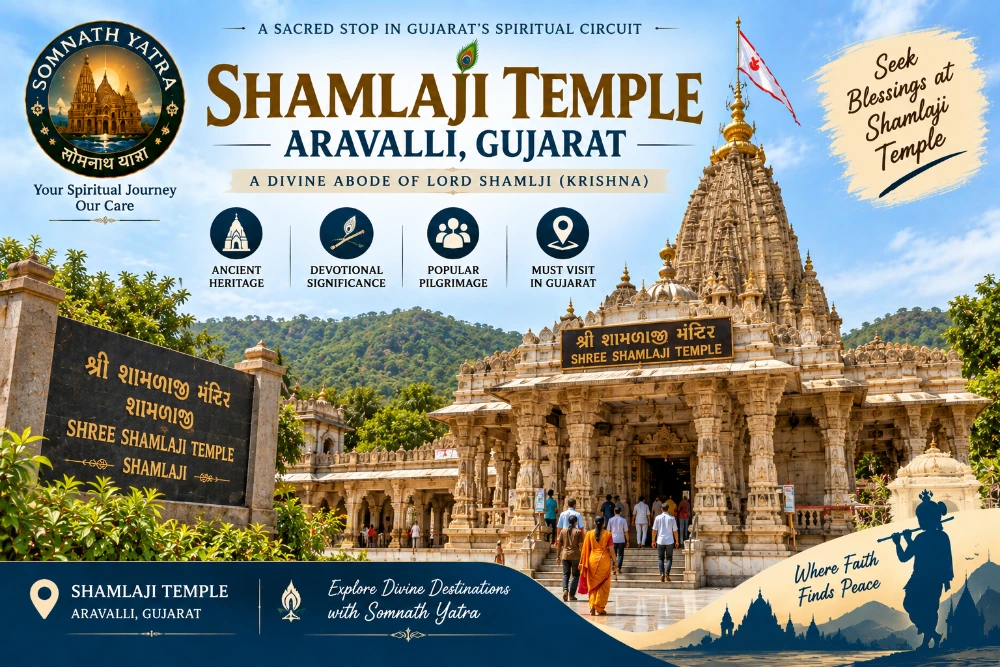
Shamlaji Temple, Aravalli – The Dark One of the Meshwo Valley
A temple where the Lord appears in the colour of storm clouds. Shamlaji, on the banks of the Meshwo River in Gujarat’s Aravalli hills, is dedicated to Lord Vishnu in his dark form—Sham, the colour of dusk. The Bhil tribal communities who have worshipped here for centuries call him “Kaliyo Bavji”—the dark father. A white silk flag, the Dholi Dhajawala, flutters from the sandstone shikhara above. The outer walls carry Chalukya-style carvings that tell the complete stories of the Ramayana and Mahabharata in stone. Every November, lakhs of tribals walk on foot from across Gujarat and Rajasthan for the three-week Shamlaji Melo—the longest and largest tribal fair in the state. The temple has welcomed pilgrims on the Ahmedabad–Udaipur highway for over a thousand years.
Shamlaji sits in a valley surrounded by wooded hills, 150 km from Ahmedabad and 150 km from Udaipur. The original temple was started in the 11th century in the Chalukya style, though the present structure dates to the 15th and 16th centuries. The main idol of Vishnu inside the sanctum is probably from the 7th or 8th century. Across the river stands a 6th-century Shiva temple. The oldest intact structure is the 9th-century Harishchandrani Chauri Temple, with an ornamental gateway still standing. Scattered ruins, broken sculptures, and ancient brick temples across the valley confirm that Shamlaji was once a major centre of religious and cultural life—older than most people realise.
The Legend – Vishnu, Krishna, and the Dark One
The mythology of Shamlaji connects to the Mahabharata. The temple is described in ancient texts as “Gadadhar Kshetra”—the land of the mace-bearer. Lord Krishna, along with Arjuna, is believed to have visited this region to liberate people from the atrocities of Jarasandha. They rested here and worshipped Lord Shiva. The Shiva temple opposite the main shrine marks this connection.
According to another legend, Lord Vishnu slew the demon Shankhasura at this spot, making the ground sacred. Over centuries, the deity became known by many names—Gadadhar (the mace-bearer), Shamlaji (the dark one), and Kaliyo Bavji (the dark father, in Bhil language). The name “Sham” refers to the deep dark colour of Lord Krishna’s complexion—the colour of storm clouds, of dusk, of deep water.
The temple’s history is also marked by destruction and devotion. During Aurangzeb’s reign, the Muslim army burnt the village and destroyed the temple. The Garuda idol’s nose and ear were cut off. The outer idols were smashed. The Vaishnavas hid the main idol of Shamlaji in the Karambuj pond and migrated. Only the Adivasis stayed behind, continuing to cultivate the land. One Adivasi later discovered the idol while ploughing. The Vaishnavas returned, and worship resumed according to the rites of Vaishnav Dharma.
The current temple was rebuilt and the idol reinstalled by the Maharaja of Idar around 1860 AD. A legend says that when a new idol was also prepared, the Maharaja placed both idols in separate rooms overnight. The original idol emanated the sound of the Pranava Mantra—Omkar. That idol was installed in the temple. The new idol went to a temple in Gadhda Shamlaji near Khedbrahma.
Architecture – Chalukya Walls and Gupta Sculptures
The present temple structure dates to the 15th and 16th centuries, but the architectural roots go back to the 11th-century Chalukya style. The outer walls carry detailed carvings depicting scenes from the Ramayana and Mahabharata—panels that take 30 to 45 minutes to walk around and study. The sandstone shikhara rises above the sanctum, topped with the iconic white silk flag.
The Inner Sanctum
The main idol of Lord Vishnu (Shamlaji) stands in the sanctum, carved from dark stone, probably dating to the 7th or 8th century. The Lord holds a mace—hence the name Gadadhar. The idol is richly adorned with gold, jewels, and clothing. The sanctum is kept simple, allowing the ancient idol to speak for itself.
Triloknath Temple
Just outside the main temple on the right stands the Triloknath Temple—Lord of the Three Worlds. The Vishnu idol here has four hands. Alongside it is a Shiva idol in the Gupta style, covered in tiger skin, holding a trishul in the left hand with cobras circling the right. The head bears a Jata Mukut—a crown of matted hair. This temple predates the main shrine and shows the Gupta-period artistic influence that once dominated this valley.
The Underground Shiva Temple
The Kashi Vishwanath Mahadev Temple sits seven feet below ground level. Its pyramidal roof rises to the level of the surrounding land. You enter through a gateway by a gradually deepening passage. The temple was perhaps originally built in a hollow that filled up over centuries. The Sada Shiva idol inside has three eyes and a Jata on the head—ancient and unadorned.
⚠️ Safety Warning: The stone steps and sanctum floor are notoriously damp, mossy, and highly slippery—especially during and just after the monsoon (July to October). The steps wear down with centuries of use and offer poor grip. Elderly visitors and those with mobility issues should view the temple from the top of the stairs rather than descend. Everyone else—grip the walls as you go down. Take it slow. The temple is not going anywhere.
Harishchandrani Chauri – The Oldest Surviving Temple
The 9th-century Harishchandrani Chauri Temple is the oldest intact structure at Shamlaji. According to legend, King Harishchandra of Ayodhya performed a Rajasuya yagna here for begetting a son. The temple has a rectangular sanctum and a large pavilion in front. The ornamental gateway, the Torana, still stands though the enclosure walls have been lost to time. Archaeologists consider this temple a key marker of early medieval temple architecture in Gujarat.
Shamlaji Melo – Gujarat’s Largest Tribal Fair
The annual Shamlaji Melo is the largest tribal gathering in Gujarat. It takes place during the month of Kartik (October–November), peaking on Kartik Purnima—the full moon night. For three weeks, the Bhil tribal communities from Gujarat and Rajasthan walk on foot to the temple, singing, dancing, and carrying devotional banners. They call the deity Kaliyo Bavji—the dark father—and consider this pilgrimage the most important journey of their year.
On Kartik Purnima, devotees take a sacred bath in the Meshwo River at dawn before proceeding to the temple for darshan. The river ghat fills with lakhs of pilgrims. Silver ornaments, metalware, clothes, and household items are sold in a massive fairground that springs up around the temple. The Melo is not just a religious event—it is a cultural reunion for the Bhil community, a time for marriages, trade, and celebrating their identity.
⚠️ Kartik Purnima Traffic Warning: During the three weeks of Kartik, and especially on Kartik Purnima, NH8 practically ceases to function for normal transit. Millions of pedestrians walk on the highway, barricades go up, and parking is pushed kilometres away from the temple. If you are a casual road-tripper just driving from Ahmedabad to Udaipur—check the Hindu calendar before you drive. If it is Kartik Purnima, bypass the route entirely or prepare for hours of gridlock.
Darshan Timings (2026)
The temple is open daily from 6:00 AM to 9:00 PM. There are intermittent closures for aarti throughout the day. If the inner sanctum gates are closed when you arrive, wait 10 to 15 minutes—they reopen after each aarti.
Aarti Schedule
| Aarti | Time |
|---|---|
| Mangala Aarti | 6:00 AM – 6:45 AM |
| Abhishek / Puja | 7:00 AM – 11:00 AM |
| Rajbhog Aarti | 12:15 PM – 12:30 PM |
| Temple Closes (Noon) | 12:30 PM – 2:15 PM |
| Utthapan | 2:15 PM |
| Sandhya Aarti | After 6:15 PM |
| Shayan Aarti | 8:15 PM – 9:00 PM |
Entry fee: Free for all devotees. No ticket required. Charges may apply for special pujas and rituals.
Best time for darshan: Early morning, 6:00 to 8:00 AM on weekdays. The outer wall carvings are best seen in morning light, and the crowds are minimal.
Dress code: Traditional and formal clothing preferred.
Festivals and Celebrations
| Festival | Significance |
|---|---|
| Shamlaji Melo (Kartik Purnima) | Gujarat’s largest tribal fair—3 weeks of pilgrimage, bathing in Meshwo, and cultural celebrations |
| Kartik Purnima | Peak night of the Melo—sacred river bath at dawn followed by darshan |
| Janmashtami | Krishna’s birthday—special pujas and decorations |
| Maha Shivaratri | Worship at the underground Shiva temple and Triloknath shrine |
| Ram Navami | Celebrations at Harishchandrani Chauri Temple |
| Navratri | Nine nights of devotion—special cultural programs |
| Holi | Festival of colours celebrated with devotional songs |
Dal Bati at the Border – The Aravalli Culinary Experience
Most Gujarat travel guides assume you will eat Gujarati thalis. Shamlaji breaks that rule entirely. Because it sits on the Rajasthan border, the dhabas surrounding the temple town specialize in authentic Rajasthani Dal Bati Churma—baked wheat balls, spicy lentil curry, and sweet crumbled wheat. This is not Gujarat food. This is the cuisine of the Aravalli borderlands, where two states and two food cultures merge.
Skip the standard highway snacks here. The rustic dhabas just outside the temple town, along NH8, bake their batis over open cow-dung fires. The bati comes out smoky, hard on the outside, soft inside—cracked open and drenched in ghee. The dal is slow-cooked with Rajasthani spices. Pair it with a glass of chaas or masala buttermilk and you have the quintessential culinary experience of this region. This is the kind of meal that road-trippers remember long after the temple visit fades.
Tip: The best dhabas are 2 to 3 km outside the village on the highway, before you reach the temple approach road. Ask any truck driver for the one with the most parked lorries—the food there is always fresh and the portions generous.
Devni Mori – The Buddhist Connection
Two kilometres from Shamlaji lies Devni Mori, a Buddhist archaeological site dating to the 3rd or 4th century CE. Excavations between 1960 and 1963 revealed a stupa, a vihara with 36 rooms for Buddhist monks, and an inscribed casket containing body relics of the Buddha. The inscription credits the construction to a king named Rudrasen, designed by Agnivarma Sudarshan. Gold coins of Mahakshatrap Rudradaman were also found here.
The site is now partially submerged under the Meshwo Reservoir, built in the 1970s. But the discovery proves that Shamlaji was a thriving religious centre—Buddhist, Hindu, and Jain—long before the current temple was constructed. The artifacts are preserved in the Baroda Museum.
How to Reach Shamlaji
By Rail
Shamlaji Road Railway Station is 14 km from the temple. It connects to Ahmedabad and other Gujarat cities. Local trains operate daily, suitable for travel from Modasa to Nadiad.
By Road
The temple is on National Highway 8 (Ahmedabad–Udaipur road). State transport buses run regularly from Ahmedabad, Himmatnagar, and Modasa. The temple is in the village of Shamlaji, well signposted from the highway.
⚠️ Transit Warning: Shamlaji is the last major Gujarat town before the Ratanpur border checkpost into Rajasthan. The final 10 kilometres approaching Shamlaji are dominated by thousands of slow-moving interstate cargo trucks. If you are continuing to Udaipur, factor in border-crossing congestion—especially on weekends and during the night when truck volume peaks.
| From | Distance | Time |
|---|---|---|
| Modasa | 32 km | 40 minutes |
| Himmatnagar | 45 km | 1 hour |
| Ahmedabad | 150 km | 2.5–3 hours |
| Udaipur | 150 km | 2.5–3 hours |
| Idar | 50 km | 1 hour |
By Air
Nearest airport: Sardar Vallabhbhai Patel International Airport, Ahmedabad (125–130 km)
Nearby Places to Visit
| Place | Distance | Why Visit |
|---|---|---|
| Devni Mori | 2 km | Buddhist archaeological site—stupa, vihara, and Buddha relics from 3rd–4th century |
| Khedbrahma | 25 km | Temple dedicated to Lord Brahma—one of the few Brahma temples in Gujarat |
| Polo Forest | 25 km | Scenic forest with ruins of Jain and Hindu temples, trekking destination |
| Harishchandrani Chauri | Within Shamlaji | 9th-century temple with intact Torana gateway—oldest surviving structure |
| Modasa | 32 km | Town with market and connectivity to other parts of Gujarat |
Meshwo Dam – The Photographer’s Sunset
The Meshwo Reservoir, 5 km from the temple, is not just a dam—it is the best photo-op in the entire Aravalli district. A dam built between two hills, it holds back a lake that reflects the surrounding Aravalli ridges in the late afternoon light. Time your temple exit for 4:30 to 5:00 PM, drive the 5 km to the reservoir, and catch the sunset over the water. The hills turn gold, the water mirrors them, and the silence is a sharp contrast to the temple crowds. If you carry a camera, this is the shot you came for.
Visitor Tips
- Carry cash—ATMs are limited in Shamlaji village
- Wear modest traditional clothing for darshan
- Photography is not allowed inside the sanctum—fine outside
- Walk around the outer walls to see the Ramayana and Mahabharata carvings—allow 30–45 minutes
- Visit the underground Shiva temple—seven feet below ground level
- If visiting during Kartik Purnima, expect massive crowds and plan accordingly
- Combine with Devni Mori (2 km) and Polo Forest (25 km) for a full day trip
- The temple has a Gaushala—milk and prasad are available
- Best season: October to March when the weather is pleasant
- Avoid summer visits (April–June) when temperatures in the Aravalli valley are very high
Frequently Asked Questions
What is the history of Shamlaji Temple?
The original temple was started in the 11th century in the Chalukya style, though the present structure dates to the 15th and 16th centuries. The main idol of Vishnu is probably from the 7th or 8th century. The temple was destroyed during Aurangzeb’s reign and rebuilt by the Maharaja of Idar around 1860 AD. Devni Mori, 2 km away, has Buddhist relics from the 3rd–4th century, proving the area’s ancient religious significance.
What does “Shamlaji” mean?
“Sham” means the dark colour of storm clouds—the colour of Lord Krishna’s complexion. Shamlaji means “the dark one.” The Bhil tribal communities call the deity “Kaliyo Bavji”—the dark father. The temple is also called “Dholi Dhajawala” after the white silk flag that flies from the top.
What are the darshan timings?
The temple is open from 6:00 AM to 9:00 PM daily. Mangala Aarti is at 6:00 AM, Rajbhog Aarti at 12:15 PM, Sandhya Aarti after 6:15 PM, and Shayan Aarti at 8:15 PM. There are intermittent closures during aarti—wait 10 to 15 minutes if the gates are temporarily closed.
When is the Shamlaji Melo?
The Shamlaji Melo takes place during Kartik month (October–November), lasting three weeks. It peaks on Kartik Purnima—the full moon night. Lakhs of Bhil tribal devotees walk on foot from Gujarat and Rajasthan. The fair includes sacred bathing in the Meshwo River, darshan, and a massive market for silver ornaments, clothes, and household items.
Is there an entry fee?
No. Entry is free for all devotees. There are no tickets. Charges may apply for special pujas and rituals—enquire at the temple office.
What is Devni Mori?
Devni Mori is a Buddhist archaeological site 2 km from Shamlaji, dating to the 3rd or 4th century CE. Excavations revealed a stupa, a vihara with 36 rooms, and an inscribed casket containing Buddha relics. The site is now partially submerged under the Meshwo Reservoir. Artifacts are preserved in the Baroda Museum.
When is the best time to visit?
October to March is the best time when the weather is pleasant. Kartik Purnima (during the Melo in October–November) is the most vibrant time to visit, but expect massive crowds. Early morning on weekdays offers the best darshan experience with minimal crowds and good light for viewing the outer wall carvings.
How do I reach Shamlaji from Ahmedabad?
Shamlaji is 150 km from Ahmedabad on National Highway 8, taking approximately 2.5 to 3 hours by road. State transport buses run regularly. The nearest railway station is Shamlaji Road, 14 km from the temple.
Is photography allowed?
Photography is not allowed inside the sanctum. You can take photos of the outer walls, the temple exterior, and the surrounding area.
Is there accommodation near the temple?
Basic accommodation is available in Shamlaji village. For better options, Modasa (32 km) and Himmatnagar (45 km) have hotels. During the Shamlaji Melo, temporary arrangements are made for pilgrims.
Why is Shamlaji important to the Bhil tribe?
The Bhil tribal communities consider Shamlaji (Kaliyo Bavji) their family deity. They walk on foot from across Gujarat and Rajasthan for the annual Melo. Before any major life event—marriage, naming ceremony, or harvest—families invoke the deity. The temple is the spiritual heart of Bhil identity, a place where tribal faith and Hindu Vaishnavism have merged over centuries.


