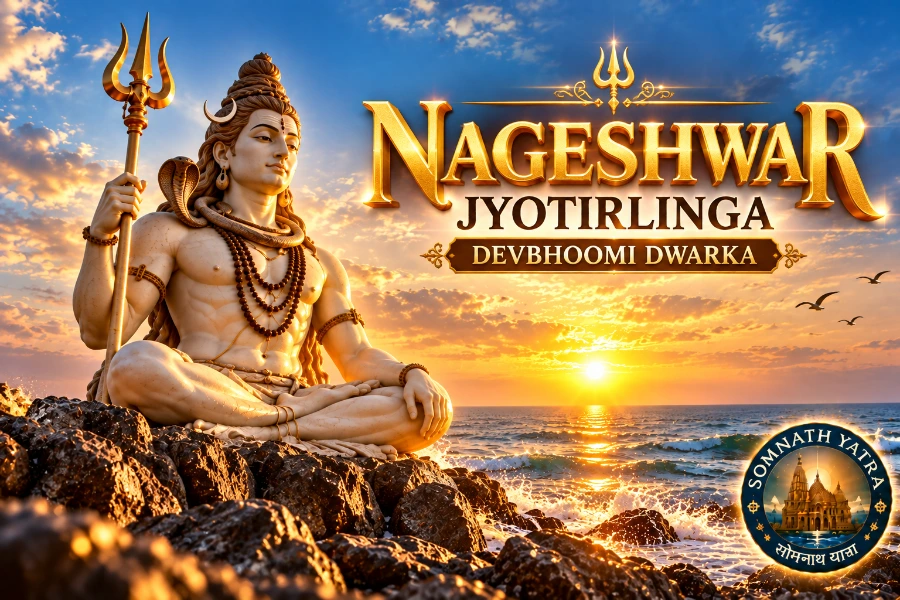
Nageshwar Jyotirlinga, Dwarka – The Only Underground Jyotirlinga in India
You do not walk up to this Jyotirlinga. You descend. Nageshwar, 17 kilometres from Dwarka on the Saurashtra coast, is the only one of the twelve Jyotirlingas where the sanctum sits below ground level. You step down into the earth—into the ancient forest of Darukavanam where Lord Shiva himself appeared as a luminous pillar of light to protect a devotee from a demon. The Shivling is carved from the sacred Dwarka Shila stone, adorned with small chakras in the form of a Teen Mukhi Rudraksha. Devotees are permitted to touch the Linga during Abhishek—personally pour milk, water, and Gangajal over the Jyotirlinga. It is one of the few major Shiva shrines where this intimate, hands-on worship is allowed. A 25-metre seated statue of Lord Shiva, right hand raised in abhaya mudra, eyes half-closed in meditation, rises from the temple grounds and is visible from kilometres across the flat Saurashtra scrubland.
Nageshwar holds an unusual position in Hindu sacred geography. It is the only Jyotirlinga along the western seaboard of India, the only one where Shiva is invoked as protector against poison and serpents, and the only one woven directly into the geography of Krishna’s earthly capital. The temple sits between Gomati Dwarka and Beyt Dwarka Island on the Saurashtra coast—a meeting point of Shaiva and Vaishnava sacred geography. For pilgrims pursuing the twelve Jyotirlinga vow, this is often the final one. And many say it is the most intimate.
Quick Info
| Detail | Information |
|---|---|
| Location | Darukavanam, 17 km from Dwarka, Devbhumi Dwarka District, Gujarat |
| Deity | Lord Nageshwar (Shiva) — Lord of Serpents |
| Significance | One of 12 Jyotirlingas — only underground sanctum among the twelve |
| Timings | 5:30 AM – 12:30 PM | 5:00 PM – 9:00 PM |
| Entry Fee | Free (Mukh Darshan) | Abhishek: ₹250–₹300 |
| Best Time | October to March | Pre-dawn Mangala Aarti at 5:00 AM |
| Nearest Railway | Dwarka Station — 17 km |
| Nearest Airport | Jamnagar — 135 km |
| Official Contact | Shree Nageshwar Mahadev Jyotirlinga Trust |
The Legend – Supriya, Daruka, and the Pillar of Light
The Shiva Purana tells the story. A demon named Daruka, who worshipped Goddess Parvati, received a boon that made him nearly invincible. He and his demoness wife Daruki terrorised the region, imprisoning sages and innocent people in the underwater city beneath the forest of Darukavanam. Among the captives was a devoted Shiva bhakta named Supriya.
Even in captivity, Supriya continued chanting “Om Namah Shivaya” and instructed the other prisoners in the mantra. Enraged, Daruka attempted to kill him. At that moment, Lord Shiva appeared in a radiant form—a Jyotirlinga, a pillar of light—destroyed Daruka, and freed all the captives. Shiva chose to remain at that spot as Nageshwar—the Lord of Serpents—promising eternal protection to all who worshipped here with sincere faith.
The name “Nageshwar” comes from “Naga” (serpent) and “Ishwar” (Lord). In Hindu iconography, Shiva wears serpents around his neck and arms as symbols of his mastery over death and fear. At Nageshwar, this form is specifically invoked for protection against poison—literal or metaphorical—and against snake venom. Devotees seeking liberation from negative influences and addictions traditionally make vows at this temple.
Krishna is believed to have performed Rudrabhishek here, and Adi Shankaracharya established the foundations of his Western Math at Kalika Peetha in this sacred location. The temple’s spiritual lineage connects Shaiva and Vaishnava traditions in a way no other Jyotirlinga site does.
The Underground Sanctum – Descend to the Deity
All other major Jyotirlingas are in elevated sanctums—approached by walking up to the deity. Nageshwar is different. You descend into the earth. The low ceiling closes around you. The Shivling sits in a depression, at your hands, close enough to touch. The sanctum is intimate, almost cave-like, and the experience is unlike any other Jyotirlinga.
The Jyotirlinga is carved from Dwarka Shila—the sacred stone of the region—adorned with small chakras that take the form of a Teen Mukhi Rudraksha. During Abhishek sessions, devotees are permitted to personally pour milk, water, and Gangajal over the Linga. This personal, hands-on worship is a rare privilege among major Shiva temples. Men are required to remove their shirts and upper garments before entering the inner sanctum—a gesture that devotees describe as a small undoing that prepares the inner approach.
Tip: The ceiling is low. If you are tall, watch your head as you descend. The space is designed for devotion, not comfort.
The 25-Metre Shiva – The Visual Anchor
Before any temple wall comes into view, you see the statue. A colossal 25-metre seated Shiva in padmasana—the lotus posture—right hand raised in abhaya mudra, eyes half-closed in meditation. Built in the 1990s under the sponsorship of Gulshan Kumar of T-Series, the statue is the visual anchor of the entire complex. Pilgrims report it as the first emotional moment of the visit—a moment of arrival that precedes formal darshan.
The statue is best photographed in the early morning light, when the Saurashtra sun hits the seated figure from the east. In the late afternoon, the statue casts a long shadow across the temple grounds—another striking composition for those who carry cameras.
Photography note: Unlike Somnath and Dwarkadhish, mobile phones and cameras are allowed inside the main temple compound. This is a huge relief for tourists—you can freely photograph the 25-metre Shiva statue and the temple grounds. Simply pocket your phone before entering the actual darshan hall. No locker rooms, no phone bans, no hassle.
Darshan Timings (2026)
The temple opens twice daily with a long afternoon break. The morning session begins before dawn. The evening session closes after dark.
Aarti and Darshan Schedule
| Session | Time |
|---|---|
| Mangala Aarti | 5:00 AM – 5:30 AM |
| Temple Opens | 5:30 AM |
| Morning Darshan | 5:30 AM – 12:30 PM |
| Maha Bhog / Midday Aarti | 12:00 PM – 12:30 PM |
| Temple Closes (Afternoon Break) | 12:30 PM – 5:00 PM |
| Evening Darshan | 5:00 PM – 9:00 PM |
| Sandhya Aarti | 7:00 PM |
| Shayan Aarti | 8:30 PM – 9:00 PM |
Entry fee: Free darshan grants Mukh Darshan—viewing the deity from behind a barricade in the outer hall. To descend into the underground Garbhagriha and touch the Jyotirlinga during Abhishek, you must purchase an Abhishek receipt (₹250–₹300) from the temple trust counter. The Abhishek ticket is what gives you access to the underground sanctum.
Abhishek: Available at the counter on arrival with the paid receipt. Devotees can personally touch the Shivling during Abhishek—pour milk, water, and Gangajal. Special Rudrabhishek can be booked in advance through the temple trust.
Best time for darshan: 5:30 to 7:00 AM on weekdays. The sea air off the Saurashtra coast, morning light on the 25-metre Shiva statue, and the underground sanctum with almost no crowd. This is the complete Nageshwar experience.
⚠️ The Afternoon Trap: Many pilgrims finish Dwarkadhish Temple by 1:00 PM and drive to Nageshwar—arriving at 2:00 PM to find it closed until 5:00 PM. Reverse the sequence: visit Nageshwar first at 5:30 AM, then Dwarkadhish by 8:00 AM. Or arrive at Nageshwar after 5:15 PM for evening darshan.
Festivals and Celebrations
| Festival | Significance |
|---|---|
| Maha Shivaratri | Chief festival—continuous darshan from 5:00 AM to late night, extended Rudri-path readings |
| Shravan Month (July–August) | Mondays bring heavy devotee flow—special Jalabhishek and daily rituals |
| Shravan Monday | Most crowded day of the week during monsoon—expect 1–2 hour waits |
| Kartik Purnima | Sacred full moon—special pujas and devotee gatherings |
| Makar Sankranti | Winter solstice celebrations with traditional offerings |
The Dwarka Circuit – One Day, Two Traditions
Nageshwar sits on the coastal road between Dwarka and Bet Dwarka. The full circuit can be completed in a single day if you start early. Here is the optimal sequence:
| Time | Temple | Distance |
|---|---|---|
| 5:30 AM | Nageshwar Jyotirlinga—opening darshan | — |
| 7:30 AM | Drive to Dwarka | 17 km, 30 min |
| 8:00 AM | Dwarkadhish Temple—Janmashtami ground, Lord Krishna | — |
| 11:00 AM | Bet Dwarka Island (by boat—30 min) | 30 km from Dwarka |
| 1:30 PM | Return to Nageshwar for evening darshan OR drive to Somnath | — |
Somnath + Nageshwar Circuit: Both Somnath (Jyotirlinga #1) and Nageshwar (Jyotirlinga #10 or #12, depending on the tradition) are in Gujarat—250 km apart. A 2-day Gujarat Jyotirlinga circuit is possible: Day 1 Somnath, Day 2 drive north to Nageshwar and Dwarka.
How to Reach Nageshwar
By Rail
Dwarka Railway Station is the nearest, 17 km from the temple. From the station, you can take a shared auto, private auto (₹600–1000), or GSRTC local bus. The drive takes about 30 minutes on the single-lane coastal road.
By Road
Nageshwar is on the Dwarka–Okha highway (NH27), well-signposted from Dwarka. GSRTC buses, shared autos, and private taxis are available. The road is scenic, running along the Saurashtra coast.
⚠️ Transport Warning: Nageshwar is in the middle of barren scrubland. If you take a one-way auto drop, you will be stranded—empty autos do not wait outside the temple. Negotiate a half-day “Dwarka Darshan” package with an auto-rickshaw or taxi from your hotel in Dwarka (₹800–₹1200 for an auto). This fixed route covers Nageshwar, Gopi Talav, and Rukmini Temple, with the driver waiting at each stop. Do not rely on finding transport outside the temple.
| From | Distance | Time |
|---|---|---|
| Dwarka | 17 km | 30 minutes |
| Okha | 25 km | 40 minutes |
| Bet Dwarka | 30 km | 1 hour (including boat) |
| Somnath | 250 km | 4.5–5 hours |
| Rajkot | 225 km | 4 hours |
By Air
Nearest airport: Jamnagar Airport (135 km) or Rajkot Airport (225 km). Ahmedabad International Airport (450 km) for long-distance travellers.
Nearby Places to Visit
| Place | Distance | Why Visit |
|---|---|---|
| Dwarkadhish Temple | 17 km | One of Char Dham—Krishna’s earthly capital, Jagat Mandir |
| Bet Dwarka | 30 km | Island temple where Krishna lived—ferry from Okha jetty |
| Rukmini Devi Temple | 18 km | Temple of Krishna’s wife, cursed by sage Durvasa |
| Gomti Ghat | 18 km | Sacred river bath before Dwarkadhish darshan |
| Gopi Talav | 3 km past Nageshwar | Sacred lake with yellow Gopi Chandan sand—only authentic place to buy the sacred clay used for Vaishnava tilaks |
| Bhadkeshwar Mahadev Mandir | 18 km | Shiva temple on the Arabian Sea coast in Dwarka |
Gopi Talav – The Gopi Chandan Connection
Gopi Talav is only 3 kilometres past Nageshwar on the exact same road—a 10-minute detour. This is the only authentic place to buy Gopi Chandan, the sacred yellow clay used for the U-shaped tilaks by Vaishnavas across Dwarka. If you have visited Dwarkadhish Temple and seen the yellow markings on devotees’ foreheads, this is where that clay comes from. Buy a small packet here—it costs almost nothing and makes a meaningful, lightweight souvenir from the pilgrimage.
Temple Administration & Contact
The temple is managed by the Shree Nageshwar Mahadev Jyotirlinga Trust, under the oversight of the Gujarat Government’s Char Dham Management Committee. The trust handles daily operations, Abhishek bookings, festival arrangements, and temple maintenance.
Online Abhishek Booking: Currently, Abhishek tickets are purchased at the temple trust counter on arrival. There is no official online booking portal as of 2026. For special Rudrabhishek or large-group pujas, contact the trust office in Dwarka in advance.
Architecture & The Modern Temple
The original temple is ancient—the Shiva Purana places it in the time of the demon Daruka. Archaeological excavations suggest five earlier cities existed at this site. The present structure is a modern reconstruction built atop the older shrine, with the 25-metre seated Shiva statue and surrounding complex completed in the 1990s under the sponsorship of Gulshan Kumar of T-Series.
The architecture follows the Nagara style—a modern interpretation with a simplified shikhara and clean lines. The temple complex includes the main underground sanctum, a outer hall for free darshan, the Abhishek area, and the iconic seated Shiva statue. Smaller shrines for Lord Ganesha and Goddess Parvati are located within the compound. The entire complex is designed to handle large crowds during festivals while maintaining the intimate atmosphere of the underground Garbhagriha.
The Dwarka Shila: The Jyotirlinga is carved from Dwarka Shila—a sacred stone found only in the Dwarka region. Geologically, this is a type of limestone unique to the Saurashtra coast, believed to be millions of years old. Spiritually, Vaishnavas and Shaivas both consider this stone sacred because it is found in the land where Krishna established his kingdom. The lingam’s surface shows natural chakra patterns that resemble a Teen Mukhi Rudraksha—believed to be a natural formation, not carved.
Where to Stay
There is no accommodation at the Nageshwar temple complex. All staying options are in Dwarka, 17 km away.
| Category | Options | Price Range |
|---|---|---|
| Budget | Dharamshalas near Gomti Ghat, GMRC Guest House, Zostel Dwarka | ₹300–₹800 per night |
| Mid-Range | Hotel Republic, Hotel Ganges, Giriraj Hotel,/The Dwaraka Hotel | ₹1,500–₹3,500 per night |
| Luxury | Welcomhotel by ITC (Bet Dwarka Road), The Fern Dwarka Resort | ₹5,000–₹10,000 per night |
| Temple Trust | GTDC Guest House, Shree Dwarkadhish Trust Bhavan | ₹500–₹1,500 per night |
Tip: Book early during Maha Shivaratri and Shravan month—Dwarka hotels fill up weeks in advance.
Food, Prasad & Dining
Temple Prasad: The temple distributes prasad after morning and evening aartis. It is typically simple—bundi ladoo and prasad packets. Collect from the designated counter after darshan.
Langar: The temple trust runs a langar (free meal) facility for pilgrims during major festivals, particularly Maha Shivaratri and Shravan Mondays. Check with the trust for availability on regular days.
Nearby Dining: There are no restaurants at the Nageshwar temple itself—the area is barren scrubland. Small tea stalls and snack vendors cluster near the temple entrance selling chai, packaged snacks, and local fare. For proper meals, return to Dwarka (17 km) where you will find:
- Gujarati Thali: Hotel Republic, Padma Restaurant, and Gokul Restaurant serve unlimited Gujarati thalis (₹150–₹250)
- Saurashtra Specialties: Gathiya, Fafda, Dhokla, and Khandvi available at local snack shops near the bus stand
- Jain Food: Available at dedicated Jain restaurants near Gomti Ghat—ask locals for “Jain bhojanshala”
- South Indian: Hotel Ganges and Udupi Restaurant near the railway station
- Non-Vegetarian: Limited options—most restaurants in Dwarka are vegetarian due to the pilgrimage nature of the city
Parking, Amenities & Facilities
Parking: A large, free parking lot exists at the temple entrance for cars, buses, and autos. During peak festivals, overflow parking is arranged on the highway shoulder. No paid parking.
Changing Rooms: Located next to the ticket counter. Men can rent dhotis (₹50) and change here. Separate facilities for men and women.
Locker Rooms: Free shoe and bag deposit counters are available at the temple entrance. Mobile phones must be carried in your pocket—no separate phone lockers.
Drinking Water: Free water stations are available throughout the complex. Carry a bottle—there are no shops inside the scrubland area.
Toilets: Clean, maintained toilet blocks are available near the parking area and changing rooms.
ATM / Cash: The nearest ATM is in Dwarka town (17 km). Carry sufficient cash from Dwarka for Abhishek, prasad, and offerings. No card payment facility at the temple counters.
Accessibility & Senior Citizens
⚠️ Underground Sanctum: The Garbhagriha is accessed by descending a flight of stairs. There is no elevator or ramp to the underground sanctum. Wheelchair users and those with severe mobility issues cannot access the underground Jyotirlinga—they can view the deity from the upper hall (Mukh Darshan).
Golf Carts: Unlike Somnath, Nageshwar does not currently have a golf cart service. The temple complex is compact, and the main walking distance is from the parking lot to the temple entrance (approximately 200 metres on flat ground).
Medical: A basic first-aid station is available at the temple. For emergencies, the government hospital in Dwarka (17 km) is the nearest medical facility.
Local Logistics & Connectivity
Mobile Network: Jio and Airtel have decent coverage in the Dwarka–Nageshwar corridor. BSNL works intermittently. Signal may weaken in the scrubland between Nageshwar and Bet Dwarka. Vi (Vodafone Idea) coverage is patchy.
Petrol Pumps: The nearest fuel station is in Dwarka (17 km) or Okha (25 km). Self-drive tourists should fill up before heading to Nageshwar—there are no fuel stations in the scrubland.
GSRTC Bus Frequency: Local GSRTC buses run from Dwarka bus stand to Nageshwar every 30–45 minutes during morning hours (6:00 AM – 10:00 AM). Frequency drops to every 1–1.5 hours in the afternoon. Last bus from Nageshwar to Dwarka is typically around 6:00 PM. Do not depend on the return bus—pre-arrange your transport.
Shared Autos: Shared autos depart from Dwarka railway station when full (typically 4–6 passengers). Drop at Nageshwar entrance. Return autos are harder to find—negotiate a round-trip or half-day package instead.
Police / Emergency: The nearest police station is in Dwarka. Emergency: 100 (Police), 108 (Ambulance). A police outpost is present at the temple during major festivals.
Safety, Rules & What NOT to Bring
Security Checks: Bag scanning and metal detectors are in place at the temple entrance. Expect basic screening during peak season.
Queue System: During regular days, there is minimal queuing. During Maha Shivaratri and Shravan Mondays, separate lines form for Abhishek and general darshan. Arrive early (5:30 AM) to avoid the longest waits, which can exceed 1–2 hours during festivals.
What NOT to Bring:
- Leather items (wallets, belts, bags) — remove before entering the sanctum
- Tobacco products and alcohol — strictly prohibited on temple premises
- Non-vegetarian food — not allowed inside the complex
- Large cameras with telephoto lenses — allowed on grounds but not inside the darshan hall
Photography Fine: No fine is imposed for photography on the temple grounds. Phones and cameras must be pocketed before entering the darshan hall. Violating this may result in being asked to leave by security.
Ferry to Bet Dwarka
Bet Dwarka is an island temple accessible by boat from Okha Jetty (10 km from Nageshwar). The ferry ride takes approximately 30 minutes each way.
| Detail | Information |
|---|---|
| Ferry Departure Point | Okha Jetty (10 km from Nageshwar) |
| Frequency | Every 15–30 minutes (morning to evening) |
| First Ferry | 7:00 AM |
| Last Ferry (to island) | 5:00 PM |
| Last Ferry (return) | 6:30 PM |
| Ticket Price | ₹20 per person (one way) |
| Boat Type | Government ferry (motorboat) — basic seating |
Tip: Visit Bet Dwarka in the morning when the sea is calmer. Afternoon rides can be rough during monsoon (June–September). Avoid if you are prone to sea sickness.
Rukmini Devi Temple – Why Krishna’s Wife Stands Apart
Just 18 km from Nageshwar on the Dwarka–Bet Dwarka road stands the Rukmini Devi Temple, dedicated to Krishna’s wife Rukmini. The temple dates to the 12th century and shows early Solanki architectural influence.
The Legend: Sage Durvasa once visited Krishna and Rukmini. When Rukmini did not serve food to the sage, he cursed her to stand apart from her husband for eternity. That is why Rukmini’s temple is located 18 km from the Dwarkadhish Temple—separated by distance, just as the curse dictated.
Darshan Timings: 6:00 AM to 12:00 PM and 4:00 PM to 8:00 PM. Entry is free. The temple has beautiful wall paintings and carved pillars. The sanctum houses the idols of Krishna and Rukmini together.
Tip: Combine Rukmini Temple with your Nageshwar visit—the half-day Dwarka Darshan package covers all three: Nageshwar, Gopi Talav, and Rukmini.
Gomti Ghat – The Sacred Bath Before Darshan
The Gomti Ghat is where the Gomti River meets the Arabian Sea in Dwarka. Pilgrims bathe here before visiting the Dwarkadhish Temple—the ritual purification is considered essential before meeting Lord Krishna.
Activities: Sacred bathing, evening Ganga Aarti (6:30 PM daily), boat rides along the creek (₹50–₹100 per person), and feeding the鱼 (considered auspicious). The ghat is lined with ancient steps and small shrines. The evening aarti, with lamps floating on the water, is a deeply atmospheric experience.
Tip: Visit Gomti Ghat at sunset before the evening aarti. The combination of golden light, flowing water, and temple bells creates one of Dwarka’s most memorable moments.
Bhadkeshwar Mahadev Mandir – Shiva on the Sea
This ancient Shiva temple sits on a small hill at the edge of the Arabian Sea in Dwarka. The Shivling here is believed to be self-manifest (swayambhu). At high tide, the sea water surrounds the temple on three sides—creating a dramatic setting where the waves crash against the temple walls.
Darshan Timings: 6:00 AM to 12:00 PM and 4:00 PM to 8:00 PM. Entry is free. The temple is 5 km from the main Dwarka town. Evening aarti at sunset is particularly powerful here—the combination of sea sounds and temple bells is unforgettable.
Tip: Check the tide timings before visiting. At high tide, the approach path may be partially submerged. Walking through knee-deep sea water to reach the temple is considered an act of devotion.
Dwarka’s Underwater City – The Sunken Mystery
Most pilgrims do not know that beneath the Arabian Sea, just off the coast of Dwarka, lies the submerged remains of an ancient city. Marine archaeologists from the National Institute of Oceanography (NIO) discovered stone structures, walls, and artefacts at a depth of 5–7 metres near Bet Dwarka—evidence of a settlement that sank into the sea centuries ago.
Some scholars connect these ruins to the legendary city of Dwarka described in the Mahabharata—the golden city that Krishna built and that reportedly submerged into the sea after his departure from the mortal world. While the archaeological dating (approximately 1500–1200 BCE) does not perfectly align with the Mahabharata timeline, the discovery has added a layer of mystery to the Dwarka pilgrimage that fascinates both devotees and scientists.
How to See It: Glass-bottom boat rides are available from Bet Dwarka during the dry season (October–May). The NIO occasionally conducts guided tours. Check locally for availability—these are not regular commercial operations.
Sunset Point & Coastal Views
Nageshwar sits on the Saurashtra coast, but the temple itself faces inland. For sunset views, drive 5 km south toward Okha or Bet Dwarka—the coastal road offers unobstructed Arabian Sea views. The rocky shoreline near Okha Jetty is a popular local sunset spot. If you visit Bhadkeshwar Mahadev in the evening, the sunset over the sea behind the temple is spectacular.
Nageshwar vs. Somnath – A Comparison
| Feature | Nageshwar | Somnath |
|---|---|---|
| Jyotirlinga Number | #10 (or #12 by some traditions) | #1 |
| Location | Dwarka, Saurashtra coast | Veraval, Saurashtra coast |
| Distance Apart | 250 km — 4.5–5 hours by road | |
| Sanctum Level | Underground — descend into earth | Ground level — walk up |
| Touch Linga? | Yes — during Abhishek | No — view from distance |
| Entry Fee | Free (Mukh Darshan) | Free |
| Abhishek | ₹250–₹300 — personal touch allowed | Puja packages ₹100–₹1,100 |
| Phone/Camera | Allowed on grounds | Banned inside complex |
| Dress Code | Dhoti mandatory for men | Traditional dress preferred |
| Timings | 5:30 AM – 12:30 PM | 5:00 PM – 9:00 PM | 6:00 AM – 9:00 PM |
| Light & Sound Show | No | Yes — 7:00 PM & 8:00 PM |
| Crowd Level | Moderate — peaceful on weekdays | Heavy — crowded year-round |
| Best For | Intimate Jyotirlinga experience | Grand scale pilgrimage |
Extended Itinerary – 2-Day Gujarat Jyotirlinga Circuit
| Day | Temple / Activity | Details |
|---|---|---|
| Day 1 — Somnath | Somnath Jyotirlinga | Morning darshan, Triveni Sangam, Bhalka Tirth, Geeta Mandir |
| Evening | Somnath Light & Sound Show (7:00 PM), beach sunset | |
| Day 2 — Dwarka | Nageshwar Jyotirlinga | 5:30 AM Mangala Aarti, underground darshan |
| Gopi Talav | 10-minute detour — buy Gopi Chandan | |
| Rukmini Devi Temple | 18 km from Nageshwar — Krishna’s wife | |
| Dwarkadhish Temple | 8:00 AM — Krishna’s earthly capital | |
| Gomti Ghat | Sacred bath, evening aarti | |
| Bet Dwarka | Island temple — ferry from Okha |
Distance: Somnath to Nageshwar is 250 km (4.5–5 hours). Start early on Day 2 if combining both.
Visitor Tips
- Arrive at 5:30 AM for the pre-dawn Mangala Aarti—the most intimate moment of the day
- Carry sufficient cash from Dwarka—no ATM near the temple, no card payments at counters
- Buy Abhishek receipt (₹250–₹300) at the counter to descend into the underground sanctum
- Men: dhoti mandatory (rent for ₹50 at changing rooms). Remove shirt before entering sanctum
- Women: saree or traditional suit with dupatta required
- Mobile phones and cameras allowed on temple grounds—pocket them before darshan hall
- Leather items (wallets, belts) and tobacco strictly prohibited
- The afternoon break (12:30–5:00 PM) is long—use this time for Dwarkadhish, Bet Dwarka, or Rukmini Temple
- Avoid Mondays during Shravan (July–August) if seeking quiet—expect 1–2 hour waits
- Negotiate a half-day “Dwarka Darshan” auto package (₹800–₹1200)—do not take one-way drops
- Visit Gopi Talav (3 km past Nageshwar) for authentic Gopi Chandan—buy before returning to Dwarka
- Combine with Somnath for a 2-day Gujarat Jyotirlinga circuit
Frequently Asked Questions
What is the history of Nageshwar Jyotirlinga?
According to the Shiva Purana, a demon named Daruka imprisoned the Shiva devotee Supriya in the forest of Darukavanam. Supriya continued chanting Om Namah Shivaya. Lord Shiva appeared as a Jyotirlinga, destroyed Daruka, and chose to remain at that spot as Nageshwar—the Lord of Serpents. The temple is believed to be the site of this divine manifestation. Archaeological evidence suggests five earlier cities existed at this location.
Why is the sanctum underground?
Nageshwar is the only Jyotirlinga among the twelve with an underground sanctum. The Shivling sits in a depression below ground level, and devotees descend into the earth to reach it. This may represent the original forest floor of Darukavanam where Shiva manifested. The low-ceilinged, cave-like space creates an intimate atmosphere unlike any other major Jyotirlinga.
What are the darshan timings?
Morning: 5:30 AM to 12:30 PM. Evening: 5:00 PM to 9:00 PM. The temple is closed from 12:30 PM to 5:00 PM for an afternoon break. Mangala Aarti begins at 5:00 AM before general darshan opens.
Can I touch the Shivling?
Yes. During Abhishek sessions, devotees are permitted to personally touch the Jyotirlinga and pour milk, water, and Gangajal over it. This is a rare privilege among major Shiva temples. Check at the counter on arrival for the next Abhishek session. Special Rudrabhishek can be booked in advance through the temple trust.
Is there an entry fee?
No. Entry is free for all devotees—this grants Mukh Darshan from the outer hall. To descend into the underground Garbhagriha and touch the Jyotirlinga, you must purchase an Abhishek receipt (₹250–₹300) from the temple trust counter. Special Rudrabhishek can be booked in advance through the temple trust.
When is the best time to visit?
October to March is the best season for pleasant weather. The pre-dawn Mangala Aarti at 5:00 AM is the most intimate darshan experience—minimal crowds, coastal morning light, and the underground sanctum in near silence. Avoid Mondays during Shravan (July–August) and Maha Shivaratri if you prefer smaller crowds.
How do I reach Nageshwar from Dwarka?
Nageshwar is 17 km from Dwarka on the Dwarka–Okha highway (NH27). Take a shared auto, private auto (₹600–1000), or GSRTC bus. The drive takes about 30 minutes. The road is scenic, running along the Saurashtra coast.
Can I visit both Somnath and Nageshwar?
Yes. Both are in Gujarat—250 km apart. A 2-day circuit works well: Day 1 at Somnath, Day 2 drive to Nageshwar and Dwarka. Both are Jyotirlingas and form the western Jyotirlinga arc of India.
Why do men remove shirts?
It is a tradition at Nageshwar—men must remove their shirts and upper garments before entering the inner sanctum. The gesture of undressing the upper body before the deity is described by devotees as a small undoing that prepares the inner approach. Most visitors report that this act itself becomes a focusing ritual.
Can I take photos with the Shiva statue?
Photography is allowed on the temple grounds and with the 25-metre Shiva statue. It is not allowed inside the underground sanctum. Best photos are in early morning or late afternoon light.
Where should I stay?
All accommodation is in Dwarka (17 km). Budget options near Gomti Ghat start at ₹300. Mid-range hotels range from ₹1,500–₹3,500. Luxury options like Welcomhotel by ITC are available on the Bet Dwarka Road. Book early during Maha Shivaratri and Shravan month.
What are the ferry timings to Bet Dwarka?
Ferries run from Okha Jetty every 15–30 minutes from 7:00 AM to 5:00 PM. Last return ferry is at 6:30 PM. Ticket: ₹20 per person one way. The ride takes approximately 30 minutes. Avoid afternoon rides during monsoon—seas can be rough.
Is there a Light & Sound Show at Nageshwar?
There is no officially confirmed Light & Sound Show at Nageshwar as of September 2026. Some sources mention an evening show, but major travel portals and the temple trust do not list it in their schedules. Verify with the temple trust before your visit—offerings may change. Somnath does have a confirmed Light & Sound Show at 7:00 PM and 8:00 PM daily.
Is there wheelchair access?
The main temple grounds are flat and accessible. However, the underground Garbhagriha is accessed by stairs with no elevator or ramp. Wheelchair users can have Mukh Darshan from the upper hall but cannot descend to the underground sanctum.
Plan Your Visit – Nageshwar Awaits
Nageshwar is not the grandest Jyotirlinga. It is the most intimate. You descend into the earth, touch the linga with your own hands, and stand where Shiva himself appeared to protect a single devotee from a demon. The 25-metre statue watches over the scrubland. The sea breeze carries salt from the Arabian Sea. The pre-dawn aarti, when the linga is bathed before sunrise, is a moment that stays with pilgrims long after they leave.
If you are planning a Gujarat pilgrimage, pair Nageshwar with Somnath—the two Jyotirlingas of Gujarat, 250 km apart, each offering a completely different experience. One is grand and ancient. The other is underground and intimate. Together, they complete the western Jyotirlinga arc of India.
Have you visited Nageshwar Jyotirlinga? Share your experience in the comments below. Check our Somnath Temple complete guide and Dwarkadhish Temple guide for the full Gujarat Jyotirlinga circuit.
Always verify timings and fees at the official temple trust before your visit—information in this guide was last updated in September 2026.


