Dwarkadhish Temple – Darshan Timings, Aarti, History & Guide
History & Scriptural Legend
According to the Skanda Purana, Vishnu Purana, and Srimad Bhagavatam, Lord Krishna established Dwarka after leaving Mathura. To escape the frequent attacks of Jarasandha, Krishna chose the western coast of India and built a magnificent city—described in texts as a prosperous capital of golden palaces and advanced infrastructure, designed by the divine architect Vishwakarma. After Krishna left his earthly form, folklore says the Arabian Sea swallowed the original city, leaving behind only its sacred memories. The temple was first constructed by King Vajranabha, Krishna’s great-grandson, over the Lord’s residential palace (Hari-griha). Archaeological findings trace the foundations back 2,000-2,200 years. The current structure? Mostly 15th-16th century, expanded under the Chaulukya dynasty. Over centuries, the temple survived wars, natural calamities, and coastal erosion. Each restoration preserved the sanctity while adding layers of architectural detail. The result is what you see today—a living temple where ancient rituals continue in a structure that blends multiple historical periods. Unlike many other Krishna temples, Dwarkadhish follows the Pushtimarg tradition, established by Vallabhacharya and Vitheleshnath. This tradition emphasizes the soulful service of Lord Krishna—dressing the deity in royal attire, offering elaborate bhog, and celebrating every moment of the Lord’s divine routine. The atmosphere is one of joyful devotion, not solemn reverence. Different mood entirely.Architecture – The World Temple
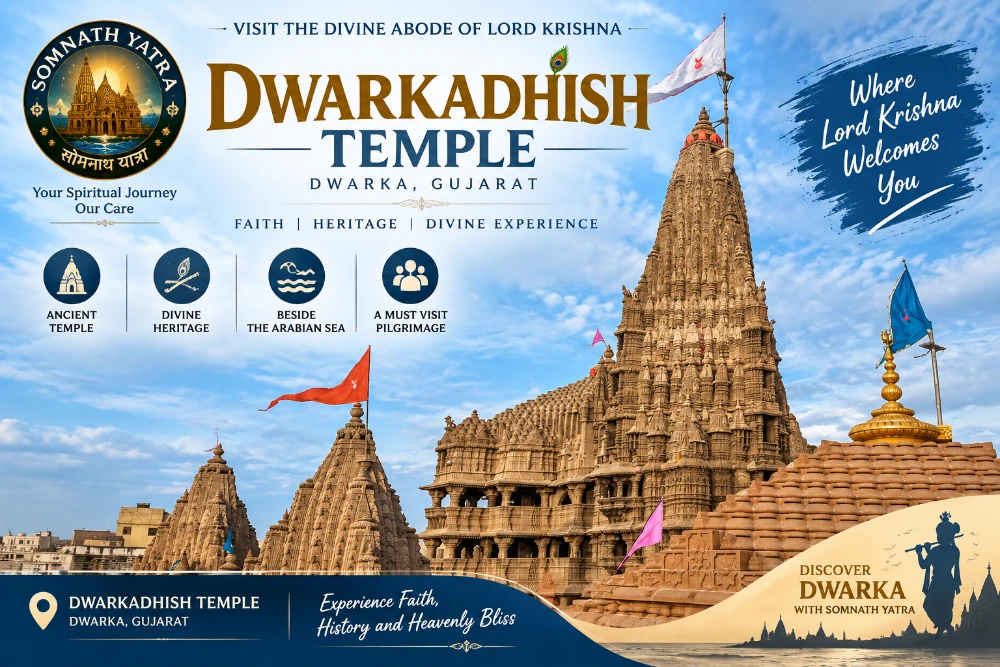
The Dwarkadhish Temple follows the Maru-Gurjara (Chalukya) architectural style. Five storeys rise on 72 intricately carved limestone pillars. The towering shikhara dominates the Dwarka skyline. A 50-metre flag—carrying the sun and moon symbols—flutters atop the spire, changed multiple times daily by priests. The flag symbolizes that Krishna stays with his devotees as long as the sun and moon endure. The flag changing ceremony, known as Dhwajarohan, happens five times a day. Gugali Brahmins climb the 78-meter shikhara barefoot to replace the flag—a breathtaking, gravity-defying spectacle that most visitors never think to watch. If you’re in the temple courtyard during the change, look up. It’s worth every second. Families can even sponsor the Dhwajarohan ritual through the temple trust, though bookings often stretch years in advance. Even if you can’t sponsor it, watching the climb is free and unforgettable. Two ceremonial gates frame the visit. Swarga Dwara (Heaven Gate) is where pilgrims enter. Moksha Dwara (Liberation Gate) leads out toward the Gomti Ghat, where devotees take a ritual bath in the sacred river before or after darshan. The temple complex also houses a memorial to Adi Shankaracharya, the 8th-century philosopher who established the Char Dham pilgrimage circuit. He visited Dwarka and marked it as one of the four sacred sites. His memorial inside the complex honors that historic journey. The sanctum sanctorum houses the black marble idol of Lord Krishna as Dwarkadhish—dressed in royal attire, adorned with jewelry, and attended by priests throughout the day. Unlike the childhood form of Krishna (Bal Krishna), this is the royal, ruling King of Dwarka. Eternal. Majestic. The kind of presence that makes you forget about your phone.Darshan Timings (2026)
The temple operates in two sessions. The afternoon closure catches first-time visitors off guard. If you arrive at 2 PM expecting to walk straight in, you’ll wait outside a closed gate. Plan around this.| Session | Timing | Notes |
|---|---|---|
| Morning Darshan | 6:30 AM – 1:00 PM | Starts after Mangala Aarti. Calmest before 8:30 AM. |
| Afternoon | Closed (1:00 PM – 5:00 PM) | Temple shut for rest and cleaning. |
| Evening Darshan | 5:00 PM – 9:30 PM | Ends after Shayan Aarti. Most atmospheric. |
Aarti Schedule – 6 Daily Rituals
The temple performs six aartis every day. Each marks a specific moment in the Lord’s divine routine—from waking in the morning to being put to rest at night. Attending at least one aarti, especially the Sandhya (evening) Aarti, is considered the most important spiritual experience of any Dwarka visit.| Aarti | Time | Significance |
|---|---|---|
| Mangala Aarti | 6:30 AM | First aarti. Auspicious morning awakening of the Lord. Calmest crowd. |
| Shringar Aarti | 7:30 AM | Decoration and adornment. The Lord is dressed for the day. |
| Gwal Aarti | 10:30 AM | Mid-morning offering. The Lord prepares to go to the cowshed. |
| Rajbhog Aarti | 12:00 PM | Grand midday offering. The royal meal is presented. |
| Sandhya Aarti | 7:00 PM | Evening aarti at dusk. Most attended. Most spectacular. Bells, oil lamps, bhajans. |
| Shayan Aarti | 8:30 PM | Final aarti. The Lord is put to rest for the night. Temple closes after this. |
Daily Rituals – The Lord’s Routine
The Pushtimarg traditions dictate the temple’s daily rhythm. The idol of Dwarkadhish is dressed in royal attire, and the atmosphere is one of joyful devotion. Here’s what happens throughout the day:| Time | Ritual | What Happens |
|---|---|---|
| 6:30 AM | Mangla Aarti | First prayers. Lord is woken. Temple opens. |
| 7:00-8:00 AM | Mangla Darshan | General darshan begins. |
| 8:00-9:00 AM | Abhishek Pooja | Ritual bathing with milk, honey, water. Darshan paused. |
| 9:00-9:30 AM | Shringar Darshan | Lord is adorned with ornaments and clothes. |
| 9:30-9:45 AM | Snanbhog | Food offering. Darshan paused. |
| 9:45-10:15 AM | Shringar Darshan | General darshan resumes. |
| 10:15-10:30 AM | Shringarbhog | Food offering. Darshan paused. |
| 10:30-10:45 AM | Shringar Aarti | Decoration aarti. |
| 11:05-11:20 AM | Gwal Bhog | Cowherd offering. Darshan paused. |
| 11:20 AM-12:00 PM | Darshan Open | General darshan. |
| 12:00-12:20 PM | Rajbhog | Royal meal offered. Darshan paused. |
| 12:20-1:00 PM | Darshan Open | Final morning darshan. |
| 1:00 PM | Anosar | Temple closes for afternoon. |
| 5:00 PM | Uthappan | Lord wakes. Evening darshan begins. |
| 7:00 PM | Sandhya Aarti | Evening aarti. Most attended. |
| 8:30 PM | Shayan Aarti | Final aarti. Lord rests. |
| 9:30 PM | Temple Closes | All darshan ends. |
Major Festivals
Janmashtami – Krishna’s Birthday
The biggest event. The temple remains open throughout the night. The midnight Abhishek ceremony is the main event—ritual bathing of the deity at the stroke of midnight. Over 5 lakh devotees flood into Dwarka. The entire city buzzes with energy. Different atmosphere entirely. If you’re planning a Janmashtami visit, book accommodation weeks in advance. The crowds are enormous. The experience is unforgettable. Worth every minute of the chaos.Holi – Festival of Colors
Celebrated with Tulsi leaves. The temple courtyard fills with colors, music, and the kind of energy that makes you want to join in. The Pushtimarg tradition adds a unique flavor—devotees offer Tulsi (holy basil) along with colors. Different from the water-holi of North India.Diwali & Annakut
During the five days of Diwali, the temple stays decked out with lamps that are never put off. The Annakut festival—the day after Diwali—sees the temple decorated with mountains of food offerings (56 dishes) to the Lord. The visual spectacle is extraordinary. Thousands of lamps. Mountains of prasad. The kind of celebration that makes you forget about sleep.Best Time to Visit
| Season | Months | Experience |
|---|---|---|
| Winter | October – March | Best time. Pleasant 18-28°C. Ideal for darshan and sightseeing. |
| Summer | April – June | Hot (35-42°C). Coastal humidity. Start early morning. |
| Monsoon | July – September | Scenic coastal views, occasional rain. Sudarshan Setu remains accessible. |
How to Reach Dwarkadhish Temple
| From | Distance | Time |
|---|---|---|
| Dwarka city centre | Walking distance | 5-10 minutes from Gomti Ghat |
| Somnath | 230 km | 4-4.5 hours by car |
| Rajkot | 220 km | 4 hours by car |
| Ahmedabad | 470 km | 8-9 hours by car |
| Veraval | 235 km | 4.5 hours by car |
| Okha (Sudarshan Setu to Bet Dwarka) | 30 km | 45 minutes by car |
Nearby Temples & Attractions
| Attraction | Distance | Time Needed |
|---|---|---|
| Nageshwar Jyotirlinga | 17 km | 1-2 hours |
| Bet Dwarka (Krishna’s residence) | 30 km via Sudarshan Setu | 3-4 hours |
| Rukmini Devi Temple | 2 km | 30 minutes |
| Sudama Setu (Bridge) | 1 km | 30 minutes |
| Gomti Ghat | Walking distance | 1 hour |
| Bhadkeshwar Mahadev Temple | 1 km | 30 minutes (low tide only) |
| ISKCON Temple Dwarka | 2 km | 1 hour |
| Gopi Talav | 20 km | 30 minutes |
| Shivrajpur Beach | 13 km | 1-2 hours |


