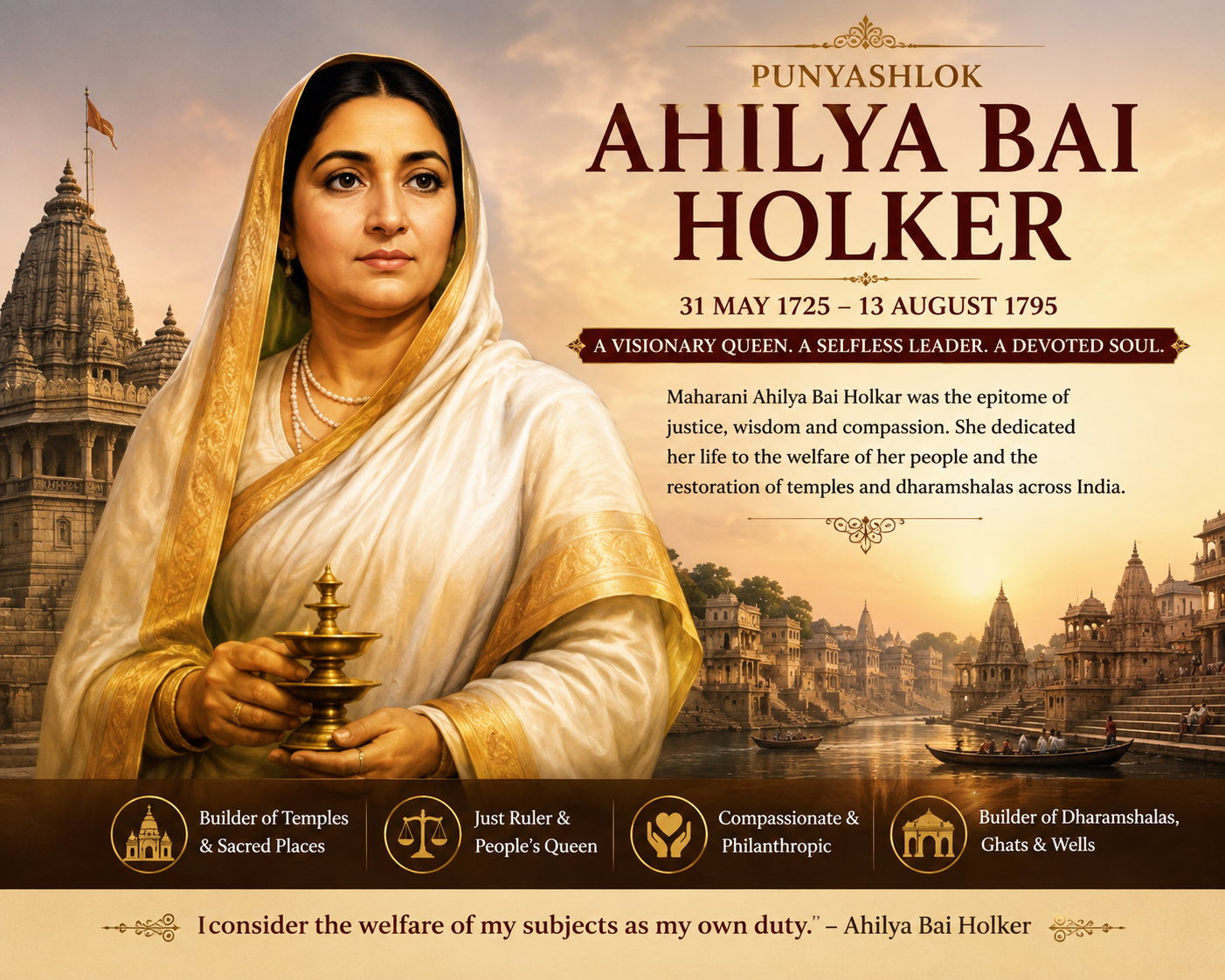
Ahilyabai Holkar: The Queen Who Rebuilt Somnath Temple
In 1767, a young widow sat on the throne of one of the Maratha Empire’s most powerful kingdoms. No formal military training. No royal blood. No precedent. Within years, Ahilyabai Holkar had turned Malwa into a functioning model of just governance—and earned the title “Philosopher Queen” from historians centuries removed from her world. She was born into modest circumstances in Maharashtra. Married into a rising dynasty. Then watched her husband, her father-in-law, and her son die—all before she turned forty. Most people would have broken. Ahilyabai Holkar did something else entirely: she took the throne herself. Her capital at Maheshwar, perched on the Narmada’s banks, became a center for trade, culture, and religious patronage that would have impressed rulers twice her age. The temples she commissioned—from Kashi to Somnath, from Dwarka to Grishneshwar—still stand. The Kashi Vishwanath Temple in Varanasi, one of the holiest Hindu shrines, was rebuilt under her direct patronage after Mughal destruction. Today, her name adorns an Indian naval ship, universities, airports, and statues scattered across Maharashtra and Madhya Pradesh. This biography traces her life from a village in Ahmednagar district to the fortress at Maheshwar—and examines the decisions that made her one of India’s most remarkable rulers.Early Life and Family Background
Birth and Childhood in Chondi Village
Ahilyabai was born on 31 May 1725. Chondi village, Ahmednagar district—nowhere special, by the standards of 18th-century India. Her father, Mankoji Shinde, held the position of village patil: a local chief with modest authority and even more modest wealth. The Shinde family belonged to the Dhangar community. Not the Maratha elite. Not aristocrats. Just… respectable. This middle-tier existence mattered more than it might appear. Ahilyabai understood ordinary people—their struggles, their rhythms, their limitations—because she’d grown up among them. She hadn’t been raised in a palace. She’d been raised in a village. And that distinction would shape everything she did later.A Rare Education for a Girl
Here’s what’s surprising. Mankoji Shinde did something almost unheard of in 18th-century India: he educated his daughter. Formal schooling for girls was virtually nonexistent. Among non-royal families, it was practically illegal. But Ahilyabai learned to read and write—acquiring intellectual tools that most women of her era never even touched.- Instruction in Marathi, Sanskrit, and basic arithmetic
- A father who believed girls deserved knowledge (radical for the period)
- Practical training in household management and religious practice
Meeting Malhar Rao Holkar
Then came the encounter that changed everything. Malhar Rao Holkar—the powerful Maratha sardar who founded the Holkar dynasty—passed through Chondi village with his entourage. He noticed Ahilyabai. Accounts differ on the details (a religious ceremony? water being served to travelers?), but the outcome was consistent. Malhar Rao saw something. Poise. Intelligence. Character. He proposed that she marry his son, Khanderao. This wasn’t casual matchmaking—it was dynastic strategy. Malhar Rao was building a kingdom, and he recognized that a woman of Ahilyabai’s caliber could strengthen the Holkar line in ways that political alliances alone could not achieve.Marriage into the Holkar Dynasty
Wedding and Integration into the Holkar Family
The marriage happened in the 1730s. Ahilyabai was young—very young, by modern standards. She left Chondi for the Holkar territories in Malwa, transitioning from a village chief’s daughter to a member of Maratha royalty overnight. The shift was enormous. She’d entered a military dynasty’s court—a world of sardars, commanders, and diplomats where political miscalculation could mean death. Khanderao, Malhar Rao’s son, was reportedly capable. The marriage appears to have been harmonious. But history, characteristically, focuses on power rather than affection.Life at the Holkar Court
The Holkar court moved between multiple locations—Indore, Maheshwar—each serving as a nerve center for territorial expansion. Malhar Rao was actively growing his domain, and the court buzzed with military planning, revenue negotiation, and diplomatic maneuvering. Ahilyabai watched. Closely. She studied how Malhar Rao managed relationships with the Peshwa (the Maratha prime minister), navigated rivalries with other sardars, and handled the unglamorous work of revenue collection. It was informal education. It was also invaluable.Training Under Malhar Rao Holkar
Malhar Rao didn’t just let his daughter-in-law observe. He actively taught her. Administrative procedures. Revenue management. Military strategy—subjects normally reserved for male heirs. The mentorship was deliberate. He couldn’t know Khanderao would die young. But he was preparing Ahilyabai for something important.- Revenue assessment and tax collection methods
- Military logistics and defense planning
- Judicial proceedings and dispute resolution
- Maratha diplomatic protocols
Role in Maheshwar Administration
She took on real responsibilities. Not ceremonial ones—actual decisions affecting actual people. Land disputes. Expenditure approvals. Holkar household operations. Maheshwar, on the Narmada, became her base. A fortress town she would later transform into her capital. By the time tragedy arrived, Ahilyabai wasn’t a royal consort playing a supporting role. She was an experienced administrator. And Malwa would soon need one.Personal Tragedies
Death of Husband Khanderao Holkar
1754. The Battle of Kumher. Khanderao Holkar was killed—struck down during the siege of a Jat fortress. The exact details remain contested. Cannonball during troop inspection? Killed in the assault itself? Sources disagree. What they agree on is simple: Ahilyabai was suddenly a widow. She was twenty-nine. They’d been married roughly two decades. She had a young son, Male Rao. The grief was real. But what came next tested her more than death itself.Attempted Sati, Stopped by Malhar Rao
Ahilyabai wanted to commit sati—immolating herself on Khanderao’s funeral pyre. It was expected. Almost routine among Rajput and Maratha women of the period. An act of supreme devotion, they called it. Malhar Rao said no. He refused. His reasoning was pragmatic: Ahilyabai’s intelligence and administrative skills were too valuable to burn. He persuaded her to live—for their son, for the dynasty. She accepted. And that decision—made under extraordinary pressure—kept the Holkar state alive.Death of Malhar Rao Holkar (1766)
For twelve years, Malhar Rao provided protection and guidance. He oversaw Holkar territories while grooming Male Rao for eventual rule. Then, in 1766, he died. The last senior figure in Ahilyabai’s life was gone. Male Rao assumed control. Barely.Death of Son Male Rao (1767)
His rule lasted a year. Maybe less. Historical sources describe mental instability—some say he was ill from birth, others that governance pressures broke him. He died in 1767. Ahilyabai had now lost her husband, her father-in-law, and her son. All gone. She was forty-two. Thirteen years. Every male member of her immediate family, dead. The dynasty Malhar Rao built from nothing appeared finished.Additional Losses
And then there were more. Her daughter Muktabai died. So did her son-in-law, Yashwantrao Phanse. Each loss stripped away another layer of support—another person she might have turned to for counsel, for companionship, for simple human comfort. She had none of that left. What she had was a kingdom. And the will to rule it.Timeline of Personal Tragedies
- 1754 – Khanderao Holkar killed at the Battle of Kumher
- 1754 – Ahilyabai prevented from committing sati by Malhar Rao
- 1766 – Malhar Rao Holkar dies
- 1767 – Male Rao dies after brief, unstable rule
- Later years – Daughter Muktabai dies
- Later years – Son-in-law Yashwantrao Phanse dies
Rise to Power
Circumstances Leading to Her Becoming Ruler
The formal mechanics were simple enough. Male Rao died without an heir. The dynasty needed a successor. Ahilyabai—the only surviving senior family member—was the logical choice. But logic rarely governs succession disputes. Power does. And in 1767, power briefly hesitated. Here’s what happened: Tukoji Rao Holkar, the military commander Malhar Rao had appointed years earlier, supported her claim openly. The Holkar sardars concurred—some enthusiastically, others cautiously, but they concurred. And Ahilyabai herself made one thing unmistakably clear: she would not serve as a figurehead. She intended to rule. Personally. Directly. Without apology.Political Challenges After Male Rao’s Death
The challenges arrived immediately. And they were serious. Rival Maratha factions watched Maheshwar with predatory interest—the Scindias, the Gaekwads, various minor sardars all calculating whether they might exploit the succession crisis. The Peshwa maintained ambiguous feelings about a woman exercising sovereign authority. Neighboring rulers tested her resolve through territorial encroachment. Internally, the Holkar state itself needed repair. Male Rao’s brief, erratic rule had created administrative gaps—revenue collection faltered, military readiness declined, judicial processes stalled. Ahilyabai inherited a kingdom that required reconstruction. Not just defense.Support from Tukoji Rao Holkar
Tukoji Rao Holkar’s loyalty proved decisive. He commanded the Holkar military forces—a position of enormous practical power. Rather than exploiting the crisis for personal advancement, he affirmed Ahilyabai’s authority. It was a calculation rooted in genuine respect; he’d served under Malhar Rao, watched Ahilyabai administer portions of the estate, and understood her capabilities firsthand. Their partnership would define three decades of Holkar governance: Ahilyabai handling administration, revenue, and justice; Tukoji managing military operations and battlefield strategy. Neither could have succeeded without the other. Both knew it.Formal Assumption of the Throne (1767)
She took the throne in 1767. No coronation ceremony survives in the historical record—no elaborate rituals, no public celebrations documented. Just a woman assuming control because the alternative was dynastic collapse. Then came the shrewd move. Ahilyabai petitioned the Peshwa directly for formal recognition—a calculated gesture that acknowledged the Peshwa’s theoretical authority while securing legitimacy that would quiet potential challengers. The Peshwa agreed. Ahilyabai Holkar was now, officially, the ruler of Malwa.Overcoming Opposition and Skepticism
Skepticism was real. Male rulers whispered. Courtiers doubted. Some sardars probed boundaries, testing how far they could push before she pushed back. Ahilyabai’s response was elegant in its simplicity: she governed. Consistently. Competently. Visibly. Within months, doubters had diminished. Within years, they’d vanished entirely. Her strategy worked like this: demonstrate capability so relentlessly that questioning her authority became embarrassing. It worked.Administration and Governance
Everything Ahilyabai built traces back to one principle. The state exists to serve its people. Not the reverse. She never articulated it philosophically—she simply governed that way, consistently, for thirty years.Capital Shifted to Maheshwar
Maheshwar became her permanent capital. A deliberate choice. The fortress town sat on the Narmada—strategically positioned between northern and southern Malwa, offering natural defenses, river access for trade, and crucial distance from the political turbulence of Indore. Rival factions couldn’t easily reach her here. She could govern without interference. The shift consolidated her authority. Maheshwar became the administrative heart of Holkar governance—a place where she heard petitions directly, maintained personal control over judicial proceedings, and exercised power without the缓冲 of intermediaries.Administrative Reforms and Structure
She built hierarchy. Districts reported to regional officers; regional officers reported to central authorities in Maheshwar. Revenue collection was standardized. Corruption was punished—sometimes severely. Officials understood that Ahilyabai monitored performance personally. That懒惰 or dishonesty would have consequences.- Revenue officers assessed land productivity and set tax rates accordingly
- Military commanders maintained local security forces
- Judicial officials resolved disputes under Ahilyabai’s direct oversight
- Administrative records were kept systematically—unusual for the period
Revenue and Taxation Policies
Taxation was structured but fair. She assessed land productivity, adjusted rates based on crop yields, and ensured collection didn’t devastate farming communities during poor harvests. Pragmatic governance recognizing an obvious truth: overtaxing peasants destroys the economic base that funds the state itself. Revenue records show consistent income throughout her rule. Trade taxes supplemented agricultural revenue. The Holkar treasury remained solvent—and unlike many contemporary rulers, Ahilyabai avoided the excessive military expenditure that drained public resources elsewhere.Justice System: Personally Hearing Grievances
Ahilyabai’s judicial approach was distinctive. She heard petitions personally. Subjects brought grievances directly to her—land disputes, property conflicts, criminal complaints. She examined evidence. Questioned witnesses. Rendered decisions based on law and precedent. No intermediaries. No缓冲. This wasn’t ceremonial. It was exhausting work. Hours each day spent adjudicating cases, reviewing documentation, issuing rulings. Her justice was known for consistency—punishing the powerful when they overstepped, protecting the vulnerable when they were wronged. The principle was simple: law applies equally, regardless of social position.Welfare-Oriented Governance Approach
State resources flowed toward public welfare. Employment policies supported artisans and craftspeople. Trade incentives encouraged commercial activity. Agricultural reforms improved irrigation and crop yields. The approach was pragmatic rather than ideological—Ahilyabai understood that prosperous populations generate more revenue, support stronger military forces, and remain politically stable. Enlightened self-interest. And it worked remarkably well.Support to Maheshwari Textile Industry
One of her most enduring economic legacies. Ahilyabai invited textile artisans to settle in Maheshwar—provided resources, protection, and market conditions that allowed handloom tradition to flourish. The Maheshwari saree—known for distinctive borders and fine cotton weave—became a recognized product under her patronage. The industry survived her. It survives today. Thousands of weavers in Maheshwar continue producing these sarees, maintaining a tradition she cultivated nearly three centuries ago.Agricultural Reforms and Irrigation Projects
Infrastructure received investment. Wells, tanks, canals—constructed across Malwa to reduce agricultural dependence on monsoon rainfall. The initiatives improved crop yields, stabilized food prices, and reduced famine risk that plagued neighboring territories. Not vanity projects. Functional infrastructure. Representing a significant portion of state expenditure—evidence that Ahilyabai prioritized long-term economic stability over short-term military expansion.Encouragement of Trade and Commerce
Trade routes through Malwa were protected. Merchants received security guarantees. Market regulations prevented exploitation. Ahilyabai understood commerce generated tax revenue, created employment, and connected Malwa to broader economic networks. Under her rule, Malwa became a commercial hub—not through aggressive expansion, but through stable governance that made trade profitable and safe.| Policy Area | Ahilyabai’s Approach | Contemporary Maratha Rulers |
|---|---|---|
| Revenue Collection | Standardized, productivity-based assessment | Often arbitrary, driven by military needs |
| Justice | Personal adjudication, equal application | Delegated, inconsistent enforcement |
| Trade Policy | Protected merchants, market regulation | Varied; some protection, some exploitation |
| Infrastructure | Irrigation, roads, public works investment | Military infrastructure prioritized |
| Welfare | Artisan support, employment policies | Limited systematic programs |
Military Leadership and Defense of Malwa
She didn’t lead armies into battle. Didn’t need to. Ahilyabai’s military intelligence lay in selection, strategy, and resource allocation—in ensuring the people who fought had training, equipment, and leadership to win.Role of Tukoji Rao Holkar as Military Chief
Tukoji Rao Holkar commanded the Holkar military forces throughout her rule. A seasoned veteran who’d served under Malhar Rao, he understood Maratha warfare’s complexities. His appointment wasn’t merely administrative—it was strategic. Tukoji brought battlefield experience that complemented Ahilyabai’s administrative expertise perfectly. Their working relationship was collaborative. She set strategic priorities, allocated resources; he executed operations. Disagreements occurred—by all accounts, they did—but they resolved internally. The public face of Holkar military authority remained unified. And that unity deterred aggressors.Strategic Decisions During Conflicts
Her strategic thinking reflected calculation, not impulse. She avoided unnecessary conflicts—recognizing Malwa’s military strength, while sufficient for defense, couldn’t sustain prolonged offensive campaigns against larger Maratha powers. When conflict was unavoidable, she committed decisively. When negotiation could achieve objectives without bloodshed, she preferred that route. Pragmatic statecraft. And it kept Malwa intact for three decades.Maintaining Malwa’s Autonomy Amid Maratha Politics
The Maratha confederacy was never unified. It was a loose alliance—Holkars, Scindias, Gaekwads, Bhonsles—each pursuing independent interests under the Peshwa’s nominal authority. Ahilyabai navigated this fragmented landscape with remarkable skill, maintaining autonomy while avoiding conflicts that invited intervention from stronger neighbors. Her diplomacy was cautious but not submissive. She acknowledged the Peshwa’s theoretical authority when convenient, resisted encroachment when necessary, and built alliances reinforcing Holkar independence. The result: Malwa remained sovereign throughout her rule—a significant achievement given the period’s political volatility.Relations with Peshwas and Other Maratha Sardars
Relationships with the Peshwa were complex. She sought recognition without submission—acknowledging nominal supremacy while resisting attempts to impose direct control over Holkar territories. The dynamic required constant calibration. Too much deference invited exploitation; too much independence provoked confrontation. With other sardars, she maintained pragmatic relations—avoiding territorial disputes with the Scindias and Gaekwads, focusing instead on consolidating established territories. Conservative, perhaps. But it preserved peace. And allowed internal development to proceed without military disruption.Handling of Bhil and Gond Tribal Issues
Malwa’s hill regions housed Bhil and Gond communities—tribal populations that frequently resisted centralized authority. Ahilyabai addressed these challenges through negotiation, accommodation, and selective force. She recognized tribal land rights in some areas, appointed intermediaries, and deployed military only when negotiations failed. Not perfect. But more effective than outright suppression favored by many contemporary rulers—and it reduced chronic instability that plagued hill regions under less flexible administrations.Religious and Cultural Contributions Across India
Temple Construction and Renovation Across India
Start with Kashi Vishwanath. One of the twelve Jyotirlingas—the holiest Shiva shrines in existence. Aurangzeb’s forces destroyed the original temple in 1669, replacing it with a mosque. For a century, Hindus worshipped in secret, maintaining their faith through Mughal persecution. Then Ahilyabai Holkar rebuilt it. Her money. Her architects. Her determination. The temple standing today on the Ganges’ banks exists because she decided it should. But Kashi was only the beginning.- Kashi Vishwanath Temple, Varanasi – Rebuilt from ruin; perhaps her most significant achievement
- Somnath Temple – Restoration work on another Jyotirlinga, equally sacred
- Grishneshwar Temple, Ellora – Renewed under her patronage
- Mahakaleshwar Temple, Ujjain – Renovation and ongoing maintenance
- Dwarka – Construction in Lord Krishna’s legendary city
- Rameshwaram – Patronage extended to southern India’s most important Shiva site
Ghats at Varanasi, Haridwar, Nashik, Ujjain
Temples required access. Pilgrims needed to reach water. Ahilyabai understood this practical reality and funded ghats—stone staircases descending to sacred rivers—at multiple locations across India. The pattern repeated itself consistently. Identify a major pilgrimage site. Fund functional infrastructure. Inscribe the Holkar name into Hindu sacred geography. Varanasi received ghats on the Ganges. Haridwar got the same. Nashik, on the Godavari. Ujjain, on the Shipra. These weren’t decorative. Thousands of pilgrims used them daily—for ritual bathing, the core practice of Hindu pilgrimage. And every single one of them encountered Ahilyabai’s name carved into stone.Dharamshalas: Rest Houses for Pilgrims
Pilgrimage in 18th-century India was brutal. Travelers walked hundreds of miles through hostile territory with minimal access to food, water, or shelter. Disease, robbery, and exhaustion killed pilgrims regularly. Ahilyabai addressed this problem directly by funding dharamshalas—rest houses—at strategic locations along major routes. Not luxury accommodations. Functional stone structures offering basic shelter, water access, sometimes free food. For pilgrims who’d spent weeks on the road, these places represented survival. And they bore the Holkar name—a constant reminder of who had provided this mercy.Wells, Tanks, and Water Infrastructure
Water. Sacred and practical. Ahilyabai grasped both dimensions simultaneously. She commissioned wells and tanks across India—not just in Malwa, but in distant regions where Holkar political control was nonexistent. The projects served religious purposes: water for ritual use. And practical ones: drinking water for communities and travelers who might otherwise die of thirst. Some still function. Others survive only as archaeological remnants—but their inscriptions persist, recording her name and her commitment to public welfare. Infrastructure that outlived dynasties, empires, and political systems. Simple stone wells. Built to last.Support to Sanskrit Scholars and Pandits
Ahilyabai didn’t just build things. She funded people. Sanskrit scholars, pandits, educators—she supported the intellectual class that sustained Hindu religious practice across generations. Financial assistance, institutional support, resources for text preservation. In an era when most rulers concentrated exclusively on military expansion, she allocated resources to cultural preservation. The decision reflected her values—and her understanding that a kingdom’s strength depended not just on armies, but on the intellectual life that gave those armies meaning.Patronage of Art and Culture
Beyond temples and infrastructure, Ahilyabai supported artistic production. Music. Visual arts. Craftsmanship. Her patronage extended across multiple cultural domains, attracting talented individuals to Maheshwar who found employment, protection, and creative freedom under her rule. The patronage wasn’t random. It was systematic. Cultural production enhanced Holkar prestige, attracted skilled workers, and contributed to economic vitality through the production and trade of luxury goods. Art as economic engine. Art as political statement. Art as cultural preservation. Ahilyabai understood all three dimensions.| Region | Major Commissions | Type |
|---|---|---|
| Varanasi | Kashi Vishwanath Temple, Ganges Ghats | Temple restoration, river access |
| Somnath | Somnath Temple | Temple restoration |
| Ujjain | Mahakaleshwar Temple, Shipra Ghats | Temple renovation, river access |
| Dwarka | Temple construction | New construction |
| Rameshwaram | Temple patronage | Restoration support |
| Ellora | Grishneshwar Temple | Temple restoration |
| Nashik | Godavari Ghats | River access infrastructure |
| Haridwar | Ganges Ghats | River access infrastructure |
Personal Life and Character of Ahilyabai Holkar
Here’s what’s strange about Ahilyabai Holkar. She commanded extraordinary resources—agricultural revenue, trade taxes, textile income, artisan production. The Holkar treasury could fund temples across the subcontinent, maintain military forces, and operate one of the Maratha Empire’s most efficient administrative machines. She controlled wealth that most rulers could only imagine. And she lived like a monk.Simple Lifestyle Despite Wealth and Power
Plain clothes. Modest meals. A simple cot for sleeping. The historical accounts are consistent: Ahilyabai’s personal lifestyle was austere. Not performatively so—not ostentatious poverty designed to impress observers. Genuinely austere. She simply didn’t care about personal luxury. The contrast with the temples she commissioned was striking. Palaces for deities; simplicity for herself. It wasn’t denial born of necessity. It was choice. A philosophical statement enacted through daily habit: wealth exists to serve public purposes, not private desires.Personal Piety and Devotion to Lord Shiva
Devout Shaivite. That’s the consistent description across sources. Her daily life revolved around worship of Lord Shiva—prayers, rituals, meditation. The devotion was genuine, not performative. She believed. Deeply. And she structured her personal existence around that belief with a consistency that impressed even contemporaries who didn’t share her faith. This matters because it contextualizes her temple-building. She didn’t construct shrines because they were politically useful—though they were. She constructed them because she believed in Shiva, and she believed honoring him through architecture was a sacred obligation. The political benefits were incidental. Or maybe they weren’t. Maybe devotion and strategy weren’t separate categories for Ahilyabai. Maybe they were the same thing.Daily Routine and Habits
Dawn. Prayers—usually an hour or more of personal worship before anyone else in the fortress stirred. Then administrative work: petitions, officials, revenue reports. Afternoons for judicial proceedings—she heard grievances personally, examined evidence, rendered decisions. Evenings brought more prayer, sometimes followed by scholarly discussions or advisory meetings. Relentless. Thirty years of this routine. No vacations. No withdrawal periods. No delegation of core responsibilities. She governed directly until her body made it impossible. And even then, she resisted stepping back.Relationship with Her Subjects: Called “Rajmata”
“Rajmata.” Mother Queen. That’s what her subjects called her—and the title persisted long after death. Not mere flattery. It reflected something real: a maternal relationship between ruler and ruled that Ahilyabai deliberately cultivated through decades of consistent behavior. She heard their complaints. Personally. She punished officials who exploited them. She invested in infrastructure that improved their daily existence. The relationship was reciprocal: loyalty, revenue, and military service in exchange for justice, protection, and welfare. A social contract expressed through action rather than philosophy.Approach to Justice: Punishing Her Own Son
One incident captures her judicial philosophy perfectly. Her son, Malerao (also known as Male Rao), committed criminal offenses—violence or extortion against subjects, depending on which account you trust. Ahilyabai punished him. Personally. Publicly. No special treatment. No dynastic immunity. Her own blood received the same justice as the poorest peasant. The message was unmistakable: law applies equally, regardless of who you are. That single act probably did more to establish judicial credibility than years of consistent ruling could have achieved. It was dramatic. It was public. And it worked.Views on Duty, Dharma, and Public Service
Dharma. The concept dominated her worldview. Rulers had sacred obligations to subjects. Governance wasn’t a privilege to exploit—it was a responsibility to fulfill. This wasn’t abstract philosophy for Ahilyabai. It was operational principle. Every decision she made—from tax policy to temple construction to judicial proceedings—reflected this conviction. Many rulers invoked dharma when convenient. Ahilyabai practiced it regardless of convenience. The difference defined her legacy.A Notable Quote
“This empire has been entrusted to me by providence. I have to protect my subjects, and I cannot tolerate injustice being done to them. I shall myself look into the complaints of my subjects.”Whether these were her exact words remains uncertain. Historical records from 18th-century India rarely preserve direct quotations verbatim. But the sentiment matches her behavior perfectly. She did look into complaints. Personally. For thirty years. Without exception. The quote—whether authentic or paraphrased—captures something true about how she governed.
Family, Successors, and Grooming Future Leaders
Relationship with Adopted Son and Heir
Khanderao II became her heir. Sometimes called Male Rao’s successor. The adoption wasn’t emotional—it was dynastic survival. She needed someone to continue the line. She chose a candidate whose capabilities she could assess. Whose loyalty she could test. Whose development she could control. The relationship was complex. Ahilyabai maintained authority throughout. She didn’t transfer power and retreat. She continued governing. Continued hearing petitions. Continued making decisions. Her heir was being prepared, not empowered. She remained in charge until death removed her.Grooming Tukoji Rao’s Sons for Future Roles
Tukoji Rao Holkar had several sons. Ahilyabai evaluated each one. Identified the most capable: Kashirao, Vitthal Rao, later Yashwantrao. Positioned them according to strengths. It wasn’t random favoritism—it was systematic human capital development. Training future administrators and military commanders who would serve the dynasty long after she was gone. Kashirao learned administration. Vitthal Rao studied military command. Each son received responsibilities matching his abilities—not arbitrary assignments, but deliberate placements based on observed aptitude. The approach was methodical. And it ensured continuity.Preparing Succession Plan
Succession planning is governance. That’s what Ahilyabai understood that many rulers don’t. She didn’t wait for death to force the issue. She prepared for it—established clear authority lines, trained successors, created administrative structures capable of functioning without her direct oversight. The approach was comprehensive. Revenue officers, military commanders, judicial officials—all positioned to continue working during any transition. The Holkar state she built wasn’t dependent on her presence. It was designed to survive her absence. That’s the mark of a true administrator.Later Years and Death of Ahilyabai Holkar
The final decade was hard. Her health declined—chronic ailments accumulated, physical strength faded, the relentless pace of governance exacted its toll. But she refused to stop. Administrative duties continued. Petitions were heard. Decisions were made. The routine persisted even as her body failed.Health Decline in Later Years
Specific medical details are scarce—18th-century records rarely preserve clinical information. What survives suggests chronic weakness. Possibly arthritis or joint pain that worsened with age. She experienced periods of incapacity, brief withdrawals from public life, but always returned. Always resumed her duties. The stubbornness was characteristic. She had governed for nearly thirty years. The idea of relinquishing control—allowing others to make decisions she could make herself—was apparently intolerable. So she persisted. Until persistence was no longer possible.Death Date and Place (13 August 1795, Maheshwar)
13 August 1795. Maheshwar. She died at approximately seventy years of age—remarkable longevity for someone who had endured decades of personal loss, political pressure, and administrative workload. She died in the fortress she had made her capital. Surrounded by the machinery she had built. No dramatic deathbed scenes recorded. No final speeches preserved. Just a woman who had governed for three decades, declining gradually, and then stopping. The administrative systems continued functioning without interruption. That was her final achievement.Funeral and Memorial
The funeral reflected public affection she had cultivated for thirty years. Mourners gathered in large numbers—subjects, officials, soldiers, priests, merchants. The grief was genuine. She had been the visible embodiment of just governance. Her death represented not just dynastic transition, but the loss of a personal relationship between ruler and ruled. Memorials were constructed. Temples maintained her memory. Inscriptions preserved her name. And the systems she built kept functioning—perhaps the most meaningful memorial of all.Legacy and Historical Significance
Thirty years. Temples across India. Administrative systems that outlasted dynasties. A reputation that survived British colonialism, Indian independence, and modern political upheavals. Ahilyabai Holkar’s legacy isn’t historical. It’s active. Present tense.Titles: Philosopher Queen, Ahilyamata
“Philosopher Queen.” Western historians chose that title—capturing her intellectual rigor and political authority. Indian sources prefer “Ahilyamata”—Mother Ahilya—reflecting the maternal bond she created with her subjects. Both titles are accurate. She was philosophical—systematic, principled, consistent. She was maternal—personally invested in welfare, hearing complaints, addressing needs. The dual identity defined her rule. Intellectual precision combined with nurturing care. Rare combination. She embodied it completely.Comparison with Contemporary Rulers
Compare her with contemporaries. The Peshwas faced constant succession crises. The Scindias oscillated between alliance and conflict. The Gaekwads struggled with internal factionalism. Ahilyabai maintained stability for three decades. No succession disputes. No internal rebellions. No territorial losses. The contrast was stark. And contemporaries noticed. British administrators who encountered Holkar governance during their expansion into central India frequently commented on its efficiency. The praise wasn’t sentimental—it was comparative. Her administration simply functioned better than most.Influence on Later Indian Rulers
Her influence extended beyond her lifetime. Later Maratha rulers studied her methods. Indian independence leaders invoked her example when arguing for women’s participation in governance. Modern politicians reference her legacy during administrative reform discussions. Not always direct influence. Sometimes cultural memory—the persistent Indian tradition of Ahilyabai as ideal ruler, referenced in textbooks, folk stories, political discourse. She became an archetype. And archetypes shape behavior long after specific details are forgotten.Recognition by British Historians and Administrators
British administrators encountered her governance in the early 19th century. Their assessments were consistently positive. Her administrative systems impressed officials accustomed to judging Indian governance by European standards. The praise was sometimes patronizing—colonial observers framed Indian achievements through Western lenses—but the recognition was genuine. British historians later included her in surveys of Indian rulers, noting administrative efficiency, judicial fairness, religious patronage. The assessments established her reputation beyond regional traditions—creating national and eventually international awareness of her achievements.| Recognition Type | Name | Year/Location |
|---|---|---|
| Naval Ship | INS Ahilyabai | Indian Navy, commissioned 2021 |
| Airport | Devi Ahilyabai Holkar Airport | Indore, Madhya Pradesh |
| University | Ahilya Bai Government Girls Post Graduate College | Indore |
| Statues | Multiple memorials | Maharashtra, Madhya Pradesh |
| Postal Stamps | Commemorative stamp | India Post |
| Highway | Ahilyabai Holkar Marg | Mumbai |
Modern-Day Recognition
Her name appears everywhere. An airport in Indore—Devi Ahilyabai Holkar International Airport. Universities, colleges, hospitals, roads. The Indian Navy commissioned INS Ahilyabai in 2021. Stamps, statues, textbooks. Her face appears in classrooms, government offices, political discourse. She’s part of India’s national identity now—not just Maratha history, but a symbol of just governance recognized across the subcontinent. A woman who ruled in her own right nearly three centuries ago, still invoked in modern political debates about administrative reform and women’s leadership.Why Her Legacy Endures
Why does she matter now? Because she proved something many rulers claim but few achieve: governance that prioritizes subjects over self. She controlled resources sufficient for extravagant personal luxury. She chose simplicity. She could have delegated judicial responsibilities—hearing petitions is exhausting work. She chose personal involvement. She could have focused exclusively on military expansion—typical for 18th-century rulers. She chose balanced development. The choices defined her legacy. And the legacy endures because the questions she answered—What does just governance look like? How should rulers balance power and responsibility?—remain unanswered in many parts of the world. Her example still speaks. Still challenges. Still inspires.Ahilyabai Holkar in Popular Culture
Books Written About Her
Biographical literature spans languages. Centuries. Marathi sources dominate—regional historians documented her rule extensively. Administrative records. Court proceedings. Personal accounts. The raw materials for modern scholarship. English-language biographies emerged during British colonial expansion. Western administrators encountered Holkar governance in central India and wrote assessments. Some were patronizing—colonial observers filtered Indian achievements through European lenses. But Ahilyabai’s competence impressed even skeptical officials. The praise was genuine. Modern publications continue. Academic histories. Popular biographies. Children’s books. Political analyses. Each generation reinterprets her for contemporary audiences. The common thread never changes: admiration for administrative genius that transcends gender, era, political context.Films and TV Serials
Indian television serials have featured Ahilyabai. Maratha history dramas. The portrayals emphasize administrative genius. Personal piety. Tragic family circumstances. Dramatic elements that translate to screen effectively. Film adaptations remain limited—periodically announced, rarely produced. The challenge is brutal: condensing thirty years of complex governance into cinematic narrative. Compressing achievements that unfolded gradually into dramatic structures demanding resolution. The task is formidable. But the interest persists.Her Image in Indian Folklore and Public Memory
Beyond formal publications, Ahilyabai survives in oral tradition. Folk songs in Maharashtra. Folk songs in Madhya Pradesh. Stories passed between generations—some historical, some embellished, some entirely legendary. Communities that never encounter academic biographies still tell stories about the queen who governed justly. The folk tradition matters because it operates independently. No textbooks assigning her. No politicians promoting her. People tell her stories because the stories resonate. Organic survival across three centuries suggests genuine cultural impact—not manufactured legacy.Her Relevance to Women Empowerment Discourse
Contemporary Indian feminism claims her. She ruled a major kingdom in her own right. Exercised executive authority. Commanded military resources. Maintained power for three decades—in an era when women’s public participation was severely restricted. Her example shatters narratives framing women’s leadership as modern innovation. The appropriation sometimes simplifies—reducing complex history to inspirational soundbites. But the core relevance is real. She demonstrated female political leadership could be effective. Stable. Celebrated. That message resonates powerfully in contemporary India.Historical Assessment and Historian Perspectives
Multiple perspectives converge. Administrative efficiency. Political strategy. Religious patronage. Gender dynamics. Economic development. Historians examining Ahilyabai from different angles reach the same conclusion: she was exceptional.Views of Historians on Her Rule
Indian historians emphasize administrative innovations. Systematic revenue assessment. Personally supervised judicial system. Welfare-oriented governance. They position her within Maratha traditions—refining existing systems rather than inventing new ones. Improvement, not revolution. Western historians often focus on gender. Her rule as evidence of women’s capacity for pre-colonial political leadership. Valid perspective. Sometimes reductive—framing achievements primarily through gender rather than examining them independently. Modern scholarship integrates both. Examines administrative competence while acknowledging gendered context that made her achievement remarkable. Nuanced. Balanced. More honest than either perspective alone.Comparison to “Ideal Ruler” Concept in Indian Tradition
Rajadharma—the Hindu concept of just governance. Ahilyabai’s rule maps perfectly onto classical standards. Personal austerity. Judicial fairness. Religious patronage. Public welfare. Administrative competence. She didn’t merely claim just governance. She practiced it. Consistently. For thirty years. Not coincidental. She was educated in Hindu political philosophy. Understood rajadharma principles. Implemented them regardless of convenience. The result: governance contemporaries recognized as embodying traditional ideals. Creating resonance across centuries.Her Administrative Model’s Relevance Today
Modern Indian administrators study her. Revenue techniques she pioneered remain relevant. Her judicial accessibility—personally hearing grievances—offers lessons for contemporary systems struggling with backlogs and public distrust. Her welfare approach provides developmental administration models. Not merely historical relevance. In an era of criticism—corruption, inefficiency, detachment from public needs—Ahilyabai offers counter-narrative. Competent governance is possible. Transparent governance is possible. She demonstrated it. The demonstration remains instructive.Criticism or Challenges During Her Reign
No figure is beyond criticism. Some historians note her cautious foreign policy—avoiding conflict, prioritizing internal development—limited territorial expansion. Scindias and Gaekwads expanded more aggressively during the same period. Established larger domains through conquest. Others examine patriarchal constraints. Her authority derived partly from husband’s and father-in-law’s positions. She maintained power partly by avoiding actions provoking male elites into rebellion. Debatable interpretation—applies modern standards to 18th-century realities—but acknowledges genuine constraints. Criticism contextualizes rather than diminishes. She ruled effectively within severe limitations. Thirty years of stability and prosperity under those conditions makes achievement more impressive. Not less.Famous Quotes and Anecdotes
The stories survive. Three centuries later, people still tell them. The queen who heard petitions personally. Who punished her own son. Who lived simply while funding temples across the subcontinent. Some stories documented. Others legendary. All reveal something true about Indian memory.Famous Incidents Showing Her Sense of Justice
The most famous incident. Her son. Malerao—sometimes called Male Rao—committed criminal offenses. Violence against subjects. Extortion. Details vary across sources. Outcome remains consistent: Ahilyabai punished him. Personally. Publicly. No special treatment for the Holkar heir. Legendary because it demonstrated judicial equality. A queen punishing her own son for crimes against subjects—that’s not principle. That’s action. Established precedent constraining judicial corruption for remainder of her rule.Notable Quotes Attributed to Her
“This empire has been entrusted to me by providence. I have to protect my subjects, and I cannot tolerate injustice being done to them.”Exact words uncertain. 18th-century India rarely preserved direct quotations verbatim. But sentiment matches behavior perfectly. She protected. She tolerated no injustice. Quote—authentic or paraphrased—captures something true. Another attribution: “I shall myself look into the complaints of my subjects.” Almost certainly accurate. Multiple sources confirm personal petition hearings. Direct evidence examination. Decisions without intermediaries. Practice unusual. Commitment absolute.
Stories Illustrating Her Humility and Wisdom
- The Petition Queue – Subjects waited hours to present grievances directly, believing her judgment fairer than any official’s
- The Simple Cot – Despite vast resources, she slept on basic wood, refusing comfort while subjects struggled
- The Temple Funding – She personally inspected construction, questioned expenses, ensured every coin served intended purpose
- The Market Regulation – She punished exploitative merchants, established fair pricing protecting ordinary buyers
- The Rain Prayer – During drought, she led public prayers—combining piety with visible solidarity with suffering subjects


