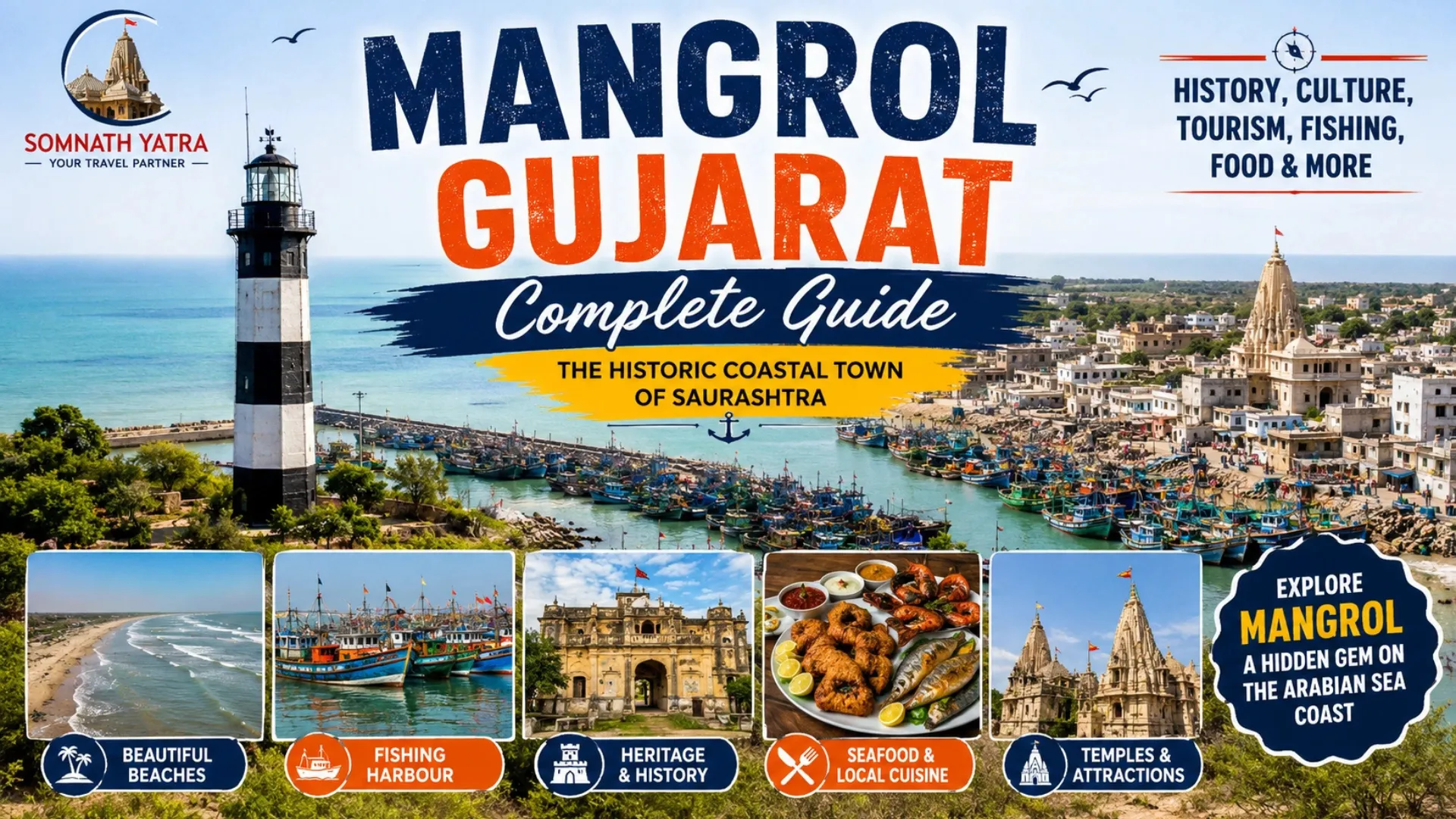
When people think about Gujarat’s famous coastal destinations, places like Dwarka, Somnath, Diu or Veraval often come to mind. However, not very far from these well-known places lies Mangrol, a historic coastal town in the Junagadh district that has quietly preserved centuries of history, maritime traditions and cultural heritage.
Today, Mangrol is widely known as one of Gujarat’s important fishing centres, but its story goes much deeper than fishing boats and busy harbours. Over hundreds of years, this coastal town has witnessed the rise of local kingdoms, flourishing sea trade, colonial administration, the political changes of India’s Independence, and the growth of educational institutions that continue to shape thousands of lives.
Unlike many towns that developed around agriculture, Mangrol grew because of the sea. The Arabian Sea has always been the town’s greatest strength. It provided livelihood to generations of fishermen, connected traders with distant lands, and helped Mangrol become an important regional port long before modern transportation networks were built.
Even today, visitors arriving in Mangrol will notice that life revolves around the coastline. Fishing boats leave before sunrise, local markets remain busy throughout the day, and the sea continues to influence the town’s economy, traditions and daily life.
Although Mangrol may not appear on every tourist itinerary, it offers an interesting combination of history, culture, coastal beauty and local traditions that make it worth exploring. Whether you are interested in Gujarat’s princely states, maritime history, fishing industry or simply wish to discover a less-explored destination, Mangrol has a fascinating story waiting to be told.
This comprehensive guide explores the complete history, geography, economy, education, culture, tourism and modern significance of Mangrol in a simple and informative manner.
Where is Mangrol Located?
Mangrol is situated in the Junagadh district of Gujarat on the western coast of India. It lies along the Arabian Sea on the southern side of the Saurashtra (Kathiawar) Peninsula.
The town is located approximately:
- 65 km from Somnath
- 55 km from Keshod
- 70 km from Junagadh
- 140 km from Porbandar
- 110 km from Diu
Its geographical location has played a major role in shaping the town’s identity. Unlike inland towns that depended mainly on farming, Mangrol naturally evolved as a fishing and trading settlement because of its direct access to the Arabian Sea.
The town falls under Mangrol Taluka and serves as an important commercial centre for many surrounding villages.
Quick Facts About Mangrol
| Feature | Details |
|---|---|
| State | Gujarat |
| District | Junagadh |
| Region | Saurashtra (Kathiawar) |
| Elevation | Approximately 18 metres |
| PIN Code | 362225 |
| Official Language | Gujarati |
| Primary Occupation | Fishing, Agriculture, Trade |
| Coastline | Arabian Sea |
Geography and Climate of Mangrol
Mangrol enjoys a typical tropical coastal climate that remains pleasant for most of the year compared to many inland regions of Gujarat.
The Arabian Sea helps moderate temperatures throughout the seasons. Summers are warm but generally less extreme than interior parts of Gujarat, while winters remain comfortable and suitable for tourism.
Summer (March to June)
Summer temperatures generally range between 28°C and 38°C. Sea breezes provide some relief during the evenings, making coastal areas comparatively comfortable.
Monsoon (June to September)
Mangrol receives moderate rainfall during the southwest monsoon. The rains are extremely important for nearby agricultural areas and also influence fishing activities, as deep-sea fishing is often restricted during this period for safety and marine conservation.
Winter (October to February)
Winter is considered the best season to visit Mangrol. Temperatures usually range between 18°C and 28°C, creating pleasant weather for sightseeing, beach walks and exploring nearby attractions.
The Ancient History of Mangrol
Although modern Mangrol is a relatively small coastal town, the region around it has been connected with maritime activity for thousands of years.
The western coast of Gujarat has always been among India’s most active seafaring regions. Archaeological discoveries at sites such as Lothal, Dholavira, Bet Dwarka and several other Harappan settlements demonstrate that Gujarat maintained overseas trade nearly 4,000 years ago with civilizations in Mesopotamia, Oman and the Persian Gulf.
While there is no archaeological evidence proving that present-day Mangrol itself functioned as a Harappan dockyard, historians agree that the entire Saurashtra coastline formed part of an extensive maritime network that connected ancient Gujarat with distant regions across the Arabian Sea.
For centuries, small natural harbours like Mangrol served fishermen, coastal traders and merchant vessels navigating between western India and ports in Arabia and East Africa.
The sea was not merely a source of food; it was also a gateway to commerce, cultural exchange and economic prosperity.
Gujarat’s Maritime Legacy and Mangrol’s Coastal Importance
Gujarat has one of the longest coastlines in India, stretching for over 1,600 kilometres. This geographical advantage made the state a major centre for maritime trade from ancient times.
Several historical records indicate that traders from Gujarat exported goods such as:
- Cotton textiles
- Spices
- Indigo
- Beads
- Salt
- Handcrafted products
In return, merchants imported:
- Horses
- Dates
- Pearls
- Dry fruits
- Precious metals
- Luxury goods
Although ports like Bharuch, Khambhat and later Surat became internationally famous, smaller ports such as Mangrol played an equally important supporting role in regional coastal trade.
Local fishermen and sailors possessed remarkable knowledge of tides, winds and navigation long before modern technology became available.
Even today, traditional fishing communities in Mangrol preserve many customs that reflect this centuries-old relationship with the sea.
Mangrol During the Medieval Period
During the medieval era, the Saurashtra region witnessed the rule of several powerful dynasties, including the Chudasamas, Gujarat Sultanate, Mughal Empire and later the Marathas.
Like many coastal settlements, Mangrol benefited from its strategic position on the Arabian Sea. Merchant ships frequently sailed along the western coast of India, and ports such as Mangrol became useful stopping points for regional trade.
Fishing communities expanded steadily, while merchants dealing in grains, salt and other goods contributed to the local economy.
Because of its coastal location, Mangrol occasionally faced threats from pirates and rival powers. Protecting maritime trade was an important responsibility of local rulers, who maintained control over coastal routes and harbour activities.
The town gradually developed into an administrative centre for surrounding villages, laying the foundation for the princely state that would emerge in the following centuries.
The Rise of the Princely State of Mangrol
One of the most fascinating chapters in Mangrol’s history is its role as a princely state.
Unlike today’s administrative divisions, pre-independence India consisted of hundreds of princely states governed by local rulers under British paramountcy. Mangrol was one such state.
Historical records trace the ruling family’s influence in the region back to around the 14th century. Over time, the rulers adopted the hereditary title of Sheikh Saheb, which became closely associated with the administration of Mangrol.
A significant turning point came in 1748, when Sheikh Mian successfully asserted greater autonomy from the Marathas. Although Mangrol later accepted the suzerainty of the neighbouring Junagadh State, its rulers retained considerable authority over local administration.
The princely state governed nearly twenty-one villages, collected revenue, maintained law and order, and managed local affairs while remaining under the broader political influence of Junagadh.
During British rule, Mangrol enjoyed recognition as a princely state with a unique constitutional status. While it was not among the largest princely states in western India, it occupied an important place within the political landscape of Kathiawar.
Its strategic coastal location further increased its significance, as maritime trade remained valuable throughout the colonial period.
Mangrol’s Role During the Partition of India
The year 1947 brought dramatic political changes across the Indian subcontinent, and Mangrol became part of one of the most significant constitutional debates in western India.
When British rule ended, princely states were given the option to join either India or Pakistan, considering factors such as geography, population and political interests.
Initially, the ruler of Mangrol expressed his intention to accede directly to the Union of India, independent of the decisions taken by the neighbouring Junagadh State.
This position became particularly important because the Government of India maintained that subordinate states such as Mangrol should not automatically follow Junagadh’s political decisions without their own consent.
However, the political situation soon became complicated. Under considerable pressure from different quarters, the ruler temporarily altered his position, leading to uncertainty regarding Mangrol’s future.
The issue formed part of the wider Junagadh accession dispute, one of the most important political developments in western India during Independence.
Eventually, after the Government of India assumed administrative control over Junagadh and a public referendum was conducted, the overwhelming majority of the population supported accession to India.
Mangrol subsequently became part of the newly formed Saurashtra State in 1949, marking the end of its existence as a separate princely state.
From Saurashtra State to Modern Gujarat
Following Independence, India’s administrative boundaries underwent several changes.
- Mangrol first became part of Saurashtra State in 1949.
- In 1956, Saurashtra merged with the bilingual Bombay State under the States Reorganisation Act.
- Finally, on 1 May 1960, Gujarat was formed as a separate state, and Mangrol became part of the newly created state of Gujarat, where it remains today as a taluka headquarters in Junagadh district.
This administrative journey reflects the larger political transformation that reshaped western India after Independence and laid the foundation for modern governance in the region.
Demographics of Mangrol
Mangrol has always been a culturally diverse coastal town where different communities have lived together for generations. Its population reflects the rich social fabric of the Saurashtra region, with people from fishing, farming, trading and service-oriented backgrounds contributing to the town’s development.
According to the 2001 Census of India, Mangrol had a population of around 55,000, while the wider Mangrol Taluka is now home to well over two lakh (200,000+) people. Over the years, improvements in healthcare, education and transportation have contributed to steady population growth across the region.
Gujarati is the primary language spoken in everyday life. Hindi is widely understood, especially in business and government offices, while English is commonly used in educational institutions and official communication.
The people of Mangrol are known for their hardworking nature, particularly those engaged in fishing and agriculture, where work often begins before sunrise and continues until late in the evening.
Like most towns in Saurashtra, Mangrol celebrates religious harmony, with Hindu, Muslim and Jain communities living peacefully and participating in each other’s social and cultural occasions.
The Economy of Mangrol
The economy of Mangrol has always been closely connected with the Arabian Sea. Fishing remains the largest source of employment, but over the years the local economy has diversified into agriculture, transportation, trade, seafood processing, retail businesses and educational services.
Unlike major industrial cities in Gujarat, Mangrol has developed as a traditional coastal economy where small businesses play an equally important role alongside larger commercial activities.
Today, thousands of families depend directly or indirectly on the fishing industry, while many others earn their livelihood through transport services, wholesale markets, cold storage units, boat repair workshops and agricultural trade.
Mangrol Fishing Port ? The Lifeline of the Town
One of Gujarat’s Important Fishing Centres
If there is one thing that truly defines Mangrol, it is its fishing port.
Every morning before sunrise, hundreds of fishing boats leave the harbour and head into the Arabian Sea. The port becomes a busy centre of activity as fishermen prepare their nets, load supplies and begin another day’s work.
By afternoon, the harbour transforms into a bustling seafood marketplace where freshly caught fish are unloaded, sorted and auctioned.
The fishing industry supports not only fishermen but also thousands of people involved in:
- Fish trading
- Ice manufacturing
- Cold storage
- Transportation
- Boat maintenance
- Net manufacturing
- Seafood processing
- Export businesses
For many families, fishing has been their traditional occupation for several generations.
Fish Species Found Around Mangrol
The Arabian Sea surrounding Mangrol is rich in marine biodiversity.
Some of the commonly caught fish include:
- Pomfret
- Bombay Duck
- Ribbon Fish
- Prawns
- Shrimps
- Croakers
- Mackerel
- Tuna
- Seer Fish
- Cuttlefish
- Squid
These seafood products are supplied to markets across Gujarat and other Indian states.
A significant portion is also processed for export to international markets, particularly in the Middle East, Southeast Asia and Europe.
Challenges Faced by Local Fishermen
Despite being one of Gujarat’s important fishing centres, the profession comes with many challenges.
Weather Conditions
Fishing activities depend heavily on weather conditions.
During the monsoon season, deep-sea fishing is restricted to ensure the safety of fishermen and to protect fish breeding cycles.
Rising Fuel Costs
Modern fishing boats require large quantities of diesel, making fuel prices a major concern for boat owners.
Maritime Boundary Issues
One of the most sensitive issues affecting Mangrol’s fishermen is the International Maritime Boundary Line (IMBL) between India and Pakistan.
Because fish often migrate across the boundary, fishermen sometimes unintentionally cross into Pakistani waters while following fish schools.
Over the years, several fishermen from Gujarat, including those from Mangrol, have been detained by Pakistani authorities before being released through diplomatic efforts.
This has remained an important humanitarian issue for coastal communities across Gujarat.
Mangrol Port and Maritime Trade
Although Mangrol is primarily known as a fishing harbour, it also functions as a minor port under Gujarat’s extensive port network.
Unlike commercial ports such as Mundra, Kandla or Pipavav, Mangrol mainly serves regional trade.
The port handles:
- Agricultural products
- Cement
- Food grains
- Salt
- Construction materials
- Local cargo
Its contribution may appear modest compared to Gujarat’s major ports, but for nearby villages and businesses, it remains an important transportation hub.
Agriculture Around Mangrol
While the sea dominates the town’s economy, agriculture remains equally important in the surrounding rural areas.
Major crops include:
- Groundnut
- Cotton
- Bajra
- Wheat
- Sesame
- Castor
- Gram
- Cumin
Horticulture has also grown steadily in recent years, with many farmers cultivating mangoes, coconuts and vegetables for nearby markets.
Agricultural produce from villages surrounding Mangrol is traded in local markets before reaching larger commercial centres like Junagadh, Veraval and Rajkot.
Local Business and Trade
Mangrol has developed into an important commercial centre for neighbouring villages.
The town’s markets remain busy throughout the day with businesses dealing in:
- Agricultural products
- Fishing equipment
- Building materials
- Electronics
- Household goods
- Clothing
- Jewellery
- Medical supplies
The weekly markets attract buyers and sellers from nearby villages, strengthening Mangrol’s role as a regional trading centre.
Education in Mangrol
Education has played an important role in Mangrol’s development over the last several decades.
From government schools to higher education institutions, the town offers educational opportunities for students from both urban and rural backgrounds.
Several students from nearby villages travel daily to Mangrol for secondary education and college studies.
Government Schools and Private Institutions
Mangrol has numerous government and private schools offering Gujarati and English-medium education.
Among the older educational institutions is Tower Pay Centre School, regarded as one of the town’s earliest government primary schools.
Other well-known schools include:
- Tirupati School
- MMEW High School
- Various government primary and secondary schools
These institutions have helped improve literacy levels and educational awareness across the region.
Shri Shardagram ? A Landmark Educational Institution
Perhaps the most respected educational institution associated with Mangrol is Shri Shardagram.
Its story is deeply connected with India’s freedom movement.
The parent organisation, Shri Bharat Saraswati Mandir Sansad, was originally established in Karachi in 1921, inspired by Mahatma Gandhi’s vision of national education.
Following the Partition of India in 1947, the institution had to relocate.
Its founder, Mansukhram Jobanputra, received land near Mangrol from the Government of Saurashtra.
On 1 April 1949, the institution was re-established as Shri Shardagram, beginning a new chapter in its history.
Today, Shardagram manages several educational institutions, including schools, colleges and vocational centres.
Thousands of students from different parts of Saurashtra have completed their education through these institutions.
Higher Education
Mangrol also offers higher education opportunities through institutions affiliated with Bhakta Kavi Narsinh Mehta University, Junagadh.
One of the prominent colleges is:
Shri M. N. Kampani Arts & Shri A. K. Shah Commerce College
The college offers undergraduate courses in:
- Arts
- Commerce
- Computer Science
Students from nearby talukas choose Mangrol for affordable higher education without having to move to larger cities.
Culture and Lifestyle in Mangrol
Mangrol reflects the traditional culture of the Saurashtra region.
People here are known for their simplicity, hospitality and strong community values.
Daily life revolves around family, business, farming and fishing.
The local markets become lively during festivals, while coastal areas remain active throughout the year because of fishing activities.
Traditional Gujarati customs continue to play an important role in weddings, festivals and community celebrations.
Major Festivals Celebrated
Like other parts of Gujarat, Mangrol celebrates almost every major Hindu festival with enthusiasm.
Some of the important festivals include:
- Navratri
- Diwali
- Janmashtami
- Holi
- Makar Sankranti
- Raksha Bandhan
- Mahashivratri
The Muslim community celebrates:
- Eid-ul-Fitr
- Eid-ul-Adha
- Milad-un-Nabi
These festivals bring together people from different communities, reflecting the town’s social harmony.
Traditional Food of Mangrol
Food in Mangrol combines the flavours of Kathiawadi cuisine with fresh seafood.
Popular local dishes include:
Vegetarian
- Bajra Rotla
- Sev Tameta
- Ringan no Olo
- Kadhi
- Khichdi
- Thepla
- Undhiyu (seasonal)
Seafood
Being a fishing town, Mangrol is well known for:
- Fried Pomfret
- Prawn Curry
- Fish Fry
- Surmai Masala
- Dry Fish Preparations
Visitors interested in authentic coastal Gujarati cuisine often enjoy the fresh seafood available in local restaurants.
Tourism in Mangrol
Although Mangrol is not yet a mainstream tourist destination, it offers a peaceful coastal experience that appeals to travellers looking beyond crowded tourist spots.
The town provides an opportunity to witness authentic fishing harbour life while exploring Gujarat’s maritime heritage.
Mangrol Beach
One of the most peaceful attractions is Mangrol Beach.
Unlike commercial beaches, it offers a calm environment where visitors can enjoy:
- Sunrise
- Sunset views
- Walking along the shore
- Watching fishing boats
- Sea breeze
The beach is ideal for photography and quiet evenings.
Mangrol Lighthouse
The lighthouse near the coast serves as an important navigational aid for fishing vessels and coastal traffic.
Although it is not among India’s tallest lighthouses, it remains a recognisable landmark for local fishermen returning from the sea.
The surrounding coastline offers beautiful views, especially during sunset.
Religious Places in Mangrol
Mangrol is home to several temples, mosques and shrines that reflect its religious diversity.
Many residents also undertake pilgrimages to nearby religious destinations such as:
- Somnath Temple
- Bhalka Tirth
- Triveni Sangam
- Madhavpur
- Dwarka
- Gopnath
Because of its location, Mangrol is often included in travel routes connecting Somnath and Porbandar.
Why Tourists Should Visit Mangrol
Unlike commercial tourist destinations, Mangrol offers something more authentic.
Visitors can experience:
- Traditional fishing harbour activities
- Local seafood markets
- Coastal village life
- Historical heritage
- Peaceful beaches
- Gujarati hospitality
- Less crowded sightseeing
For travellers who enjoy exploring offbeat destinations, Mangrol provides an opportunity to see a different side of Gujarat beyond its famous pilgrimage centres.
Top Places to Visit Near Mangrol, Gujarat
One of the biggest advantages of visiting Mangrol is its location. Situated on the southern coast of the Saurashtra peninsula, the town is surrounded by several famous pilgrimage centres, beaches, wildlife destinations and historical places. Whether you are travelling for a day or planning a longer trip across Gujarat, Mangrol can easily be included in your itinerary.
Somnath Temple ? The First Jyotirlinga
Distance from Mangrol: Approximately 65 km
No trip to Mangrol is complete without visiting the world-famous Somnath Temple, one of the twelve sacred Jyotirlingas of Lord Shiva.
Located on the shores of the Arabian Sea, the temple has been rebuilt several times after repeated invasions and today stands as a symbol of India’s rich cultural and spiritual heritage. Apart from the temple, visitors can also explore:
- Triveni Sangam
- Bhalka Tirth
- Panch Pandav Gufa
- Somnath Beach
- Sound and Light Show
Thousands of pilgrims from across India visit Somnath throughout the year, making it one of Gujarat’s most important religious destinations.
Gir National Park
Distance from Mangrol: Approximately 70 km
Gir National Park is internationally known as the only natural habitat of the Asiatic Lion.
Spread across thousands of square kilometres, the park is home to:
- Asiatic Lions
- Leopards
- Hyenas
- Jackals
- Marsh Crocodiles
- Nilgai
- Chital
- More than 300 species of birds
A jeep safari through Gir offers an unforgettable wildlife experience and is one of Gujarat’s biggest tourist attractions.
Chorwad Beach
Distance from Mangrol: Around 25 km
Chorwad is a peaceful coastal village famous for its scenic beach and historical connection with the Junagadh royal family.
The beach is known for:
- Rocky coastline
- Sunset views
- Sea breeze
- Photography
- Weekend outings
It is also the birthplace of renowned businessman Dhirubhai Ambani, founder of Reliance Industries.
Madhavpur Beach
Distance from Mangrol: Approximately 45 km
Madhavpur is famous for both its beautiful beach and its religious significance.
According to Hindu tradition, this is the place where Lord Krishna married Rukmini while travelling from Vidarbha to Dwarka.
Every year, the Madhavpur Fair (Madhavpur Mela) attracts thousands of devotees and tourists.
Porbandar
Distance from Mangrol: Around 95 km
Porbandar is best known as the birthplace of Mahatma Gandhi.
Major attractions include:
- Kirti Mandir
- Sudama Temple
- Porbandar Beach
- Bharat Mandir
- Bird Sanctuary
The city also serves as an important commercial and fishing port.
Diu
Distance from Mangrol: Approximately 115 km
Once a Portuguese colony, Diu offers a unique blend of history and beach tourism.
Popular attractions include:
- Diu Fort
- Naida Caves
- Nagoa Beach
- St. Paul’s Church
- INS Khukri Memorial
- Sunset Point
Its relaxed atmosphere makes it a favourite weekend destination for travellers from Gujarat.
Veraval
Located just a short drive from Somnath, Veraval is another major fishing port on Gujarat’s coast.
The city is known for:
- Shipbuilding industry
- Fishing harbour
- Seafood exports
- Historic Nawabi architecture
Many visitors combine Veraval and Mangrol while exploring the coastal region.
How to Reach Mangrol ?
Despite being a relatively small coastal town, Mangrol is well connected by road and can be easily reached from different parts of Gujarat.
By Road
Mangrol is connected through Gujarat’s state highways with major cities such as:
- Junagadh
- Veraval
- Somnath
- Porbandar
- Rajkot
- Ahmedabad
Both Gujarat State Road Transport Corporation (GSRTC) buses and private buses operate regular services to the town.
Private taxis and self-drive vehicles are also convenient options, especially for tourists exploring the Saurashtra region.
By Rail
Mangrol has a railway station on the Delvada?Junagadh railway section, providing connectivity to nearby towns. For better train connectivity, travellers often use:
- Veraval Railway Station
- Keshod Railway Station
- Junagadh Junction
These stations are connected to cities such as Ahmedabad, Rajkot, Surat and Mumbai.
By Air
The nearest airports are:
- Keshod Airport (limited services)
- Diu Airport
- Rajkot International Airport
- Ahmedabad Airport (for wider domestic and international connectivity)
From the airport, visitors can hire taxis or use bus services to reach Mangrol.
Best Time to Visit Mangrol
Mangrol can be visited throughout the year, but some seasons are more comfortable than others.
October to February ? Best Season
Winter offers pleasant weather with temperatures ranging between 18°C and 28°C.
This is the ideal time for:
- Sightseeing
- Beach visits
- Photography
- Pilgrimage tours
- Wildlife trips to Gir National Park
March to June ? Summer
Summers are warm, though the sea breeze makes evenings relatively comfortable.
Travellers should avoid afternoon sightseeing and carry sufficient drinking water.
July to September ? Monsoon
The monsoon transforms the coastal landscape with lush greenery.
However, fishing activities are restricted during this season, and heavy rainfall may occasionally affect travel plans.
Why Mangrol Continues to Matter Today
Although Mangrol may not receive the same attention as Gujarat’s larger cities, its importance remains significant for several reasons.
A Strong Fishing Economy
Mangrol continues to be one of Gujarat’s recognised fishing centres, supporting thousands of families and contributing to the state’s seafood industry.
A Living Maritime Heritage
For centuries, the Arabian Sea has shaped Mangrol’s identity. Even today, traditional fishing practices, boat-building skills and coastal trade continue to reflect this rich maritime legacy.
An Educational Hub for the Region
Institutions such as Shri Shardagram have helped transform education in rural Saurashtra by providing affordable learning opportunities to generations of students.
A Gateway to Coastal Gujarat
Mangrol’s location makes it an excellent base for exploring nearby destinations, including Somnath, Gir National Park, Madhavpur, Porbandar and Diu.
Interesting Facts About Mangrol
- Mangrol was once a princely state under British paramountcy.
- The town has been associated with maritime trade for centuries.
- Fishing remains the backbone of the local economy.
- Shri Shardagram traces its origins to Karachi before being re-established near Mangrol after Partition.
- Mangrol is part of Gujarat’s historic Saurashtra region, known for its rich cultural and maritime heritage.
- The town serves as a regional commercial centre for nearby villages.
- Fresh seafood from Mangrol is supplied to markets across India and exported to several countries.
- The Arabian Sea continues to influence the town’s economy, traditions and lifestyle.
Frequently Asked Questions (FAQs)
Where is Mangrol located?
Mangrol is a coastal town in Junagadh district of Gujarat, situated along the Arabian Sea in the Saurashtra region.
Why is Mangrol famous?
Mangrol is famous for its fishing industry, historic princely state, coastal heritage, educational institutions and its proximity to Somnath and Gir National Park.
What is the main occupation in Mangrol?
Fishing is the primary occupation, followed by agriculture, trade, seafood processing and small businesses.
Is Mangrol a tourist destination?
Yes. Although it is less commercial than many coastal destinations, Mangrol offers beaches, a fishing harbour, historical significance and easy access to nearby attractions.
Which language is spoken in Mangrol?
Gujarati is the primary language, while Hindi and English are also understood.
Which is the nearest airport to Mangrol?
Diu Airport and Keshod Airport are the nearest airports. Rajkot International Airport offers broader connectivity.
How far is Mangrol from Somnath?
Mangrol is approximately 65 kilometres from Somnath by road.
Which sea is located near Mangrol?
Mangrol lies on the coast of the Arabian Sea.
What is the PIN code of Mangrol?
The PIN code of Mangrol is 362225.
Is Mangrol safe for tourists?
Yes, Mangrol is considered safe for tourists. The town has a peaceful atmosphere with friendly locals accustomed to visitors.
What are the famous foods of Mangrol?
Mangrol is known for Kathiawadi vegetarian dishes like Bajra Rotla and Sev Tameta, as well as fresh seafood including Fried Pomfret, Prawn Curry and Fish Fry.
Can I visit Gir National Park from Mangrol?
Yes, Gir National Park is approximately 70 km from Mangrol and can be visited as a day trip or part of a longer itinerary.
What is the best time to visit Mangrol?
The best time to visit Mangrol is from October to February when the weather is pleasant with temperatures between 18°C and 28°C.
Is there a beach in Mangrol?
Yes, Mangrol Beach is a peaceful coastal attraction ideal for sunrise and sunset views, walking along the shore and watching fishing boats.
Conclusion
Mangrol may not always feature in glossy travel brochures or make headlines like Gujarat’s larger cities, but that is precisely what makes it special. It is a town where history is not confined to museums or monuments?it lives on in the rhythm of everyday life. The fishing boats that set sail before dawn, the bustling harbour, the local markets, and the generations of families connected to the sea all tell the story of a community that has grown alongside the Arabian Sea for centuries.
Its journey from a coastal settlement to a princely state, its role during the political changes of 1947, and its continued importance as a regional fishing and educational centre highlight a legacy that is both rich and enduring. Institutions like Shri Shardagram have expanded opportunities for education, while the port continues to support livelihoods and local trade.
For travellers, Mangrol offers something increasingly rare?an authentic glimpse into coastal Gujarat without the crowds of more commercial destinations. Its proximity to Somnath, Gir National Park, Madhavpur, Chorwad, Porbandar and Diu makes it an excellent stop on any Saurashtra itinerary. Visitors can experience peaceful beaches, fresh seafood, traditional Gujarati hospitality and a way of life shaped by the sea.
Whether you are interested in history, maritime heritage, local culture or simply exploring lesser-known destinations, Mangrol deserves far more attention than it often receives. It is a reminder that some of Gujarat’s most fascinating stories are found not only in its famous cities but also in its quiet coastal towns, where the past and present continue to meet every day.


