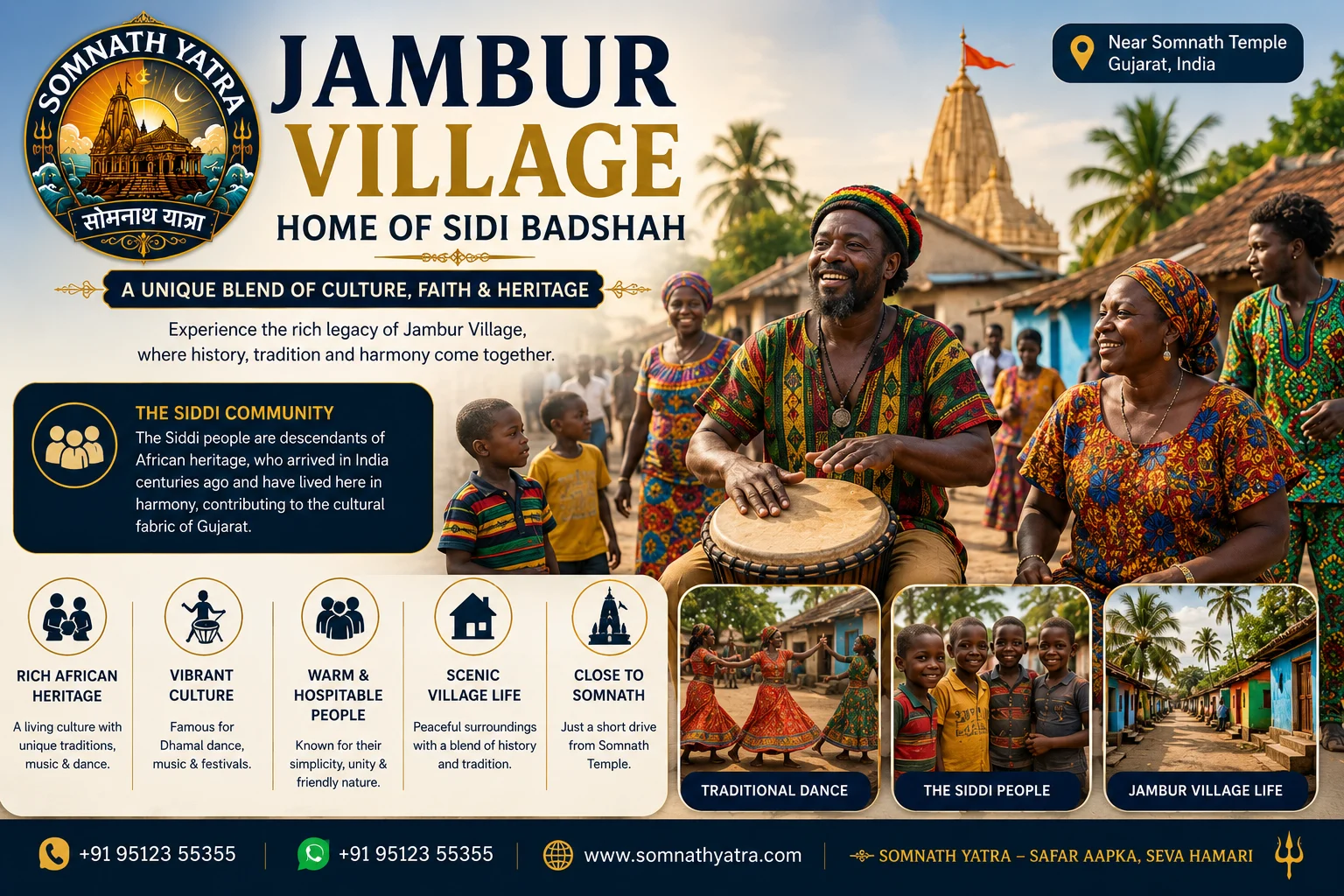
You won’t believe this village exists in India.
I didn’t believe it either — until I stood in the middle of Jambur’s narrow lane, watching a grandmother in a green sari pound millet while humming a tune that could have been from Zanzibar. The woman turned, smiled, and asked me in perfect Gujarati: “Bapu, tea piyega?” You want tea, father?
That moment cracked something open. Here was a village where the faces look East African, the language is Gujarati, the faith is Islam, and the backyard is lion country. Jambur sits on the edge of the Gir Forest in Gujarat’s Saurashtra region — the last home of the Asiatic lion — and it’s been quietly existing for over 300 years. The world just hasn’t noticed.
“Where the drums of Africa meet the roar of the Asiatic lion.”
Quick Fact Box
| Detail | Info |
|---|---|
| Location | Talala Taluka, Gir Somnath district, Gujarat |
| PIN Code | 362150 |
| Nearest Town | Talala (12 km), Veraval (45 km) |
| Best Season | October–February (pleasant weather, Dhamal festivals) |
| How to Reach | Fly to Diu/Rajkot, train to Veraval/Junagadh, road to Talala → Jambur |
| Ideal Duration | 1–2 days (combine with Gir safari + Somnath) |
| Budget | ₹1,500–3,000/day (budget) to ₹4,000–6,000/day (mid-range) |
What makes Jambur different from every other “offbeat India” story you’ve read? The Siddis. They’re a community of African descent — many traced to the Bantu peoples of East Africa — who were brought to Gujarat as slaves, soldiers, and merchants centuries ago. They stayed. They married locally. They built a village that sounds like Gujarat, tastes like Gujarat, but looks like nothing else in the country.
This guide covers everything: how to get there without losing your mind on rural roads, where to sleep (including a Siddi homestay that’ll change how you see travel), how to witness the Dhamal dance without being a clueless tourist, and how to photograph this place with your eyes and your heart, not just your camera.
Jambur isn’t a checklist item. It’s the kind of place that rewires how you think about India.
Getting There — How to Reach Jambur Without Getting Lost
The Nearest Airports, Railways and Road Routes
Jambur doesn’t have an airport or a railway station. That’s part of its charm — and part of your challenge.
By Air: Diu Airport (DIU) is closest at about 100 km, but flight options are limited. Rajkot Airport (RAJ) has better connectivity — IndiGo and Air India fly here from Mumbai and Delhi. From Rajkot, it’s a 3.5-hour drive south through Saurashtra’s dry, flat landscape.
By Train: Veraval Junction (VRL) and Junagadh (JND) are your best bets. Veraval gets the Rajkot-bound trains and some long-distance services. Junagadh is slightly closer to Talala. Both stations have auto-rickshaws and taxis waiting.
By Road: From Rajkot, take NH27 toward Junagadh, then cut south on the Junagadh-Talala road. From Ahmedabad, it’s roughly 400 km — a 7-8 hour drive if you don’t stop for every roadside chai stall (you will). Self-drive works, but honestly, a private taxi from Rajkot or Veraval is ₹3,000–4,000 and saves you the stress of navigating village roads.
Approximate Costs: Private taxi from Rajkot: ₹3,500–4,500 one-way. From Veraval: ₹1,200–1,800. GSRTC bus from Junagadh to Talala: ₹80–120 (hourly service, basic but functional).
The Final 12 Kilometers — Talala to Jambur
This is where the real adventure begins. The road from Talala to Jambur is narrow, partially paved, and passes through farmland and scrub forest. In monsoon (July–September), parts of it turn into a muddy argument with your suspension.
What to expect: The last 5 km are a single-lane road flanked by thorny bushes and occasional cattle. GPS works until about Talala town, then gets unreliable. After that, ask locals for “Siddi gaam” — everyone in the area knows it.
Hiring local transport: Talala’s bus stand has auto-rickshaws (₹200–300 to Jambur) and occasionally jeeps. A better option: your homestay host can arrange pickup. Call ahead.
Monsoon warning: If you’re visiting July–September, confirm road conditions before you commit. The Gir buffer zone gets heavy rainfall, and flash floods can cut access for a day or two.
Pro tip: Don’t arrive after dark. The road has no streetlights, and spotting a crossing peacock at 8 PM with high beams is not the spiritual experience you think it is.
Best Time to Visit — Season by Season
October–February: This is prime time. Post-monsoon greenery makes Gir’s buffer zone look like an African savanna — golden grass, acacia trees, clear blue skies. Temperatures hover between 18–28°C. Festival season hits hard here: Eid celebrations, Urs at local shrines, and the Dhamal dance performances that make Jambur famous.
March–June: Summer in Saurashtra is brutal (38–42°C), but it’s dry. Wildlife sightings increase as animals come to waterholes. You’ll have the village almost to yourself. Carry water, a hat, and the understanding that afternoon walks are for the masochistic.
July–September: Monsoon transforms the landscape into something lush and wild. The road gets rough, but the village comes alive with agricultural activity. Few tourists, authentic rural life, and if you’re lucky, a wedding with full Dhamal performance.
Festival Calendar: Eid (dates vary) is celebrated with communal meals and drumming. Urs at Sufi shrines brings music and spiritual gatherings. Harvest celebrations in October–November often feature impromptu Dhamal sessions in the village square.
Suggested Itinerary — 1 Day vs. 2 Days in Jambur
The Day-Tripper (1 Day): Arrive by 9 AM. Walk the village with a local guide — see the mosque, the temple, the farmland edge where Gir begins. Lunch at a Siddi home (₹200–300). Afternoon: arrange a Dhamal performance (₹500–1,000 for a group). Evening: drive into the Gir buffer zone for a sunset walk. Leave by 6 PM before dark.
The Overnighter (2 Days): Day 1 same as above, but sleep at a Siddi homestay. Day 2: sunrise walk along the forest edge — listen for lion calls, spot pugmarks. Morning cooking session with your host (learn to make bajra rotla). Late morning: visit the forest rest house area. Afternoon: tea with village elders, oral history session. Evening: drum circle under the banyan tree. Leave next morning.
Combining with other circuits: Jambur fits perfectly into a Saurashtra loop: Somnath Temple (70 km) → Jambur (1 day) → Gir Safari at Sasan Gir (30 km) → Diu Beach (100 km). Three to four days, packed with everything Gujarat offers.
Where to Stay — Homestays, Forest Lodges and Nearby Hotels
Siddi Family Homestays — Sleeping in Mini Africa
This is the experience. A Siddi homestay means sleeping in a family courtyard, eating what the family eats, and waking up to the sound of goats and a grandmother reciting morning prayers.
What to expect: Rooms are basic — a cot, a fan, clean sheets. Bathrooms are shared. The real luxury is the people. Your host will treat you like a long-lost cousin. Evening meals are communal: you sit on the floor, eat from a steel thali, and try to explain what you do for a living while their kids peek through the doorway.
Booking: There’s no Booking.com listing. Contact the Talala tourism office (02876-XXX XXX) or ask your Rajkot taxi driver — most know someone. Alternatively, reach out to local NGO workers who facilitate cultural tourism. Expect to pay ₹800–1,500 per night including two meals.
Reality check: The water pressure might disappoint. The Wi-Fi won’t exist. The stars, though — the stars will blow your mind.
Forest Rest Houses and Government Lodges
Gir Forest Department runs guest houses near Talala and on the fringes of the sanctuary. These are no-frills government properties — clean beds, basic bathrooms, no luxury.
Why stay here: If you’re a wildlife photographer wanting to hit the safari gates at 6 AM, this is your spot. Some rest houses sit right on the buffer zone boundary. You might hear lions roaring at night.
Booking: Through the Gujarat Forest Department website or the Talala range office. Permits required for buffer zone access. ₹1,000–2,500 per night depending on the property.
Best for: Early risers, wildlife enthusiasts, and people who find resort pools “distasteful.”
Mid-Range Hotels in Talala and Veraval
If you want village visits without giving up air conditioning, Talala has a few small hotels (₹1,500–3,000/night). Nothing fancy, but functional — hot water, TV, room service.
Veraval (45 km) offers more options, including some beachside properties. After two days of dust and drumming, a cold beer by the Arabian Sea sounds about right. The Fisherman’s Cove and Hotel Somnath Gateway are decent mid-range picks.
Recommended with local character: Check out the government-approved gir-friendly properties that market themselves as “eco-lodges.” Some are genuine; others are just regular hotels with a plant in the lobby. Read recent reviews.
Camping and Offbeat Stays Near the Buffer Zone
A handful of tented camps and farmstays have popped up on the Talala-Jambur road. These are basic — canvas tents, shared bathrooms, bonfire dinners.
What makes it special: Stargazing from your tent with zero light pollution. The occasional leopard call at 3 AM (exciting if you’re in a secure tent; terrifying if you’re not). Bush dinners with local food cooked over wood fire.
What to pack: Mosquito nets (non-negotiable), power banks (electricity is intermittent), warm layers (nights get cool October–February), and a good flashlight.
Cost: ₹1,200–2,500 per night including dinner and breakfast.
Meeting the Siddis — Culture, Conversations and Community Life
Who Are the Siddis? A Five-Minute History for Travelers
The Siddis are India’s African community — and most Indians have never heard of them.
Their origins trace to the Bantu peoples of East Africa, brought to the Indian subcontinent over 500 years ago through the Arab slave trade, Portuguese colonialism, and voluntary migration. Some arrived as slaves. Others came as merchants or soldiers. Many found refuge in the Gir Forest’s remoteness, away from the caste systems that governed life elsewhere in Gujarat.
What you’ll notice first: The faces. High cheekbones, dark skin, tight curls — features that look Ethiopian or Somali, but the sari is Gujarati, the accent is pure Saurashtra, and the tea they offer you is as sweet as any chai in the state.
Why they’re called “Mini Africa of India”: Because within Jambur’s boundaries, you can experience African cultural roots — the music, the dance, the communal living — within an unmistakably Indian context. It’s not a theme park. It’s a living, breathing community.
Current population: Roughly 50,000 Siddis live across Gujarat, concentrated in Junagadh and Gir Somnath districts. Jambur is one of several Siddi villages, but it’s the most accessible and tourism-friendly.
Walking Through Jambur — A Village Tour
Jambur is small enough to walk in 30 minutes, but you’ll want to linger.
The layout: The village clusters around a central square with a mosque and a temple — yes, both, side by side, as naturally as breathing. Narrow lanes branch outward, lined with stone and mud houses. Courtyards are where life happens: women sorting grain, children doing homework, elders on cots watching the world.
What you’ll see: A man fixing a bicycle with his grandson. A woman carrying water from the hand pump. Goats sunning themselves on warm stone. The farmland edge where sugarcane fields give way to Gir’s scrub forest.
Guided vs. self-guided: If your homestay host offers to walk you around, take it. Language barriers are minimal — most Siddis speak Hindi and Gujarati fluently. A few younger ones speak English. Point, smile, and ask “photo?” before clicking.
Don’t miss: The village well. It’s the social hub. Everyone passes through, and everyone has a story.
Language, Faith and Daily Rhythms
Language: Gujarati, with a distinct accent and occasional Swahili or Bantu words mixed in. Hindi works everywhere. English works with the younger generation. But honestly, gestures and smiles work best of all.
Faith: Most Siddis are Sunni Muslim. Prayer times structure the day — you’ll hear the azaan at dawn and dusk. Some families follow Sufi traditions, with shrine visits and spiritual gatherings. There’s also a small Hindu Siddi population. The temple and mosque coexist without drama.
Daily rhythms: Early morning: women at the hand pump, men heading to fields. Midday: siesta hours, village quiet. Late afternoon: the social hour — elders gather, children play, tea flows. Evening: prayers, family time, occasional drumming.
Respecting boundaries: Don’t photograph women without explicit permission. Don’t enter homes without being invited. Don’t assume you can join a prayer session. Watch first, ask second, and if someone says no, smile and move on.
Stories from the Elders — Oral History Over Tea
This is the stuff guidebooks can’t capture. Sit with a Siddi grandfather — your homestay host can arrange it — and ask about the old days.
What you’ll hear: Tales of the forest when lions were more common than people. Stories of grandparents who spoke Swahili. Memories of the first motor road reaching Jambur in the 1970s. The time a film crew came and promised to make the village famous (they didn’t).
How they see themselves: This is the fascinating part. Some Siddis identify as African-Indian. Others say they’re simply Gujarati. Many claim both without contradiction. “We are from everywhere and nowhere,” one elder told me over chai. “The forest doesn’t care where your grandfather was born.”
Best time for storytelling: Late afternoon, under the banyan tree near the mosque. The light is golden, the heat breaks, and old men have nowhere to be. Bring biscuits — Parle-G works — and patience. The best stories come after the third cup of tea.
The Dhamal Experience — Drums, Dance and Trance
What Is Dhamal? Understanding the Dance Before You See It
Dhamal is not Garba. It’s not Bhangra. It’s not any Indian folk dance you’ve seen on Instagram.
It’s a spiritual performance with East African roots — a circle dance that combines drumming, chanting, and rhythmic movement to connect participants with nature and community. Think of it as a moving meditation that happens to involve very loud drums and foot-stomping that shakes the ground.
The roots: Siddis brought Dhamal from East Africa centuries ago. Over time, it absorbed local influences — Sufi mysticism, Gujarati folk rhythms, Hindu devotional elements — but its core remains African. The drums are the heartbeat. The dancers are the body. The trance is the spirit.
Why it’s the soul of Jambur: You can see the village, eat the food, meet the people, but if you miss Dhamal, you’ve missed the point. It’s the living thread connecting this community to its African past.
Spiritual significance: Dhamal isn’t entertainment for the Siddis — it’s ceremony. It’s performed at weddings, festivals, Sufi gatherings, and during times of celebration or mourning. When you witness it, you’re watching something sacred, not a show.
Where and When to Watch Dhamal
Festival performances: The best Dhamal happens during Eid, Urs celebrations (check local dates), and harvest festivals in October–November. The village square becomes a stage, and the entire community participates.
Wedding Dhamal: If you’re lucky enough to be invited to a Siddi wedding, the Dhamal will be the highlight. Three hours of drumming, dancing, and energy that leaves everyone drenched in sweat and grinning.
Arranging a private performance: Your homestay host or a local fixer can organize a small Dhamal session for visitors. Expect to pay ₹500–1,500 for a group of 4–6 drummers and dancers. Timing: late afternoon or evening works best. The performance lasts 30–45 minutes.
Gir Festival and government programs: The Gujarat Tourism department occasionally organizes cultural showcases during the Gir Festival (usually November). These are more polished but less intimate than village performances.
What to expect: A circle of drummers, 2–4 dancers in the center, call-and-response chanting. The rhythm builds slowly, then crescendos. By the end, everyone is breathless, and you’ll feel like you’ve been teleported.
Can You Join In? Participating Respectfully
When tourists are welcomed: During informal village celebrations or arranged performances, visitors are often invited to join the circle. The Siddis are generous hosts — they want you to experience it, not just watch.
When to stay back: If it’s a religious ceremony or a private family event, observe from the edges. If the dancers are in deep trance, don’t approach. Use common sense: if the energy feels sacred rather than celebratory, watch with respect.
Basic Dhamal steps: There’s no choreography to learn. The dance is grounded — knees bent, feet stamping the earth, arms moving with the rhythm. Follow the person next to you. You’ll get it wrong. Nobody cares.
What to wear: Comfortable, breathable clothes. No flashy colors or revealing outfits — this isn’t a rave. Cotton kurtas or simple t-shirts and pants work. Remove shoes before entering the performance area.
Photography: Ask first. During the performance, stay still and let the camera capture the motion. Don’t shove your lens into a dancer’s face mid-trance.
The Sound of Jambur — Instruments and Musicians
The drums: The primary instrument is the mugarman — a tall, cylindrical drum played with sticks. There’s also the manjira (cymbals) and sometimes a shehnai-like wind instrument. The drums are handmade, usually from local wood and animal hide.
Who plays: Traditionally, specific families in the community are the drummers. Young men learn from their fathers and uncles. It’s a lineage, not a hobby. Today, some Siddi drummers have performed at national and international festivals, but the heart of the tradition stays in Jambur.
Meeting the drummers: Your homestay can introduce you. Some are happy to demonstrate technique. Others are shy. Either way, they’re keeping a tradition alive that most of the world doesn’t know exists.
Buying a drum as a souvenir: Small hand drums make incredible souvenirs and directly support the artisan. Expect to pay ₹800–2,000 depending on size and craftsmanship. Ask your host to help with the purchase — it ensures the money goes to the right family.
On the Wild Edge — Forest, Wildlife and Nature Walks
Jambur as a Gateway to Gir (Without the Safari Crowds)
Most visitors to Gir stay in Sasan Gir, queue for safari permits, and jostle with 40 other jeeps to spot a lion for 30 seconds. Jambur offers a different experience: Gir’s buffer zone, accessed on foot, with no crowds and no time limit.
Why stay in Jambur instead: The psychological shift is real. In Sasan Gir, you’re a tourist in a wildlife theme park. In Jambur, you’re a guest on the forest’s edge. Morning walks along the buffer zone reveal pugmarks, bird calls, and a silence so deep it rings in your ears.
What you’ll see without a safari: Pugmarks (lion and leopard) are common on morning walks. Birdlife is extraordinary — peafowl, raptors, kingfishers. If you’re very lucky, you might spot a lion crossing the track at dawn.
The buffer zone access: Your homestay host or a local guide can take you along the forest fringe. No permits required for buffer zone walks (but always check current regulations). Stay on the path, stay quiet, stay alive.
Wildlife You Might Spot Around the Village
Leopards at dusk: Jambur sits in leopard country. These cats are more elusive than lions but more common. On evening walks, listen for alarm calls from langurs — that’s your signal that something big is moving.
Hyenas after dark: Striped hyenas occasionally wander close to the village, attracted by waste and livestock. Your host will warn you about nighttime movement. Listen.
Deer at dawn: Chital (spotted deer) and sambar graze along the forest edge. Dawn is the best time — the light is soft, the animals are active, and you might see a herd crossing the farmland boundary.
Other residents: Jungle cats, monitor lizards, mongooses, and an absurd number of peafowl. The peafowl aren’t shy — they’ll strut across the village lane like they own the place.
Safety rules: Never walk alone at night. Always inform your host of your route. Carry a flashlight. Don’t approach wildlife — observe from distance. If a lion roars at night (you’ll hear it), stay indoors. That’s not fear; that’s respect.
Birdwatching Hotspots Near Jambur
The forest fringe: The transition zone between farmland and Gir’s scrub forest is birding gold. Raptors like crested serpent eagles and short-toed eagles patrol the thermals. Paradise flycatchers — white-tailed, impossibly elegant — flash through the undergrowth.
Indian pittas: These colorful ground-dwellers hide in the leaf litter. You’ll hear their distinctive two-note call before you see them. Dawn and dusk walks near the forest edge are your best bet.
Best hours: 6–9 AM and 4–6 PM. Midday heat sends birds into cover. Patience is key — sit on a rock, stay quiet, let the forest come to you.
What to carry: Binoculars (8×42 works well), a field guide to Indian birds, water, and a hat. The Indian Subcontinent Bird Guide by Grimmett is excellent and fits in a jacket pocket.
Hotspot locations: The track from Jambur to the forest rest house, the scrubland east of the village, and the waterhole near the range office. Ask your guide — they know where the kingfishers nest.
The Forest-Village Interface — A Photographer’s Dream
Golden hour shots: The best photographs from Jambur come at the edges — farmers returning at sunset, cattle silhouetted against Gir’s hills, the village framed by forest. The light in Saurashtra is extraordinary: golden, warm, cinematic.
Documenting coexistence: This is what makes Jambur visually unique. Humans, livestock, and wilderness occupy the same frame. A Siddi woman carrying water with a peacock in the background. Children playing football with Gir’s hills rising behind them. This isn’t staged — it’s daily life.
Ethical wildlife photography: No baiting. No flash at night. No approaching nests or dens. No disturbing animals for “the shot.” The Gir buffer zone is sensitive — your presence is tolerated, not welcomed. Act accordingly.
Best shots to aim for:
- Village elders on cots at golden hour
- Dhamal drummers in motion (fast shutter, low angle)
- The mosque and temple side by side at dusk
- Forest tracks at dawn with pugmarks in the foreground
- Siddi children — but only with family permission
Gear recommendations: A 24-70mm lens covers most village scenes. A 70-200mm works for wildlife at the buffer zone. A wide-angle captures the village-forest interface. And a smartphone is perfectly adequate for most shots — don’t let gear anxiety stop you from being present.
What to Eat — Saurashtra on Your Plate
A Meal in a Siddi Home — The Real Jambur Flavor
Forget restaurants. The best food in Jambur comes from a Siddi family’s kitchen.
The experience: You sit on the floor — on a mat or a cot — with steel plates in front of you. The woman of the house brings out food in steel bowls. You eat with your hands. No fork, no knife, no Instagram plating. Just food.
What’s served: Bajra rotla (millet flatbread), tuvar dal (pigeon pea lentils), bhindi or seasonal vegetable, rice, and buttermilk. Simple, nutritious, and exactly what the family eats every day. There’s no “tourist menu.” You eat what they eat.
The surprise: It tastes exactly like rural Gujarat — because it is rural Gujarat. The spices are familiar, the cooking style is traditional, and the flavors are honest. The African connection shows up in technique — slow-cooking methods, specific spice combinations — but the palate is Saurashtra.
Cost: ₹200–400 per meal, depending on what’s prepared. Offer to pay generously — this isn’t a commercial transaction, it’s hospitality.
Seasonal Specialties and Festival Feasts
Winter (October–February): Undhiyu — Gujarat’s famous mixed vegetable dish — appears when the weather cools. Fresh sugarcane and sesame seed preparations are common. Winter weddings bring elaborate spreads.
Summer (March–June): Mango season dominates. Raw mango pickles, aam panna (raw mango drink), and fresh mangoes eaten over the sink with juice running down your elbows. The best way to eat a mango.
Eid and festival food: If you visit during Eid, you’ll eat biryani — real biryani, not the takeaway kind — and sheer khurma (vermicelli milk pudding). The communal cooking is an event in itself: large pots over wood fires, men chopping onions, women managing the spice blends.
Harvest sweets: Churma (crushed wheat with gud/jaggery), sesame laddus, and gud-jaggery preparations. These are made during harvest celebrations and offered to guests as a matter of pride.
Tea Stalls and Snacks in Talala
The pre-village meal: Talala’s bus stand area has several small tea stalls serving Gujarati snacks — dhokla, khandvi, fafda-jalebi on weekends. A plate costs ₹30–80. The chai here is aggressively sweet and exactly what you need before heading into the village.
Where locals eat: Skip the highway restaurants. Ask your auto driver where he eats lunch. Small hotels with hand-painted signs serving Saurashtra thali — unlimited refills of dal, rice, rotla, and two vegetables for ₹100–150.
Packing snacks for the road: Buy sev (spiced gram flour noodles), chikki (peanut brittle), and thepla (spiced flatbread) in Talala before heading to Jambur. Thepla travels well and survives in a backpack for days.
Drinking Water, Dietary Restrictions and Food Safety
Water: Carry bottled water or use your homestay’s filtered supply. Don’t drink from the tap. If your stomach is sensitive, stick to sealed bottles and avoid ice in drinks.
Vegetarian travelers: Excellent news — most Siddi meals are naturally veg-forward. Meat appears occasionally, but the default is vegetarian. You won’t struggle to find meals.
Food safety basics: Eat where your host eats. Avoid raw salads from roadside stalls. If something smells off, trust your nose. Carry basic stomach medications (Imol, Electral powder) just in case.
Allergies: Communicate clearly. Most Siddi cooks aren’t familiar with “gluten-free” or “vegan” as concepts, but they understand “no wheat” or “no dairy” if you explain simply.
Photography, Etiquette and Being a Responsible Traveler
The Ethics of Photographing a Distinct Community
Let’s be direct: “They look African” is not a reason to treat people as subjects.
The rule: Always ask before clicking portraits. Especially women and elders. A simple “photo?” with a pointing gesture works. If someone says no, respect it immediately and don’t sulk.
Why it matters: The Siddis have been exoticized for decades. Travelers come, photograph them like zoo exhibits, and leave. That’s extractive tourism. You’re a guest in their village — act like one.
Offering to share photos: If you take a portrait, offer to send it back. Get their WhatsApp number or mailing address. Print photos on your next visit. This turns a transactional moment into a relationship.
Documenting daily life: Candid shots of the village — architecture, landscapes, food, the forest — are fine. But faces require consent. Children require parental consent. Religious moments require distance.
What to Wear and How to Behave
Modest clothing: Shoulders and knees covered. Loose fabrics work better in the heat anyway. No tank tops, no short shorts, no low necklines. This isn’t prudishness — it’s respect in a conservative rural Muslim community.
Removing shoes: Before entering homes, mosques, temples, and any space that looks like it might be sacred. Your host will tell you when.
Greeting norms: Folded hands (“Namaste” or “Jai Shri Krishna” for Hindu contexts) work universally. For Muslim families, “Salaam” is appropriate. “Bapu” (father) or “Ben” (sister) are respectful address terms in Gujarati.
Alcohol and smoking: Don’t drink alcohol in the village. Don’t smoke near elders or religious spaces. If you must, do it privately and dispose of evidence.
General behavior: Speak softly. Don’t play loud music. Don’t litter. Don’t touch things without asking. Don’t assume your urban habits are welcome in a rural space.
Supporting the Local Economy Directly
Pay fairly: Homestay hosts, guides, drummers, cooks — they’re providing you with an experience that money can’t usually buy. Pay what it’s worth, not what you’d pay in Mumbai.
Tipping: ₹100–200 for a guide after a village walk. ₹200–500 for a Dhamal performance group. ₹100 for a cooking session. These amounts are significant in rural Gujarat.
Buying local: Honey from Gir’s edge, handmade drums, farm produce, handicrafts. Skip the “souvenir shop” mentality — buy directly from families. The quality is better, the price is fairer, and the money stays.
Avoiding “poverty tourism”: Jambur is not a slum tour. The Siddis aren’t poor (some are; some aren’t). They’re a community with a unique heritage living on the edge of a national park. Frame your visit accordingly.
Leaving No Trace — Sustainable Travel in a Fragile Buffer Zone
Plastic: Carry a reusable water bottle. Bring your own bags. Don’t leave wrappers in the village or forest. The Gir buffer zone is already stressed — your trash doesn’t help.
Wildlife: Don’t feed animals. Don’t pick plants. Don’t disturb nests or dens. Stay on paths during forest walks. Your footprints are enough — leave nothing else.
Spreading the word: Tag locations responsibly on social media. Don’t geotag sensitive wildlife spots. Tell Jambur’s story with dignity — highlight the community, not just the “exotic faces.” Share this article, not clickbait.
Return visits: The best way to support Jambur is to go back. And to tell others to go. And to bring gifts — Parle-G, stationary for kids, fabric for women. Small gestures that say “I remember you.”
Conclusion
Jambur isn’t a destination you conquer. It’s one you sit with.
You’ll arrive expecting African faces and Gir lions. You’ll leave having tasted the best bajra rotla of your life, hearing drums in your sleep, and understanding — maybe for the first time — that India’s diversity isn’t just about language and religion. It’s about the Siddi grandmother who asked if you wanted tea, the drummer who taught you three beats, and the silence of Gir’s forest at dawn that made you forget your phone existed.
This village doesn’t need your Instagram post. It doesn’t need your pity. It needs your attention. Your presence. Your willingness to sit on a cot, drink chai, and listen to a story that starts with “My grandfather came from Africa” and ends with “but this is home.”
“Some places change how you see a country. Jambur is one of them.”
Quick Reference
| Detail | Info |
|---|---|
| Best Month | November (post-monsoon green, Dhamal festivals, perfect weather) |
| Budget Estimate | ₹3,000–5,000 per day (including homestay, meals, transport) |
| One Thing Not to Miss | Sitting with a Siddi elder under the banyan tree, drinking chai, hearing how the lions sound at night |
Visit before it changes. Travel slow. Listen more than you photograph.


