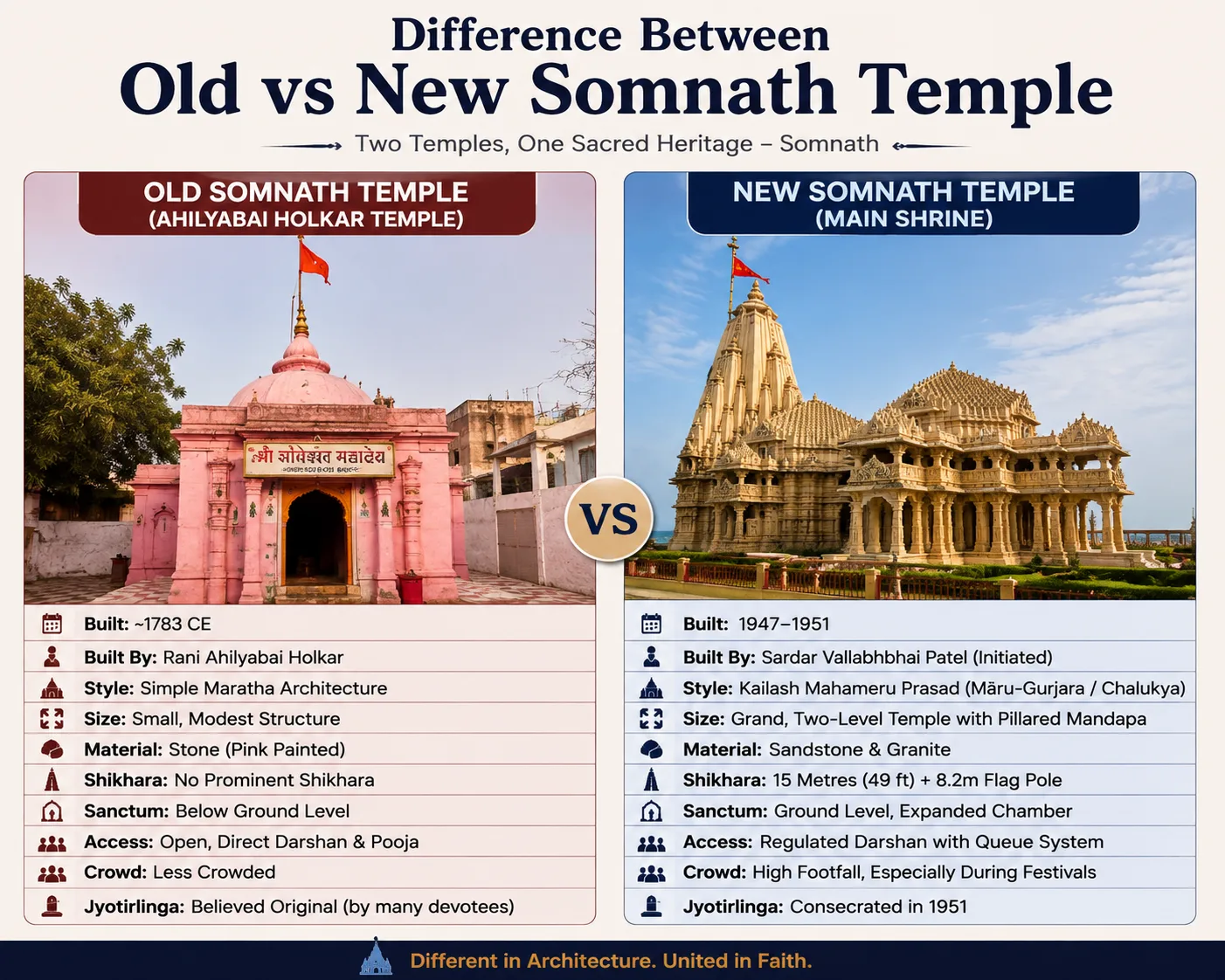
Difference Between Old and New Somnath Temple
Quick Comparison: Old vs New Somnath Temple
Here’s the fast version. Scroll past if you want the full story.| Feature | Old Somnath Temple (Ahilyabai Holkar) | New Somnath Temple (Main Shrine) |
|---|---|---|
| Built | Approximately 1783 CE | 1947–1951 |
| Built By | Rani Ahilyabai Holkar of Indore | Sardar Vallabhbhai Patel (initiated); Shree Somnath Trust |
| Architect | Unknown (Maratha-era construction) | Prabhashankarbhai Oghadbhai Sompura |
| Architectural Style | Simple Maratha shrine | Kailash Mahameru Prasad (Māru-Gurjara / Chalukya) |
| Structure Size | Small, modest | Grand, two-level temple with pillared mandapa |
| Shikhara (Spire) | No prominent shikhara | Prominent shikhara with flag pole |
| Sanctum (Garbhagriha) | Below-ground level | Ground level, expanded chamber |
| Relief Panels | Minimal carving | Numerous relief panels with intricate carvings |
| Primary Material | Stone, painted pink | Sandstone and granite |
| Jyotirlinga | Believed by many to be the original (buried for protection) | Consecrated in 1951 |
| Darshan Access | Open — all visitors can enter garbagriha, perform pooja | Regulated darshan with queue system |
| Pooja Style | Personal — priest-assisted, accompanied by damroos and musical instruments | Institutional — managed by Shree Somnath Trust |
| Crowd Level | Less crowded | High footfall, especially during festivals |
| Current Status | Active place of worship, managed separately | Main Jyotirlinga shrine, operated by Shree Somnath Trust |
The Old Somnath Temple (Ahilyabai Holkar Temple)
History and Construction
Late 18th century. The main Somnath Temple is a shell — historical accounts associate a major destruction with Aurangzeb’s reign in the early 1700s. The Jyotirlinga, the sacred lingam at the heart of everything, was buried. Hidden. Some say it was moved. Others say it stayed put, covered in rubble and earth. Either way, worshippers had nowhere to go. Then came Rani Ahilyabai Holkar. She wasn’t just building temples. She was rebuilding a civilization — one shrine at a time. Kashi Vishwanath in Varanasi. Dwarka in Gujarat. And here, at Prabhas Patan, she constructed a separate, smaller temple adjacent to the ruins. The location of the buried Jyotirlinga? Reportedly revealed to her in a dream. Whether you take that as literal or metaphorical depends on your perspective. Point is: she built it. Around 1783. A functioning temple while the main shrine sat in pieces.Architecture and Design
Modest. That’s the word. No towering shikhara. No pillared mandapa. No elaborate carvings. The structure is small — painted pink, set at a lower level than the current main temple. And that lower level isn’t accidental. The sanctum sits below ground. Why underground? Protection. Building the garbhagriha below street level made it harder for attackers to locate and destroy the lingam. It’s a design born from survival, not aesthetics. The architectural vocabulary reflects a comparatively simple Maratha-era approach — functional, devotional, unadorned. It was built to serve, not to impress. Compare that to the main temple’s numerous relief panels. Different eras. Different priorities.The Jyotirlinga Question
Here’s where it gets complicated — and honest. Many Hindus believe the lingam in the Old Temple is the original Swayambhu Jyotirlinga — the self-manifested form of Shiva worshipped at Prabhas Patan since ancient times. The tradition holds that it was buried for safekeeping during invasions, and Ahilyabai’s dream led her to its location. That’s the story. It’s been told for over two centuries. The Shree Somnath Trust — which manages the main temple — says the Jyotirlinga there was consecrated in 1951. Which is “the original”? That question lives in religious tradition, not in historical documentation. Both lingams are worshipped. Both draw devotees. Some pilgrims visit both. Others don’t care about the distinction. Your call.Visitor Experience at the Old Temple
Walk in. Generally no queue, no security checkpoint, no ticket required — though arrangements can change. The garbagriha is open — visitors can generally approach the lingam, perform pooja with a local priest, and spend time in the sanctum. The aarti here includes damroos (small drums) and other instruments. It’s loud. It’s personal. It feels like something that hasn’t changed in decades. Less crowded too. You won’t fight through hundreds of people to reach the sanctum. It’s intimate — almost private. Some visitors prefer it to the main temple for exactly that reason. The 10 places to visit near Somnath includes the Old Temple as a key stop.The New Somnath Temple (Main Shrine)
History and Construction
November 12, 1947. Sardar Vallabhbhai Patel stands at the Somnath ruins. He picks up water from the nearby sea. And announces — to a huge public gathering — that the temple will be rebuilt. Not as a religious act alone. As a national one. India’s new, independent India would restore what had been destroyed. The reconstruction also became part of a wider debate in newly independent India about the relationship between religious heritage, public life, and the state. Mahatma Gandhi suggested that the project should be funded by public contributions rather than the government. Prime Minister Jawaharlal Nehru expressed reservations about the government’s association with the reconstruction. K.M. Munshi drove the Trust. The foundation stone went down on May 8, 1950. On October 19 that year, the old medieval ruins were pulled down. Patel died in December. Never saw it finished. The temple was completed in 1951. President Rajendra Prasad inaugurated it on December 1, 1951 — a decision that was not without controversy at the time. The total cost: roughly 24.92 lakh rupees. A fraction of what it would cost today.Architecture and Design
The architect was Prabhashankarbhai Oghadbhai Sompura. His descendants would later work on the Ram Temple in Ayodhya. He studied surviving Chalukya-era temples — Modhera, Sidhpur, others — and designed the new structure in the Kailash Mahameru Prasad form of Māru-Gurjara architecture. A tradition that peaked under the Solanki dynasty, centuries ago. Two levels. Pillared mandapa. Numerous intricate relief panels — Shiva in his various forms, celestial figures, geometric patterns. The shikhara rises above the sanctum, topped by a tall flag pole visible from the sea. The carvings are intricate, but cleaner than medieval Māru-Gurjara work — less dense, more legible. Sandstone and granite. Modern seismic reinforcement. The design draws on the earlier Chalukya tradition, and historical accounts suggest some elements from prior structures may have been incorporated — though the extent of this is not fully documented. The Ram Mandir near Somnath reflects similar traditional carving techniques.The Jyotirlinga in the New Temple
Consecrated 1951. The Shree Somnath Trust describes it as the primary Jyotirlinga. The present temple stands on the historic Somnath site — where the Hiran, Kapila, and mythical Saraswati rivers meet the Arabian Sea — while the current lingam was consecrated in 1951. The sacred position is understood within the temple tradition as continuous with the ancient site. The new garbhagriha is bigger. Better lit. Designed for multiple devotees at once. The spatial experience is open rather than confined — a departure from the small, dark sanctum typical of medieval Hindu temples. Whether that’s an improvement depends on what you’re looking for.Visitor Experience at the New Temple
Structured. Organized. Designated gates, security screening, queues that move. The system handles thousands daily — it’s efficient, but it’s a different experience from the Old Temple’s informal access. See our guide to visiting from Ahmedabad for transport options. Evening aarti. That’s the recommendation. Sunset, Arabian Sea breeze, temple bells — it’s a thing. Not something photographs capture well. For festival schedules, check our Shravan 2026 timings guide.| Event | Time | Notes |
|---|---|---|
| Temple Opens | 6:00 AM | Early morning darshan recommended |
| Morning Aarti | 7:00 AM | Key ritual |
| Bhav Sahita Darshan | 7:00 AM – 11:30 AM | Regular darshan hours |
| Afternoon Darshan | 12:00 PM – 5:00 PM | Crowds typically thin mid-afternoon |
| Sunset Aarti | 7:00 PM (approx.) | Timings shift with sunset |
| Night Aarti (Shaam) | 7:30 PM – 8:00 PM | Sound and light presentation |
| Temple Closes | 9:00 PM (approx.) | Confirm locally — timings change seasonally |


