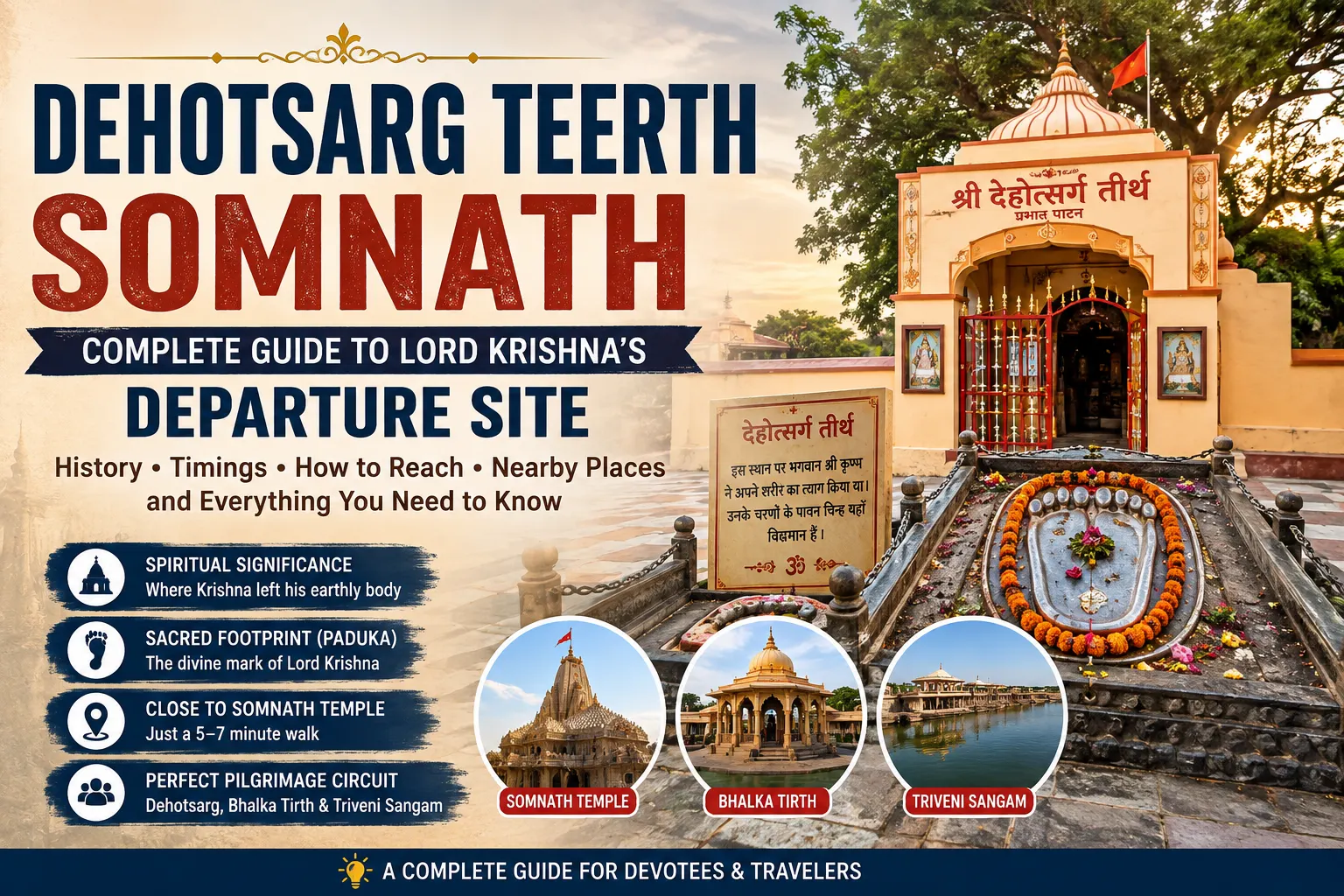
Dehotsarg Teerth, Somnath — Complete Travel Guide
Quick Facts: Dehotsarg Teerth
Here’s the fast version. Details follow.| Detail | Information |
|---|---|
| Name | Dehotsarg Teerth (Dehotsargam) |
| Location | Prabhas Patan, near Somnath Temple, Gujarat |
| Distance from Somnath Temple | Walking distance (~5–7 min) |
| Dedicated to | Lord Krishna’s departure from his earthly body (Dehotsarg) |
| Key Feature | Footprint mark (Paduka) believed to be Krishna’s |
| Timings | Generally 6:00 AM – 9:00 PM (confirm locally) |
| Entry Fee | Free |
| Time Needed | 20–30 minutes |
| Best Combined With | Bhalka Tirth, Triveni Sangam, Somnath Temple |
What is Dehotsarg Teerth?
The Meaning of Dehotsarg
Dehotsarg — sometimes spelled Dehotsargam — comes from Sanskrit. “Deha” means body. “Utsarga” means departure or relinquishment. Together: the place where the body was abandoned. According to Hindu tradition, this is where Krishna’s mortal form left the earth. For devotees, that makes Prabhas Patan one of the most significant sites in Vaishnavite tradition. Not just a Shiva pilgrimage (Somnath is the first Jyotirlinga). But also a Krishna pilgrimage. Two major Hindu traditions converge here — at the same sacred geography, within walking distance of each other.Why This Site Matters
The Mahabharata and Bhagavata Purana contain accounts connected with Krishna’s final days. In the traditional understanding of the Prabhas region, these events are associated with the sacred landscape around present-day Somnath. According to these texts, the Yadava clan destroyed itself in internal conflict. Krishna, foreseeing the end of his earthly mission, walked to Prabhas Kshetra — the sacred zone near the confluence of the Hiran, Kapila, and Saraswati rivers. There, he sat in meditation. And there, a hunter named Jara mistook his foot for a deer and shot him with an arrow. That’s the departure. Not a battle. Not a dramatic exit. A quiet moment — misidentified, almost accidental. Dehotsarg Teerth is traditionally identified with the place associated with Krishna’s departure. It’s one of those places where mythology and geography connect. The story needs a location. The location needs the story. Bhalka Tirth, nearby, is traditionally identified as the exact spot where the arrow struck.The Story of Krishna’s Departure
The Curse of Gandhari
After the Kurukshetra war, Gandhari — the mother of the Kauravas, all dead at the hands of Krishna’s strategy — cursed Krishna. According to the Mahabharata, his Yadava clan would destroy itself, just as the Kauravas had. Krishna accepted the curse. The curse fulfilled itself quickly. Internal fighting broke out among the Yadavas. A brawl at a festival escalated. Friends killed friends. Relatives killed relatives. The clan annihilated itself — exactly as Gandhari had foreseen. Krishna watched. He had known this was the price.The Journey to Prabhas Kshetra
With the Yadavas gone, Krishna walked south — toward Prabhas Kshetra. These texts describe the journey. He wasn’t fleeing. He was completing. The sacred geography of Prabhas — where rivers meet the sea, where Somnath’s Jyotirlinga stands — was, according to tradition, the appropriate place for departure. He sat under a peepul tree. Meditated. Waited. The story says he knew what was coming — a hunter, an arrow, a mistaken identity. He didn’t resist it. The departure was accepted, not inflicted.The Final Moments
Jara, the hunter, saw what he thought was a deer resting under the tree. He shot an arrow. It struck Krishna’s foot. When Jara realized what he had done, he was devastated. Krishna comforted him — told him this was destined. The arrow was merely the instrument. According to tradition, Krishna’s body was cremated at the site. The place where he sat, the place where the arrow struck, the place where the cremation occurred — these are all marked within the Prabhas Patan complex, though the exact locations are based on religious tradition rather than archaeological evidence. Dehotsarg Teerth specifically marks the departure point. Triveni Sangam, the confluence nearby, is where the rivers meet — sacred geography completing the narrative.“Krishna’s departure was not an ending. It was a return.”
Dehotsarg Teerth: What You’ll See
Don’t expect grandeur. Dehotsarg is modest — a small shrine, a sacred spot, some markings. The significance isn’t architectural. It’s geographic — or rather, traditional. This is, according to Hindu belief, the place. The architecture simply points to it.The Main Shrine
The shrine is compact. A modest structure — not the towering sandstone of Somnath’s main temple. Inside, you’ll find representations related to Krishna’s departure. The atmosphere is quieter than the main Somnath complex. Fewer crowds. Less noise. More room to think. The priests here tend to be unhurried. They’ll explain the significance if you ask. The aarti is simpler — fewer instruments, fewer people, more intimacy. If the main Somnath Temple feels like a national monument, Dehotsarg feels like a local shrine. Both serve their purpose.Footprint Mark (Paduka)
The most important feature. A footprint impression — attributed to Krishna by tradition — is preserved at the site. For devotees, this is the tangible connection. Not a story. Not a narrative. A physical mark. The traditional spot where he sat. Where he departed. Whether you regard it as literal or symbolic depends on your faith. But the effect is real — pilgrims touch the paduka, offer prayers, and some sit quietly for extended periods. It’s one of those spaces where belief creates its own gravity.Surrounding Areas
Dehotsarg sits within the larger Prabhas Patan sacred zone. Walk outside and you’re in the same complex that includes Somnath Temple, Bhalka Tirth, and Triveni Sangam. The surrounding area has some smaller shrines, open spaces, and the general infrastructure of a pilgrimage site — shops, pathways, basic facilities. A peepul tree associated with Krishna’s meditation stands nearby. Whether it’s the exact tree from the story is impossible to verify — peepul trees live for centuries, and this one may be a descendant. But it marks the traditional spot. And that’s enough for most pilgrims.Dehotsarg vs Bhalka Tirth vs Triveni Sangam
Three sacred sites. Same area. Different stories. Here’s how they compare.| Feature | Dehotsarg Teerth | Bhalka Tirth | Triveni Sangam |
|---|---|---|---|
| What It Marks | Krishna’s departure point — where he left his earthly body | The exact spot where Jara’s arrow struck Krishna’s foot | Confluence of Hiran, Kapila, and mythical Saraswati rivers |
| Key Feature | Footprint mark (Paduka) | Krishna shrine, arrow mark, tree | River confluence, ghats |
| Distance from Somnath Temple | Walking distance | ~2 km | ~3 km |
| Crowd Level | Low to moderate | Moderate | Moderate (higher during festivals) |
| Time Needed | 20–30 minutes | 20–30 minutes | 15–20 minutes |
| Entry Fee | Free | Free | Free |
| Best For | Krishna devotees, quiet reflection | Mythology enthusiasts, Krishna pilgrimage | Ritual bathing, sunset views |
How They Connect
The Krishna departure narrative unfolds across all three sites — in sequence. Dehotsarg Teerth is traditionally associated with Krishna’s final departure, while Bhalka Tirth is traditionally identified as the place where the hunter Jara’s arrow struck Krishna. Triveni Sangam is where the rivers meet — the sacred geography connecting both sites. Here’s the sequence:- Dehotsarg Teerth — Where Krishna sat in meditation before departure. The preparation. The acceptance.
- Bhalka Tirth — Where the arrow struck. The moment of physical death. The hunter’s mistake.
- Triveni Sangam — Where the rivers meet. Sacred geography. The cremation site according to some traditions.
Visiting Dehotsarg Teerth: Practical Guide
Timings and Entry
Dehotsarg generally follows similar timings to the broader Somnath complex. Here’s what to expect — but confirm locally before visiting, as arrangements can change:| Detail | Information |
|---|---|
| Opening Time | Approximately 6:00 AM |
| Closing Time | Approximately 9:00 PM |
| Entry Fee | Free |
| Photography | Generally allowed outside; check locally for shrine restrictions |
| Time Needed | 20–30 minutes |
How to Reach
Dehotsarg is within walking distance of the main Somnath Temple. If you’re already at Somnath, you don’t need transport — it’s a 5–7 minute walk. Coming from further away?- From Somnath Temple: Walk south. Signage is available. 500 metres, 5–7 minutes.
- From Veraval Railway Station: 7 km. Auto-rickshaw or taxi, 15–20 minutes.
- From Rajkot: 190 km. Bus or car, 3.5–4 hours. Our guide to visiting from Ahmedabad covers Rajkot connections too.
- From Ahmedabad: 410 km. Overnight train to Veraval, or car (6–7 hours). The nearest airport to Somnath is Rajkot.
- By Air: Nearest airport is Rajkot (approximately 4 hours by road). Diu Airport is closer (approximately 2.5 hours) but has fewer flights.
Best Time to Visit
October to March. Weather’s cooler — important for walking between sites. Summer (April–June) gets brutally hot. Monsoon (July–September) is humid but manageable. Early morning or late afternoon works best. Fewer crowds. Better light for photography. And the coastal breeze makes the walk between Dehotsarg, Bhalka, and Triveni much more pleasant.Tips for Visitors
- Wear comfortable walking shoes — you’ll likely walk between Dehotsarg, Bhalka Tirth, and Triveni Sangam
- Carry water. The sacred zone has basic facilities, but shade is limited
- Respect the shrine’s atmosphere — it’s quieter than Somnath; keep voices low
- If you want to perform pooja, ask the priest — they’re generally helpful
- The footprint mark (Paduka) is the key feature — don’t miss it
- Combine with Bhalka Tirth for the complete Krishna departure narrative
What to Expect When You Visit
Dehotsarg is not a large complex. It’s a small, focused shrine. Here’s what you’ll realistically encounter:- Parking: Limited near the shrine itself. Larger parking areas are available near the main Somnath Temple — walk from there
- Accessibility: The shrine is generally accessible, but pathways may be uneven. Elderly visitors should take care on stone surfaces
- Children: Manageable for children. The short walk from Somnath is fine for most kids. Carry water and snacks
- Footwear: Remove before entering the shrine (standard temple practice). Shoe racks are generally available nearby
- Dress: Modest clothing recommended — covered shoulders and knees. No specific dress code beyond standard temple etiquette
- Photography: Generally permitted outside the shrine. Check locally for restrictions inside the garbagriha
- Facilities: Basic — water, restrooms near the Somnath complex. Don’t expect extensive amenities at Dehotsarg itself
- Pooja: Available through the temple priest. Ask about offerings and timing when you arrive. Generally free, though donations are accepted
Nearby Sacred Sites
Dehotsarg is part of a larger sacred geography. Here’s what else is within walking or short driving distance:- Bhalka Tirth — Where Jara’s arrow struck Krishna. 2 km from Somnath. The most narratively connected site to Dehotsarg.
- Triveni Sangam — Confluence of three rivers. Sacred for ritual bathing. 3 km from Somnath.
- Somnath Temple — The first Jyotirlinga. 500 metres from Dehotsarg. The main pilgrimage site.
- Old Somnath Temple (Ahilyabai Holkar) — 18th-century shrine. Adjacent to the main temple.
- Geeta Mandir — Bhagavad Gita-themed temple. Short drive from Somnath.
- 10 Places to Visit Near Somnath — Full list of nearby attractions.


