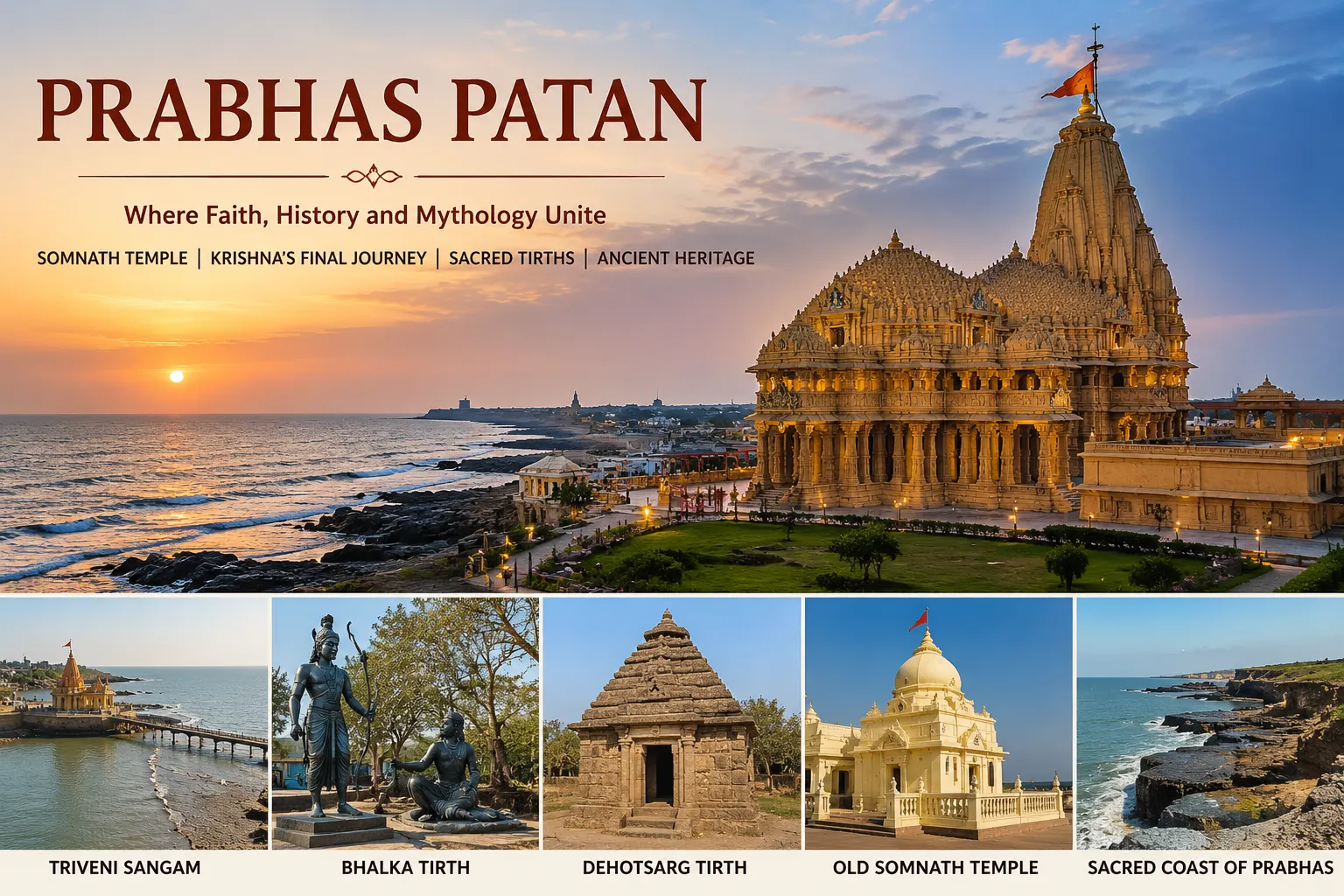
Prabhas Patan: Complete Guide to Somnath’s Sacred Town
Prabhas Patan at a Glance
| Detail | Info |
|---|---|
| Time needed | 3 hours (essentials) to full day (all sites) |
| Best for | Pilgrimage, history, architecture, photography |
| Entry fee | Temple: Free | Museum: Rs 5 (Indians), Rs 100 (foreigners) |
| Best season | October to March |
| Nearest city | Veraval (5 km) |
| Nearest airport | Diu (40 km), Rajkot (190 km) |
Is Prabhas Patan the Same as Somnath?
Not exactly. And the distinction matters — at least when you’re booking a hotel. Somnath = the temple. Prabhas Patan = the town where the temple sits. Veraval = the nearest city and taluka headquarters. People use them interchangeably. Nobody will correct you. But your GPS might, if you type “Somnath” instead of “Prabhas Patan.” Older texts call the place Dev Patan. That name predates the current temple by centuries — maybe millennia. The shift to “Somnath” happened gradually. The temple’s reputation swallowed the town’s identity. Common enough in India (Varanasi/Benaras, Madurai/Meenakshi). Here, though, the naming confusion creates real navigation problems for first-time visitors.Why Prabhas Patan Matters in Hindu Sacred Geography
Density. That’s the word. You aren’t visiting one temple here. You’re walking through a landscape where every rock and river bend carries mythological weight. Three rivers — Saraswati, Kapila, Hiran — converge before meeting the sea. The ancient texts called this Triveni Sangam. A Moksha Teerth. The spot where souls break free from rebirth. The Puranas mention Prabhasa Kshetra as one of India’s most sacred pilgrimage zones. Mahabharata references it. Skanda Purana devotes entire passages to the temples here. But here’s what the texts don’t emphasize: the physical reality of standing where three water bodies meet, then vanish into the ocean. It’s something you feel. Not just read about. Strategically, the town sat on Gujarat’s coast. Merchants, monks, armies — everyone passed through. That traffic left marks. Buddhist caves northwest of Dholeshwer. Jain temples scattered through the old town. Prehistoric artefacts in the museum. Layers upon layers. And each layer connects to the next.Mythological Origins: From Dev Patan to Somnath
The Legend of the Moon God
Soma (Moon) + Nath (Lord) = Somnath. The name tells the origin story. Shiva Purana: Moon God married all twenty-seven daughters of Daksha Prajapati. Favouritism followed — he loved Rohini most. Daksha cursed Soma to lose all lustre. Brahma intervened. Sent the Moon here. Soma performed penance. Prayed to Shiva. Received the blessing to wax and wane rather than disappear entirely. The Jyotirlinga inside the temple marks the exact spot. Every month, when the Moon waxes and wanes, the cycle repeats. Cosmic reminder. Or mythology. Depends on your framework. But the symbolism holds regardless.The Somnath Jyotirlinga
First among twelve. Adi Shankaracharya’s Dwadash Jyotirlinga Stotram opens with: “Prabhasam cha Shrishileshe…” — placing Prabhasa at the head. Not random. The temple’s antiquity, its coastal position, the Moon God association — all contributed. Chalukya architecture. Concentric rectangles. Towering shikhara. Exterior carvings that took years. The current structure was rebuilt post-independence, but shrines have occupied this site for over two millennia. Museum evidence dates fragments to at least 4th century BCE. Some historians argue even earlier. The Skanda Purana mentions a “golden temple” here. Literal? Mythological? Nobody agrees. And maybe that’s the point.Historical Timeline: Invasions, Rebuilding, and Resilience
Destruction. Reconstruction. Repeat. Prabhas Patan’s history reads like a loop — almost stubborn in its repetition.| Period | Event | Key Figure |
|---|---|---|
| c. 649 CE | Earliest documented reconstruction | Mularaja Solanki (Chalukya dynasty) |
| 1026 CE | First major invasion and looting | Mahmud of Ghazni |
| 1299 CE | Second major destruction | Alauddin Khilji’s forces |
| 1395 CE | Third attack | Muzaffar Shah I |
| 1665 CE | Partial demolition ordered | Aurangzeb |
| 1783 CE | Reconstruction funded by Holkar dynasty | Queen Ahilyabai Holkar |
| 1951 CE | Modern reconstruction completed | Sardar Vallabhbhai Patel; K.M. Munshi |
Mahmud of Ghazni and the Temple Attacks
1026 CE. Ghazni marched from Afghanistan. Crossed the Thar Desert. Reached Prabhas Patan. The temple held centuries of royal donations — gold, jewels, wealth accumulated over generations. His forces looted everything. Destroyed the idol. Persian historian Utbi documented the raid in Taquim-ul-Ulum. Called the temple “a jewel encrusted palace.” The treasury funded Ghazni’s campaigns for years. But the site survived. Rebuilt. Attacked again — 1299 (Alauddin Khilji’s generals). Then 1395 (Muzaffar Shah I). Each time, local communities and royal patrons restored it. The Rajput Vaja clan defended the town during multiple invasions. Princess Veni’s story at the Veneshwar Temple comes from this period. A tale of defiance that Gujarat still tells. Aurangzeb’s 1665 order was partial. Didn’t destroy the temple entirely. Stripped its wealth. Defaced portions. The shrine survived — diminished but intact. Then waited. Nearly two centuries in relative obscurity.Ahilyabai Holkar’s Restoration
Late 18th century. Temple in ruins. Queen Ahilyabai Holkar (Indore) funded the 1783 reconstruction. Built the Mahakali Temple too. Contributed to other shrines in the complex. Read more about her connection to Somnath. Quiet work. No fanfare. But the Mahakali Temple she built still stands — and Vallabhghat (the sunset point beside it) carries her name in local memory. She didn’t just rebuild a structure. She restored continuity.Sardar Patel and the Modern Temple
Post-independence. Sardar Vallabhbhai Patel took personal interest. K.M. Munshi (Gujarat historian-politician) spearheaded the effort. Somnath Trust formed. Temple completed 1951. President Rajendra Prasad presided over installation. Inscription reads: “The tradition of Somnath is the tradition of the undying spirit of India.” Controversial? Some saw it as political. Others as cultural reclamation. The Trust’s efficiency, though — free meals, clean premises, organised darshan — isn’t controversial at all. It just works.“Somnath stands for the survival and reconstruction of Indian culture.”
Temples and Sacred Sites Within Prabhas Patan
Over a dozen significant temples. A sacred confluence. Cave sites. All walkable from the main shrine. Reducing Prabhas Patan to just the Somnath Temple misses the density of this place.Somnath Temple: Architecture and Darshan Guide
Chalukya (Kailash Mahameru Prasada) style. Concentric rectangles. Towering shikhara. Main sanctum faces west — toward the Arabian Sea. The Sabha Mandap handles large congregations during aarti. Exterior walls carry intricate carvings of deities, dancers, geometric patterns. Sound and Light Show runs nightly. 45 minutes. Covers mythology, invasions, reconstruction. Good context for first-timers. Watch it before or after darshan — not instead of it. Key details:- Opening hours: 6:00 AM to 9:00 PM (extended during Shravan and Mahashivratri)
- Aarti times: Morning (7:00 AM), Noon (12:00 PM), Evening (7:00 PM)
- Dress code: Traditional attire preferred; shorts and sleeveless tops discouraged
- Photography: Not permitted inside the main sanctum
Triveni Sangam: The Confluence of Three Rivers
Walk south. Ten minutes. You reach the Triveni Sangam — Saraswati, Kapila, Hiran meet here before flowing into the Arabian Sea. Moksha Teerth. Pilgrims bathe here before temple darshan. Read more about Triveni Sangam. Stone steps to the water. Evening aarti: oil lamps float on the surface, bells carry across the river. Atmospheric. The ghat is clean — the Trust maintains it. And here’s what most visitors miss: the Saraswati is considered extinct across most of India. But here, water still flows. Geological debate aside, the belief holds. Three rivers meeting at one point. Then vanishing into the sea.Gita Mandir: Where Krishna’s Footprints Remain
Krishna rested here. After the arrow struck at Bhalka Tirth, before reaching Dehotsarg. His bleeding footprints — carved into marble — sit inside the sanctum. Eighteen marble pillars. Each carries one chapter of the Bhagavad Gita. Natural echo inside — bhajans reverberate through the hall. Complete Gita Mandir guide. Polished marble. Krishna idol flanked by Laxminarayan and SitaRam. Interior paintings depicting episodes from Krishna’s life. But the draw — the real reason pilgrims come — is the footprint. A physical mark of divine departure. Small. Faint. Present.Parshuram Temple and Other Shrines
Opposite Rudreshvara Temple. Parshuram — sixth Vishnu avatar, one of seven immortals — performed penance here. Atoned for Kshatriya Vadh. Idol flanked by Kala and Kama. Sub-shrines for Hanuman and Ganesha. Two ancient bathing tanks within the complex. Architecture is modest compared to Somnath. But the historical depth? Real. And the scenic backdrop — river, old town — makes the detour worthwhile. Other temples:| Temple | Dedicated To | Notable Feature |
|---|---|---|
| Mahakali Temple | Goddess Kali | Ahilyabai Holkar’s construction; Vallabhghat sunset point |
| Daityusudan Temple | Lord Vishnu | 7th-century idol; oldest structure in the area |
| Veneshwar Mahadev | Lord Shiva | Princess Veni legend (Ghazni invasion era) |
| Kamnath Mahadev | Lord Shiva | Adi Shankaracharya’s meditation cave; healing pond |
| Suraj Mandir | Sun God | Elephant/lion carvings; step well |
| Panch Pandav Gufa | Five Pandavas | Hillock cave; panoramic sea view; Sanskrit college |
| Lakshminarayan Temple | Vishnu & Laxmi | Beachside; modelled on Badrinath |
Prabhas Museum: Stones That Speak
Lane north of the main temple. Government-run. Low-traffic. Most visitors walk right past. Their loss. 3,500+ objects. Prehistoric artefacts through medieval sculptures. The collection tells a story the modern temple can’t. And unlike the temple, you can photograph almost everything here.- Stone sculptures from destroyed shrines — fragments predating the current building by centuries
- Chalukyan-era carvings (c. 649 CE, Mularaja Deva Solanki) — detailed, ornate, well-preserved
- Inscriptions and copper plates — royal donations, temple administration records
- Pottery, shells, tools — prehistoric settlement layer; people lived here before the first temple
- Hindu and Jain iconography — religious plurality; both faiths coexisted for centuries
Lord Krishna’s Final Journey: Bhalka Tirth to Dehotsarg
Mahabharata ends not on a battlefield. On a quiet path here. Kurukshetra war concluded. Krishna retired to this region. Hunter named Jara mistook his glowing foot for a deer. Arrow. Mortal wound. Krishna told Jara to forgive himself — destiny — and walked south toward the sea. Two sites. Bhalka Tirth: arrow struck. Dehotsarg Teerth: body departed. Four kilometres between them through old lanes.Bhalka Tirth: Where the Arrow Struck
Outskirts. Small marble image — Krishna with the arrow wound. Banyan tree overhead. Pilgrims whisper. Monks meditate. Sea sound carries in. Modest shrine. No grand architecture. Just a marker at the wound spot. Jhulan Yatra tradition: monsoon swing ritual. Connects the wound to Krishna’s larger cycle — birth, childhood, adulthood, departure. Bhalka marks the beginning of the end.Dehotsarg Teerth: The Departure Point
Peepal tree. Stone headrest. Krishna sat here, rested, departed. Stone still lies in the temple compound. Adjacent: Vallabhghat — unobstructed Arabian Sea sunset. The same light Krishna would have faced. Complete Dehotsarg guide. Balaramji ki Gufa nearby. Bhagavata Purana: Balarama (Krishna’s elder brother) shed mortal form here after witnessing the departure. Cave wall shows what locals describe as Aadisesha’s mark — the serpent departing in its original form. Interpret literally or symbolically. The cave holds energy regardless. Cool. Dim. Old. Shree Mahaprabhuji Bethakji — 65th of 84 bethakjis. Vallabhacharya gave seven days of Bhagavad Gita discourses here. Often overlooked. Significant for Pushtimarg followers.How to Plan Your Visit — Suggested Route
If You Have 3 Hours (Essentials Only)
Somnath Temple first. 6:00 AM ideal. 45 minutes to an hour. Walk south to Triveni Sangam (10 minutes). 30 minutes there. Finish at Gita Mandir — right next to the Sangam. Buffer for walking and queues. Tight but doable.Half Day (5–6 Hours)
Add Prabhas Museum (1–2 hours) after the main temple. Then Parshuram Temple and Rudreshvara Temple — both near the Sangam road. Skip Bhalka Tirth loop (needs transport). Covers the walkable core comfortably.Full Day (8–10 Hours)
All above, plus Bhalka Tirth → Dehotsarg → Balaramji ki Gufa loop. Requires auto-rickshaw or taxi (30–40 minutes round trip). Start 6:00 AM. Walkable sites first. Transport to Bhalka Tirth by late morning. Lunch at Trust bhojanalay. Afternoon: museum revisit or day trip to Diu/Gir.| Stop | Time Needed | Walk to Next |
|---|---|---|
| Somnath Temple | 45–60 min | 10 min walk |
| Triveni Sangam | 20–30 min | 2 min walk |
| Gita Mandir | 15–20 min | 5 min walk |
| Prabhas Museum | 1–2 hrs | 5 min walk |
| Parshuram Temple | 15–20 min | 10 min walk |
| Bhalka Tirth* | 20–30 min | Auto: 15 min |
| Dehotsarg Teerth* | 20–30 min | Auto: 15 min |
Visiting Prabhas Patan: Practical Guide
How to Reach
| Mode | Details | Time |
|---|---|---|
| By Air | Diu (40 km) or Rajkot (190 km). Airport options | 45 min (Diu) / 3.5 hrs (Rajkot) |
| By Train | Veraval Junction (5 km). Ahmedabad, Mumbai, Delhi connections. | 15 min from Veraval |
| By Road | GSRTC buses, private cabs. NH-51 direct. | 7 hrs (Ahmedabad) / 2.5 hrs (Rajkot) |
Local Transport Between Sites
Core sites: all walkable. No vehicle needed. Distances under 1 km between most. Paths well-marked. Bhalka Tirth and Dehotsarg: different story. 3–4 km from main temple. Road passes through residential areas. Auto-rickshaw: Rs 100–150 round trip (negotiate first). Taxi: Rs 200–300. Loop takes 30–40 minutes including stops. Walk the full loop? Technically yes. Practically no — not in summer, not with most visitors’ time constraints. Save energy for temples, not roads.Parking Near Somnath Temple
Designated lots near the complex. Cars, buses, two-wheelers — separate areas. Municipality and Trust managed. Normal days: easy. Shravan (July–August) and Mahashivratri: arrive before 8:00 AM. Lots fill fast. Fees: Rs 20–50 (vehicle dependent).Before You Enter — What to Know
Security checks at every entrance. What gets flagged:- Mobile phones: Allowed inside. Photography restricted in sanctum. Switch off during aarti (some guards enforce this).
- Cameras: Not permitted inside main temple. External photography fine.
- Leather items: Belts, wallets, bags — often restricted inside Shiva temples. Leave in vehicle or locker.
- Footwear: Removed. Shoe stands near entrance (free; tip the attendant).
- Lockers: Near entrance. Rs 10–20. For bags and valuables.
Best Time to Visit
October to March. Pleasant evenings. Vallabhghat sunsets. Veraval beach walks. Monsoon (July–September): humidity. Summer (April–June): 40°C+. Check 2027 holiday dates for closures. Weekdays. Calmer. Weekend crowds are noticeably larger — especially December–January (winter tourist season). Tuesday or Wednesday if you can manage it.Darshan Timings and Tips
- Morning (6:00–12:00): Shorter queues. Arrive before 6:30 AM for Abhishek ceremony. Morning light on the exterior is worth the wake-up.
- Evening aarti (7:00 PM): Most atmospheric. Arrive by 6:30 PM. Lamps, chanting, sea breeze — it converges.
- Shravan: Extended hours, massive crowds. Check Shravan 2026 timings. Queue times: 1–2 hours on peak days.
- Free meals: Trust bhojanalay — 12:00–2:00 PM, 7:00–9:00 PM. Simple, clean, vegetarian. No reservation.
- Accommodation: Trust Dharamshala (budget), Hotel Somnath (mid-range), Gir resorts (premium). Book early for December–February.
Visiting During Festivals
Shravan (July–August): Busiest period. Monday shravan draws the largest crowds. Queues stretch hours. Arrive before 5:00 AM. Extended darshan (often until 10:00 PM) helps, but mornings remain calmer. Mahashivratri (February/March): Similar crowd levels. Special pujas and abhishek ceremonies throughout the day. Temple stays open late. Book accommodation weeks ahead — everything within 10 km sells out. General: Weekdays avoid weekend tourist rush. Early morning beats evening for queues. But evening aarti is more atmospheric — a trade-off. Depends on what you’re after.Day Trips from Prabhas Patan
Base location. Saurashtra spreads in every direction — coast, wildlife, heritage. Overnight stay? These extend the experience.| Destination | Distance | Highlights |
|---|---|---|
| Diu | 40 km | Portuguese forts, Naida Caves, beaches |
| Mangrol | 50 km | Coastal town, historic port — guide |
| Sasan Gir | 45 km | Asiatic lion sanctuary, jungle safaris |
| Junagadh | 80 km | Uparkot Fort, Mahabat Maqbara, Girnar ropeway |
| Jambur | 50 km | Siddi tribal village — guide |
| Khodaldham Temple | 90 km | Lakshmi temple — guide |
| Prachi River | 30 km | Ancient river site — guide |


